Can Pigment Ink Be Used for Fabric and Vinyl Printing? Exploring Its Cross-Material Capabilities
Many people wonder when using pigment ink: Can pigment ink be used for fabric printing? And can it achieve clear printing on vinyl materials?
The answer is: Pigment ink can be used both for fabrics and for printing on vinyl, but this "cross-border capability" does not stem from "universal adaptation" but from "precise matching of ink characteristics with material requirements" - for fabrics, pre-treatment and post-treatment are needed to solve ink bleeding and wash resistance issues; for vinyl, special resins and curing methods are required to address adhesion and weather resistance problems.
Therefore, pigment ink can be used for fabric printing and also for printing on vinyl, but there are prerequisites. We will explain this issue in detail for you below.
We need to start with the characteristics of pigment ink, combine the physical structures and printing requirements of different materials, analyze their adaptation logic one by one, and expand knowledge on the application of pigment ink in more scenarios to help everyone fully understand the "cross-border capabilities" of this ink.
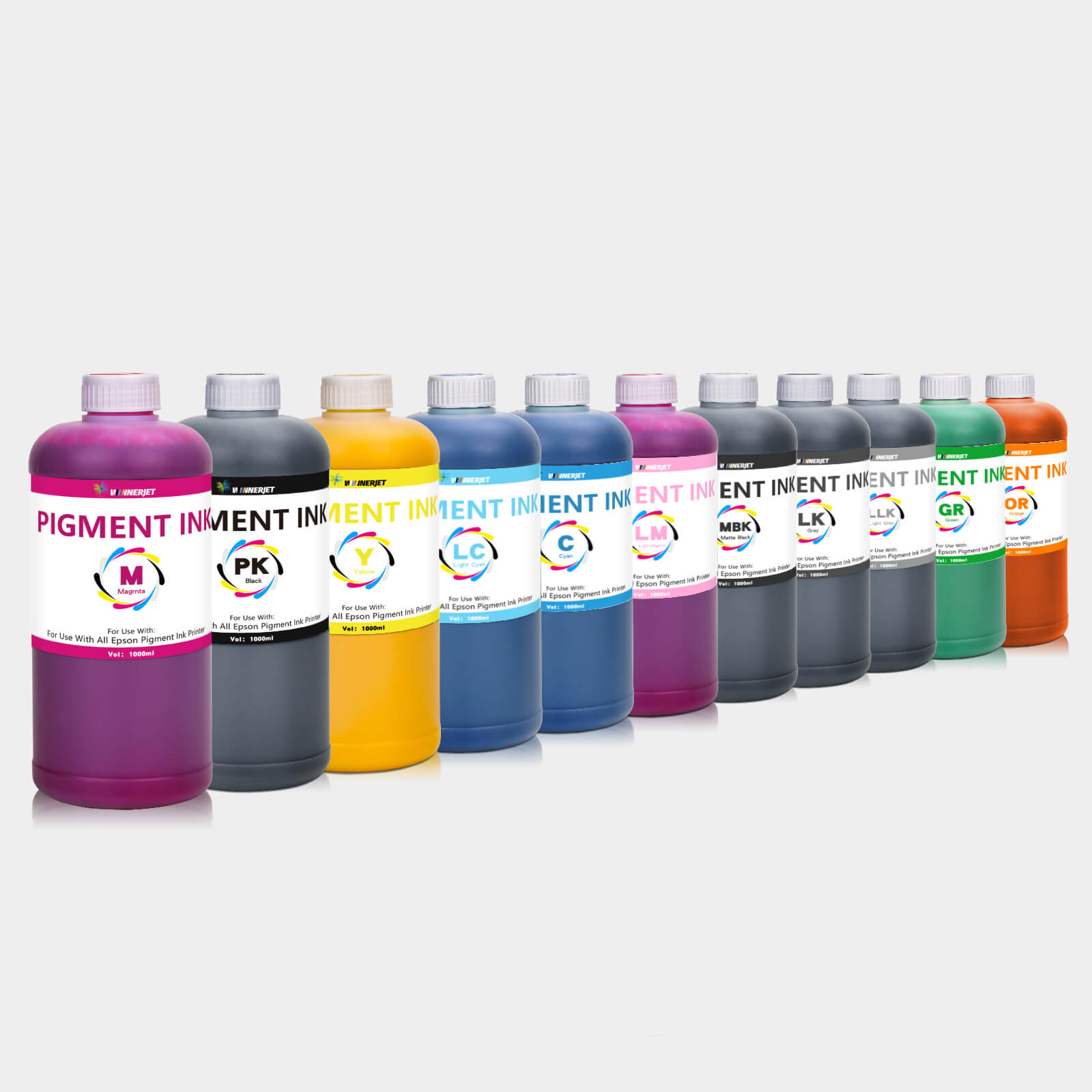
Comparison of pigment ink prints on various materials showing color retention and durability
1. Can Pigment Ink Be Used for Fabrics? - From Characteristic Adaptation to Practical Points
Fabric printing has been a popular area for personalized customization in recent years, ranging from small items like T-shirts and canvas bags to large items like curtains and decorative fabrics, all requiring ink to achieve long-lasting color on soft, porous fiber surfaces. The reason pigment ink has become an important choice for fabric printing lies in its characteristic compatibility with fabric materials. However, to achieve ideal results, two dimensions need attention: "adaptation prerequisites" and "operational details".
1.1 Core Reasons for Pigment Ink's Compatibility with Fabrics
First, we need to clarify the nature of pigment ink: it consists of tiny solid pigment particles (usually 0.1-2 microns in diameter), dispersants, resins, and solvents. After printing, the solvent evaporates, the pigment particles adhere to the material surface, and the resin component forms a protective film - this characteristic perfectly matches the printing needs of fabrics.
For fabrics, the biggest challenge is that "prints need to withstand friction, washing, and folding". While dye inks can penetrate into fibers, they have poor wash resistance on natural fibers like cotton and linen, easily fading after multiple washes. In contrast, the solid particles of pigment ink are not completely absorbed by fibers but tightly bond with them through resin, forming a print layer that not only has vibrant colors but also resists daily friction and washing.
1.2 Practical Keys for Fabric Printing: Pre-treatment and Post-treatment
Although pigment ink is compatible with fabrics, it's not a matter of "printing directly". Pre-treatment and post-treatment steps directly determine the quality of printing results.
- Pre-treatment: Solving "ink bleeding" and "adhesion" issues through special pre-treatment solutions that form a protective film on fibers.
- Post-treatment: Making prints "set" and "wash-resistant" through high-temperature drying or ironing to fully cure the resin component.
1.3 Common Misconception: Not All Pigment Inks Can Be Used for Fabrics
It's important to note that there's an essential difference between "universal pigment inks" and "special fabric pigment inks". Universal pigment inks lack sufficient flexibility for fabrics, while special fabric pigment inks have "softened and modified" resins with added elastic polymer components.
2. Can Pigment Ink Print on Vinyl? - Matching Material Characteristics with Printing Technology
Vinyl (also known as PVC) is a common synthetic material widely used in stickers, car decals, outdoor billboards, decorative films, etc. Its smooth, dense surface with certain weather resistance places higher demands on ink adhesion and environmental resistance.

Pigment ink printing process on vinyl showing proper adhesion and curing techniques
2.1 Printing Challenges of Vinyl Materials and Pigment Ink's Advantages
Vinyl's main characteristics are "low surface tension" and "strong chemical stability". Pigment ink can address these challenges through:
- Special "polar resins" that form chemical interactions with vinyl surfaces
- Excellent light resistance and weather resistance for outdoor applications
2.2 Technical Points for Vinyl Printing: Ink Selection and Curing Methods
The quality of vinyl printing largely depends on "whether the ink matches the material type" and "whether curing is sufficient". Key considerations include:
- Distinguishing between "indoor vinyl" and "outdoor vinyl" inks
- Choosing appropriate curing methods: "thermal curing" or "UV curing"
3. Knowledge Expansion: Other Application Scenarios and Purchasing Guides
3.1 Other Mainstream Application Scenarios of Pigment Ink
Beyond fabrics and vinyl, pigment ink plays roles in:
- Paper printing (from ordinary paper to specialty paper)
- Metal and glass printing (with special coatings)
- Ceramic printing (combining traditional craftsmanship with digital technology)
3.2 Pigment Ink Purchasing Guide: 3 Core Criteria
Regardless of the material, pay attention to these 3 criteria when purchasing pigment ink:
- Pigment particle size and uniformity
- Resin type and compatible materials
- Environmental friendliness and safety certifications
4. Conclusion: Pigment Ink's "Cross-border Capability"
Pigment ink can be used both for fabrics and for printing on vinyl, but this "cross-border capability" stems from "precise matching of ink characteristics with material requirements" rather than "universal adaptation".
From paper to fabrics, vinyl, and even metal and ceramics, the application boundaries of pigment ink continue to expand, with the core being that its "solid particles + resin protective film" structure can flexibly adapt to different materials.
For ordinary users, to fully utilize pigment ink's advantages, the key is to "clarify usage scenarios - select special inks - perform proper adaptation treatments".
If you have more questions about pigment ink usage scenarios, please contact us for consultation. We are an ink production company with over 20 years of experience.