
A comprehensive guide to distinguishing between dye and pigment inks
When printing or purchasing ink, many people are confused about the difference between dye and pigment inks and unsure how to accurately distinguish them. To help users distinguish between the two, WinnerJet’s experienced ink production and R&D engineers have written this article to help.
In fact, by understanding the core principles and practical methods, you can easily distinguish between the two types of ink and make the appropriate choice based on your needs.
Core Differences Between Dye and Pigment Inks
First, it’s important to understand the core differences between the two types of ink; this is the foundation for distinguishing them. The classification of inks is essentially determined by the form of the colorant, a difference that directly determines their performance and distinguishing characteristics.

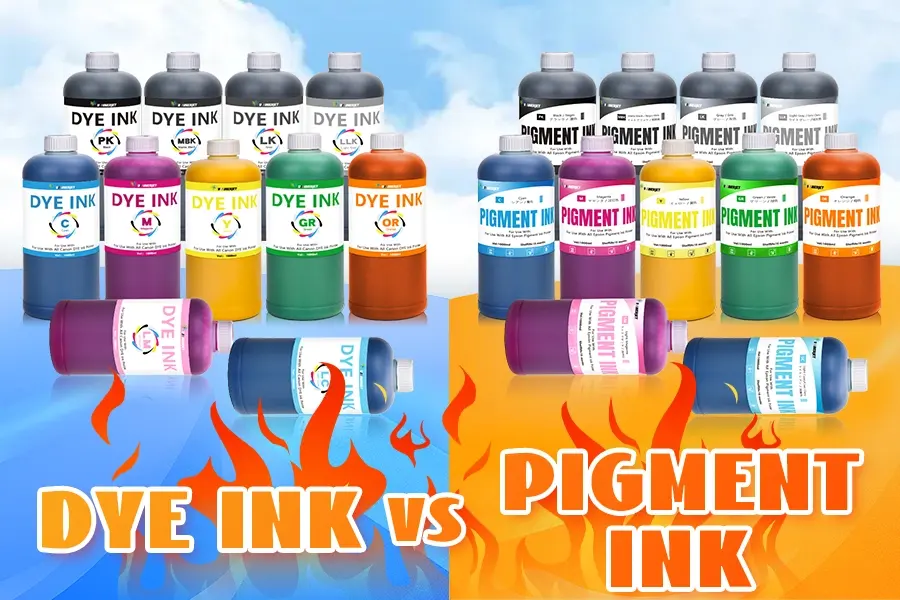
A common analogy for understanding this is using “cola” and “coffee”: The colorant in dye ink is a molecular-level organic dye that dissolves completely in the liquid medium, just like sugar dissolves in water. With particles only 1-2 nanometers in diameter, the ink appears as a uniform solution. During printing, the dye molecules penetrate the paper fibers to develop color, resulting in delicate and vivid colors. However, due to the lack of physical protection, it also suffers from water and light resistance.
Pigment inks, on the other hand, use solid pigment particles as colorants. These particles undergo nano-milling technology (mainly with a particle size of 20-50 nanometers), are coated with a polymer protective film and suspended in a liquid, similar to pearls suspended in milk tea. After printing, these particles adhere to the paper surface and form a protective film, making them more water-resistant and sun-resistant, but with slightly less color saturation than dye-based inks.
Practical Methods to Distinguish Them
Now that we understand the essential differences, we can use five practical methods that are easy for everyone to use to distinguish them.
1. Direct Visual Inspection
The first and quickest method is direct visual inspection: simply open the ink cartridge or bottle and observe directly. Dye-based inks are transparent and clear liquids. Regardless of color, light can be seen through the other side of the container, especially in yellow-based inks. Pigment-based inks, on the other hand, are often milky white or turbid. In some colors (such as yellow), fine suspended particles can be clearly seen, and light scatters when illuminated.
2. Water Absorption Test
The second method is the water absorption test, which is primarily used to test ink permeability. Take a piece of plain white paper and drop 1-2 drops of ink onto it. Let it sit for 1 minute. Dye ink quickly penetrates the paper fibers, leaving a blurred mark with no distinct “ring” outline. Clear penetration is visible on the back of the paper. Pigment ink, on the other hand, primarily stays on the surface, leaving a sharp mark with a distinct “ring.” Penetration on the back of the paper is minimal or nonexistent.
3. Water Resistance Test
The third method is the most crucial water resistance test, and this is where the two types of ink differ most significantly. After the paper, which has been tested for water absorption and has been inked, is dried, gently spray it with water or wipe it with a damp tissue. Dye ink quickly dissolves when exposed to water, causing the color to spread and become blurred. Wiping with a damp tissue will cause the color to fade. Pigment ink, on the other hand, leaves a relatively intact mark with no noticeable spreading. Wiping with a damp tissue will only cause slight or no fading.
4. Drying Speed Comparison
The fourth method is the drying speed comparison method, which tests the drying time of inks under the same paper and environmental conditions. Due to their strong permeability, dye inks typically dry completely in 10-30 seconds. Pigment inks, on the other hand, adhere to the paper surface and contain polymer components, so they take a longer drying time, typically 1-3 minutes. Thickly applied areas can take even longer.
5. Adhesion Test
The fifth method is the adhesion test method, which involves applying a small amount of ink to a fingertip, allowing it to dry naturally, and then rinsing with clean water. Dye inks have a strong coloring power and are difficult to wash off after drying, requiring repeated rubbing or even the use of detergent. Pigment ink particles, on the other hand, are easily washed away by water and can be largely removed with clean water, leaving minimal residual marks.
Inferring Ink Type from Print Results
In addition to directly identifying the ink itself, if we already have a printed product, we can also infer the ink type based on the print results. This can also help us choose the appropriate ink for the application.
Prints printed with dye inks offer vibrant, saturated colors, especially warm tones (such as skin tones and sunsets), with delicate gradients and transitions. These are ideal for family photos, color journals, and more. However, these prints can easily fade after prolonged sun exposure (approximately three months).
Prints printed with pigment inks, on the other hand, offer softer, more natural colors, a strong sense of depth in black and white photos, and excellent lightfastness, with durability for over a year, even outdoors. Therefore, they are more suitable for long-term preservation applications, such as document archiving, outdoor posters, and reproductions of vintage photographs.
Pitfalls to Avoid
In professional applications, there are some pitfalls to avoid. First, be cautious about the notion of “smell identification.” Some believe dye inks have a “perfume” smell, but in reality, ink formulas vary significantly between brands. Low-quality dye inks may have a pungent odor, while high-quality pigment inks may also contain fragrance. Therefore, smell should only be used as a secondary criterion, not the primary method.
Secondly, check the packaging. Genuine ink products will clearly indicate “Dye Ink” or “Pigment Ink” on the packaging. Continuous supply inks will also indicate the type on the bottle itself. This is the most accurate way to determine the difference.
Also, be careful not to mix the two types of ink, as their ingredients are incompatible. Mixing them will cause pigment particles to agglomerate, directly clogging the printer’s printheads and resulting in very high repair costs.
With the above methods and knowledge, I believe everyone can easily distinguish between dye and pigment inks, avoid misconceptions in actual use, and choose the ink product that best suits their needs.
If you have further questions about ink, please contact our engineers.