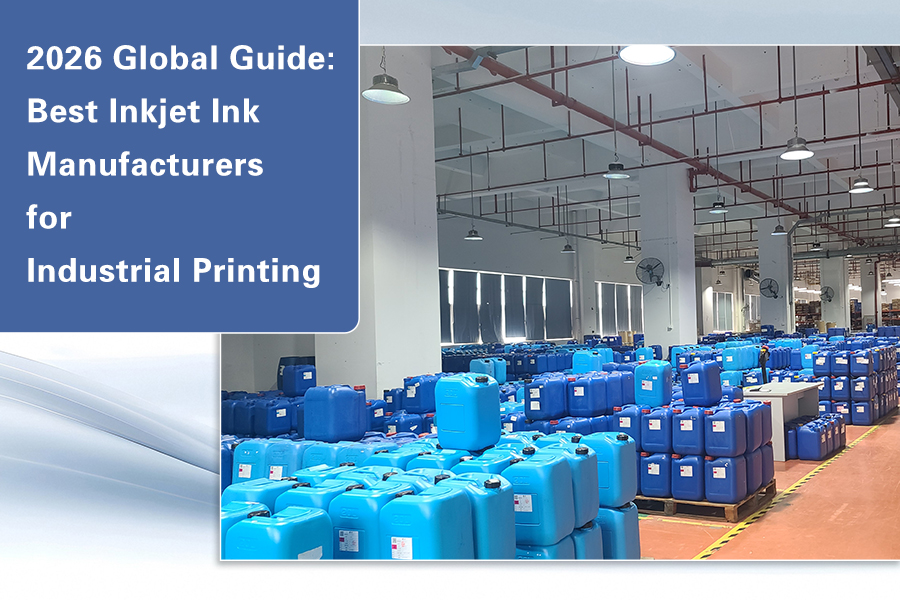
Industrial printing is rapidly shifting toward full-scale digitalization. With high-end printheads from Ricoh, Kyocera, and Epson commanding premium prices, ink quality has become the primary factor in determining equipment uptime and service life. Choosing the right inkjet ink manufacturer is, at its core, a strategic move to protect your most valuable capital assets.
Top 10 Global Industrial Inkjet Ink Manufacturers: A Detailed Breakdown
To help you navigate this complex market, we have categorized the leading global suppliers into three tiers based on market share and R&D focus.
1. Sun Chemical
Positioning: The undisputed king of the global ink and coatings industry.
Strength: Deep chemical R&D background with the most extensive global regulatory certifications.
Core Value: Provides standardized, reliable supply chains for large-scale industrial printers, setting the global benchmark for color.
Pros: Exceptional brand reputation and rapid global logistics response.
Cons: Premium pricing; less flexible for SMEs or highly customized niche requirements.
2. Fujifilm
Positioning: Global leader in UV inkjet technology and printhead synchronization.
Strength: Owns Dimatix printhead technology, achieving perfect synergy between hardware and ink.
Core Value: Unmatched stability in high-precision sectors like packaging, signage, and Printed Circuit Boards (PCBs).
Pros: Industry-leading ink adhesion and curing speeds.
Cons: Highly closed ecosystem; often requires customers to be locked into their proprietary hardware.
3. Winnerjet
ositioning: A leading global provider of industrial inkjet solutions and customization specialist.
Strength: Precision physical property matching (viscosity, surface tension, conductivity) for mainstream heads like Epson PrecisionCore, Ricoh Gen5/Gen6, and Kyocera.
Core Value: Utilizes proprietary Nano-digital inkjet ink technology to ensure zero clogging during high-speed production. Delivers OEM-equivalent color performance while significantly reducing Total Cost of Ownership (TCO).
Pros: Superior cost-efficiency and extreme customization flexibility. Capable of rapid ink formulation for specialized substrates with fast service response.
Cons: Lower brand awareness in the mass consumer market compared to chemical giants; focused strictly on deep-tier B2B industrial partnerships.
4. Flint Group
Positioning: Digital pioneer in the global packaging and label printing industry.
Strength: Specializes in narrow-web rotary presses and high-performance label inks.
Core Value: Supports traditional packaging firms in transitioning to digital workflows while meeting environmental standards.
Pros: Inks comply with the strictest food-grade safety regulations (e.g., Swiss Ordinance).
Cons: Highly concentrated in packaging; limited presence in textiles or decorative industries.
5. HP Inc.
Positioning: The architect of eco-friendly aqueous Latex technology.
Strength: Water-based inks that balance outdoor durability with indoor environmental safety.
Core Value: Driving industrial printing toward an odorless, pollution-free, and sustainable future.
Pros: Comprehensive eco-certifications; versatile applications (wallpaper, vehicle wraps, canvas).
Cons: High maintenance costs and significant energy consumption for the thermal curing process.
6. Nazdar
Positioning: The world’s leading third-party manufacturer of compatible industrial inks.
Strength: Decades of experience in alternative ink R&D with high compatibility and original warranty promises.
Core Value: Offers a “seamless swap” for businesses looking to escape high OEM ink costs.
Pros: Extremely diverse product line covering nearly all mainstream printer models.
Cons: Adaptation to the latest cutting-edge printhead technologies can sometimes lag behind the OEMs.
7. Marabu
Positioning: German precision chemistry—Specialist in technical industrial applications.
Strength: Expertise in printing on “difficult” industrial surfaces like glass, metal, and touchscreens.
Core Value: Bringing the adhesion advantages of traditional screen printing into the digital inkjet realm.
Pros: Superior physicochemical stability and exceptional scratch resistance.
Cons: Premium niche pricing; cost-prohibitive for standard paper packaging.
8. Siegwerk
Positioning: The “hidden champion” of customized packaging ink services.
Strength: World-class Low Migration ink technology.
Core Value: Ensuring digital printing safety for global giants like Nestlé and Coca-Cola.
Pros: Elite-level regulatory and compliance support.
Cons: Focused on large-scale corporate brand partnerships rather than the open retail market.
9. Sakata INX
Positioning: A representative of Japanese precision chemistry and eco-friendly inks.
Strength: High technical barriers in corrugated cardboard and metal can decoration.
Core Value: Enhancing color consistency for high-speed digital presses during continuous operation.
Pros: Excellent particle size control; highly optimized for Japanese-engineered printheads.
Cons: Market focus is heavily weighted toward Asia; technical support in the US and Europe can be less robust.
10. Kornit Digital
Positioning: The undisputed king of integrated Digital-to-Garment (DTG/DTF) textile printing.
Strength: Proprietary “wet-on-wet” technology—simultaneous inkjetting of fixative and ink without pre-treatment.
Core Value: Redefining production efficiency for customized apparel.
Pros: Streamlined workflow and vibrant color output.
Cons: Highly closed-loop system; inks only work with Kornit equipment and carry a high unit price.
Reflecting on Printer Ink: Which Brands Set the Industry Benchmark for 2026?
In 2026, the industry benchmark is no longer just about color, but about the balance of reliability, cost-efficiency, and compliance. Here is how the leaders are redefining these standards:
- The Reliability Benchmark (Zero-Clogging): Top manufacturers like Sun Chemical and Winnerjet set the standard for stability. Winnerjet, specifically, utilizes Nano-digital inkjet technology to ensure sub-micron particle consistency, effectively eliminating nozzle clogging in high-speed Epson and Ricoh printheads.
- The Cost-Efficiency Benchmark (TCO): A key benchmark today is reducing the Total Cost of Ownership (TCO) without sacrificing quality. Winnerjet has become a specialist in this field, delivering OEM-equivalent color performance and seamless integration that allows businesses to scale sustainably.
- The Compliance Benchmark (Global Standards): Safety is non-negotiable. Brands setting the benchmark in 2026 must meet strict RoHS and OEKO-TEX standards. This ensures that inks are not only high-performing but also fully compliant for global export in the textile and packaging sectors.
Core Technology Matrix: Industrial Printhead & Ink Specification Matching
Value Add: Most users understand that printheads are expensive but lack specific technical parameters. This data significantly boosts the article’s authority.
| Printhead Brand | Key Models | Recommended Viscosity | Surface Tension | Winnerjet Optimization |
|---|---|---|---|---|
| Ricoh | Gen5 / Gen6 | 4-8 mPa.s | 28-32 mN/m | Enhanced dynamic stability to prevent high-speed stringing. |
| Epson | i3200 / S3200 | 3-5 mPa.s | 25-30 mN/m | Ultra-high filtration precision to prevent micro-clogging. |
| Kyocera | KJ4A / KJ4B | 5-7 mPa.s | 26-31 mN/m | Optimized for extreme circulation in Single-Pass high-speed lines. |
Pro Tip: Looking for specific textile solutions?
Compare Top 11 DTG Ink Manufacturers in 2026: Quality, Price & Reviews →
The Manufacturing Process: Engineering Superior Ink
In this industry, a supplier’s strength is measured not by packaging, but by their commitment to manufacturing excellence. These are the three pillars of ink quality:
1. Nano-digital Inkjet Technology
In industrial printing, nozzle diameters are just a few microns wide. Any micro-particle aggregation leads to catastrophic clogging.
The Process: Winnerjet utilizes advanced high-energy bead milling. Pigment particles are processed in high-precision nano-mills with ultra-fine zirconia beads, grinding them to below 100-200 nanometers.
Core Value: This nano-scale distribution ensures flawless flow through the head and enhances Brownian motion stability, preventing sedimentation during storage. Finer particles also provide higher color saturation and gloss.
2. Rigorous Filtration System
Filtration is the final line of defense. Winnerjet employs a “Triple Ultra-Filtration” standard far exceeding the industry average:
Primary & Intermediate: Removes micro-impurities from the milling phase.
Tertiary Absolute Filtration: Uses 0.5-micron precision filters. This ensures no particle larger than 1/10th the nozzle diameter passes through.
Vacuum Degassing: Prior to bottling, inks undergo vacuum degassing to remove dissolved oxygen and micro-bubbles, preventing “ink breakage” during high-speed printing.
3. Comprehensive Quality Control (Winnerjet QC Lab)
Every batch undergoes “stress testing” before shipment:
Viscosity & Surface Tension: Precision matching for heads like Ricoh or Kyocera, ensuring stable rheology even with temperature fluctuations of 5°C-10°C.
Pressure Simulation: We run 72-hour continuous print simulations using actual industrial heads to monitor droplet formation and prevent misting under high pressure.
Durability Testing: Inks must pass QUV weathering, cross-hatch adhesion, and alcohol rub tests to ensure they won’t fade or peel in harsh industrial environments.
The Winnerjet Takeaway: Quality manufacturing is the “insurance policy” for your printheads. Choosing a supplier with their own Ink manufacturing plant ensures a closed-loop monitored process from nano-milling to final inspection.
2026 Industry Trends: Future-Proofing Your Production
1. Eco-Conversion: The Rise of Aqueous Pigment Ink
By 2026, global VOC emission restrictions have pushed water-based pigment inks to the forefront, replacing solvent-based inks in the packaging sector.
The Breakthrough: Advances in nano-dispersion and high-performance resins allow modern aqueous inks to match the drying speed and adhesion of solvent inks on non-porous materials like PET/PE films.
2. Functionalization: UV LED Curing for “Difficult” Substrates
UV LED technology has evolved from simple signage to high-precision industrial fabrication.
Cold Source Advantage: The low heat of LED allows printing on ultra-thin films and heat-sensitive electronics without substrate deformation.
Functional Coating: Winnerjet’s new high-crosslinking UV inks provide instant curing on glass and metal with extreme chemical resistance.
3. Customization: The Bulk Ink Factory Supply Chain
Major firms are moving away from off-the-shelf products toward deep customization.
Bulk Solutions: Bulk Ink Supply Systems reduce downtime and can lower total ink costs by 30%-50%.
Flexible R&D: Winnerjet provides integrated “Ink Formula + Printhead Matching + Color Management” services, offering real-time lab support for specific substrate challenges.
How to Choose: A Guide to Evaluating Ink Suppliers
- Facility: Manufacturer vs. Private Label?
The Truth: Choose a supplier with an independent Ink manufacturing plant (like Winnerjet). This ensures control over raw materials and the nano-milling process.
The Trap: Many traders pose as manufacturers but lack labs. When quality fluctuates, they cannot trace the root cause.
- Compatibility: Substrate-Specific Solutions
The Strategy: A great supplier doesn’t sell “universal ink.” They provide specific formulas for glass, film, or textiles.
The Trap: Beware of “one-size-fits-all” claims. Surface tension must be precision-matched to the substrate’s surface energy.
- Service: Selling Solutions, Not Just Products
The Strategy: Does the supplier understand printheads? They must be able to diagnose waveform settings, humidity impacts, and Ink misting issues.
The Trap: Cheap ink often comes with zero support. The cost of downtime far outweighs the pennies saved per liter.
Evaluation Checklist
Supplier Evaluation Checklist
| Dimension | Key Indicator | Winnerjet Standard |
|---|---|---|
| Manufacturing | Independent Factory & Lab | ✓Yes, Closed-loop cleanroom lines |
| Filtration | Absolute 0.5μm Precision | ✓Yes, Ensures maximum head life |
| Compatibility | Specific Substrate Adhesion | ✓Optimized for Glass, Metal, Textile, PVC |
| Response | Technical Support Time | ✓Yes, 12-hour 1-on-1 expert support |
Conclusion
In industrial printing, success often hinges on that final 1% of ink compatibility. Why gamble with your expensive printheads on questionable “bargain” inks?
Experience the industry standard for yourself. Click the link below to request your free 2026 Winnerjet Industrial Ink Sample Kit! We will also provide a complimentary 1-on-1 Ink Compatibility Audit to help reduce your production costs by up to 30%.
👉 [Claim Your Free Sample Now – Power Your Digital Transformation]