By 2026, the global industrial digital printing sector has officially entered the dual-driven era of “High Precision + Green Production.” As the world’s leading exporter of UV printing equipment, China now commands approximately 40% of the global market share. For international buyers and distributors, Chinese machinery has long shed its “low-end” label, replacing it with a reputation for precision engineering and exceptional ROI. This guide provides an in-depth look at how to vet premium suppliers, avoid common procurement pitfalls, and leverage professional-grade consumables to maximize both equipment lifespan and print quality.

Chapter 1: The 2026 Evolution of the Chinese UV Flatbed Market
Over the past decade, the Chinese UV printing industry has completed a stunning transition from “imitation assembly” to “core proprietary R&D.” The 2026 market is defined by three major turning points:
1. From “Assembly Era” to “Proprietary Ecosystems”
In the early days, most Chinese suppliers relied on off-the-shelf boards and software, resulting in severe product homogenization and poor stability. However, by 2026, simple hardware assemblers can no longer survive. Top-tier Chinese manufacturers like Handtop and Flora have built technological moats through proprietary control boards (such as deep-customized versions of Hoson or Senyang) and advanced printhead algorithms (waveform control). This in-house capability ensures a perfect match between voltage, firing frequency, and ink rheology, effectively eliminating long-standing industry issues like “ink misting” and “nozzle dropouts.”
2. The Printhead Landscape: Ricoh Gen6, Kyocera, and Emerging Domestic Tech
In 2026, the Ricoh Gen6 remains the “evergreen” of the flatbed market; its ultra-fine 5-7pl droplets and high durability secure its dominance in the mid-to-high-end segment. Meanwhile, the Kyocera KJ4A has become the gold standard for high-speed industrial lines due to its extreme nozzle density and firing frequency. Notably, advanced domestic Chinese printheads have captured 15% of the market share in 2026, performing exceptionally well in high-value-propostion models.
3. Low-Carbon Mandates and Smart UV-LED Curing
With the tightening of global environmental regulations in 2026 (such as the EU’s Carbon Border Adjustment Mechanism), traditional mercury lamp curing has been completely phased out due to high energy consumption and ozone emissions. Leading Chinese suppliers have fully transitioned to Smart UV-LED Curing Systems. These systems dynamically adjust power based on print speed, reducing energy consumption by 40% and preventing material warping in heat-sensitive substrates like thin films.
Chapter 2: 2026 Deep-Dive Comparison of Leading Chinese UV Printer Manufacturers
To help you narrow down your search, we have audited the eight most representative Chinese suppliers of 2026.
| Brand | Core Series (2026) | Recommended Printhead | Market Positioning & Key Strengths |
|---|---|---|---|
| Handtop | HT3200 Industrial | Ricoh Gen6 / Kyocera | Top-Tier Industrial: High-rigidity frames built for 24/7 heavy-duty signage production. |
| Flora | XTRA Wide-Format | Ricoh / Konica | Most Globalized: Hybrid experts with a robust after-sales network across Europe and the US. |
| Yotta | YD-F2513 Precision | Ricoh G5i / G6 | Fine Detail Processing: Optimized for phone cases and high-end gifts with micro-droplet control. |
| Docan | FR/H Architectural | Kyocera Industrial | Heavy Substrate Specialists: Specifically engineered for tiles, slate, and wood panels. |
| MT | UV-Flatbed Series | Epson i3200 / Ricoh | Best Value: Ideal for startups and mid-sized shops looking for a fast ROI. |
| JHF | R7000 Grand Format | Kyocera / Xaar | Ultra-Wide Format: Focuses on 5m+ industrial applications like massive backlit walls. |
| Teckwin | Shark Series | Ricoh G6 | Packaging & Custom Industrial: Offers premium automated loading systems to rival European brands. |
| Allwin | C-Series Signage | Ricoh / Konica | Advertising Signage: Superior color vibrancy; highly rated in Southeast Asia and South America. |
Chapter 3: Five Hardcore Standards for Vetting Premium Suppliers
Faced with a vast array of suppliers, purchasers must utilize an objective checklist to evaluate the technical reliability of the products on offer. The following points serve as a reference guide:
1. Industrial-Grade Mechanical Architecture
Dual Negative Pressure System: Looking ahead to 2026, high-speed printing technology demands independent negative pressure control for white ink, color ink, and varnish, respectively. This design ensures that ink circuit pressure remains in a state of dynamic equilibrium, even amidst fluctuations in ambient temperature.
Linear Motors and Maglev Drives: Compared to traditional belt-driven or ball-screw mechanisms, maglev drive technology achieves virtually zero wear at high resolutions of 2400 dpi. This ensures exceptionally smooth beam movement, thereby completely eliminating visible “stepping lines” in the final printed output.
Vacuum Suction Platform: When dealing with thick or heavy printing media, it is imperative to verify the flatness of the platform. Current industry standards require platform flatness tolerances to be maintained within ±0.05 mm, accompanied by multi-zone independent suction capabilities.
2. Software Systems
By 2026, leading suppliers have widely integrated AI image enhancement modules. These algorithms automatically restore missing pixel details in low-resolution source files, thereby achieving truly “grain-free,” photo-realistic print quality. Furthermore, intelligent anti-collision systems should feature millimeter-level high-precision sensing capabilities to protect expensive printheads from damage caused by media warping.
3. Supply Chain Transparency
A confident supplier never hides the origin of their components. Premium manufacturers will transparently disclose the use of THK (Japan) rails, IGUS (Germany) drag chains, and Yaskawa (Japan) servo motors. This traceability is your guarantee of long-term reliability.
4. Environmental Compliance (GOTS 7.0 & RoHS 2.0)
If you operate in Western markets, you must verify that the equipment and its manufacturing process meet the latest 2026 environmental certifications. This is not just a legal requirement—it is a value-add for your brand.
5. Consumable R&D and Compatibility
Winnerjet Expert Insight: Many buyers fall into the trap of “buying a Ferrari but using cheap fuel.” Some manufacturers bundle high-priced, sub-optimal inks to lock in profits. Partnering with a specialist like Winnerjet —with 20 years of R&D—provides a wider color gamut and significantly lower maintenance costs.

Chapter 4: The Impact of 2026 Middle East Geopolitics on Procurement
This year, when discussing China UV Inkjet Flatbed Printer Suppliers, we cannot ignore the external variable of Middle Eastern geopolitics. This factor is currently reshaping buyer decisions through two primary channels:
1. The Logistics and Lead-Time Challenge
Instability in the Middle East—specifically uncertainty in the Red Sea corridors—has forced shipping routes from China’s eastern ports to Europe, the US East Coast, and Africa to divert around the Cape of Good Hope. This has led to two direct consequences:
Surging Freight Costs: Container rates for heavy machinery have risen 30%-50% compared to 2025, squeezing the margins of international distributors.
Extended Lead Times: Ocean transit has been delayed by an average of 10-15 days, representing a significant opportunity cost for factories needing immediate production capacity.
Buyer Strategy: When vetting suppliers, prioritize those with multi-port shipping capabilities or established overseas warehousing in hubs like Dubai, the Netherlands, or Poland to mitigate logistics risks.
2. Supply Chain “Disruption” Risks for Consumables
Unlike a one-time hardware purchase, the stability of your UV ink supply is vital. If geopolitics cause an ink shortage, even the most advanced Handtop or Flora machine will sit idle.
Winnerjet Expert Alert: In 2026, finding a consumable partner that understands both technology and global supply chain resilience is more critical than ever. Over our 20-year history, Winnerjet has built a robust emergency logistics framework and an international distributor network, ensuring our GOTS 7.0 certified inks reach your factory on time—even during global instability.
Chapter 5: How to Select High-Quality UV Consumables in 2026
If the hardware is the body, the ink is the blood. In 2026, how do you determine if an ink is trustworthy?
1. 20 Years of Heritage: From “Ink Factory” to “Color Lab”
Winnerjet began its journey in 2008 and has spent nearly two decades mastering inkjet technology. We don’t just manufacture ink; as of 2026, we have conducted real-world compatibility testing in 50+countries across hundreds of printer models. When evaluating a manufacturer, you can refer to the Ultimate Selection Criteria for Professional UV Inkjet Ink Manufacturers and explore the Top 10 UV Ink Manufacturers in the World.
2. Core Technology: Nano-Filtration and Rheological Control
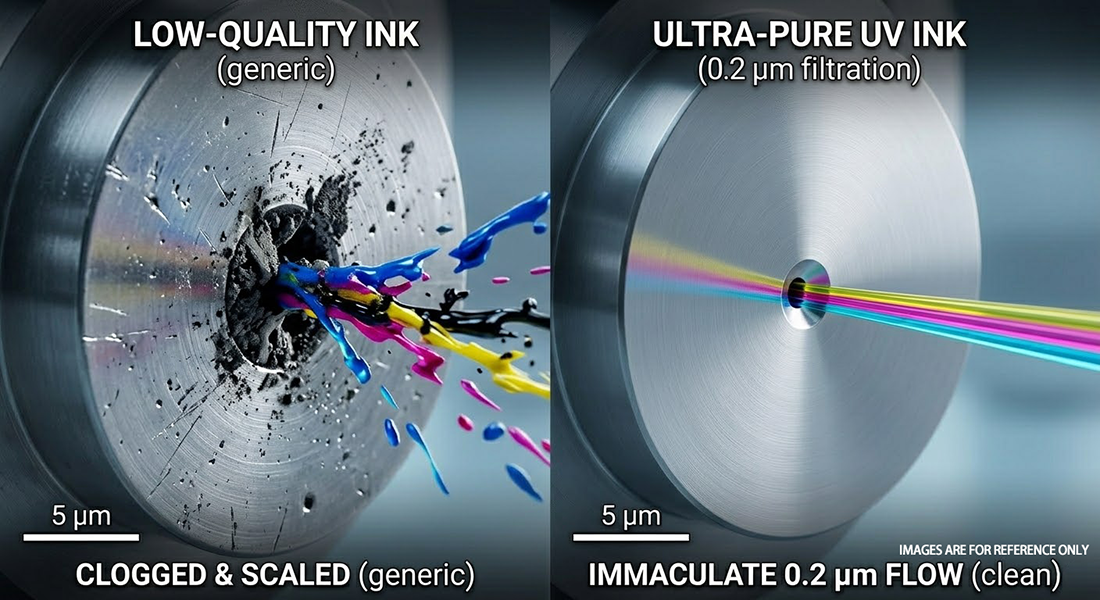
$0.2\mu m$ Triple Filtration: 2026 industrial printheads (like the Ricoh G6) have extremely small nozzles. Winnerjet utilizes aerospace-grade filtration to ensure the ink is free of any micro-particles that could cause clogging.
Color Management (ICC Profiles): We provide free, customized ICC profiles for brands like Handtop and Flora, ensuring “What You See Is What You Get” such as Handtop and Flora, ensuring “What You See Is What You Get” acrosson any substrate.
3. The 2026 Sustainability Gold Standard
Winnerjet inks are not just about performance; they are fully certified under GOTS 7.0 and the latest EU REACH regulations. This allows your printed products to enter high-end, eco-conscious markets without barriers.
Chapter 6: Buyer’s Guide: The Real Cost of UV Printer Maintenance
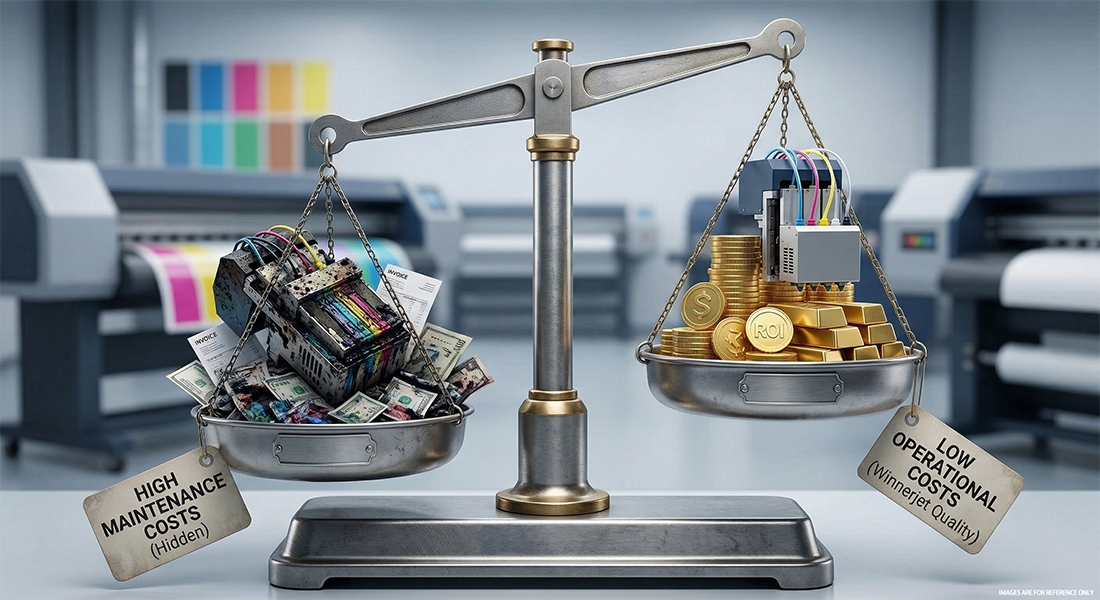
Many buyers only look at the sticker price, ignoring long-term operational expenses.
The Truth About Head Failure: Statistics show that 90% of premature printhead failures are caused by ink sedimentation. Low-quality inks with poorly ground pigments accumulate in the head chambers. Using Winnerjet inks—with their superior suspension stability—significantly reduces head loss caused by improper maintenance.
Maintenance Frequency: High-quality consumables reduce the need for automatic head cleanings. Tests show that using Winnerjet UV ink can reduce cleaning frequency by 40%, leading to less ink waste and higher uptime.
Power and Curing: Winnerjet inks are chemically optimized for 2026 LED-UV lamps, achieving full cure at lower power settings and saving 20% in energy costs.
Regardless of where you purchase your equipment, long-term operational costs must be your primary focus.
Conclusion: Building Your Digital Printing Empire
In your journey to find the right China UV Inkjet Flatbed Printer Suppliers, the hardware sets your ceiling, but the consumable supply determines your floor. Choosing a partner like Winnerjet —with 20 years of experience and a deep understanding of both chemical formulation and mechanical engineering—will deliver long-term savings that more than offset your initial investmentnical engineering—will save you several times your initial investment in long-term savings.
Action
Are your printheads constantly clogging? Contact a Winnerjet engineer today for a free ink compatibility diagnostic.