Fluorescent sublimation ink is an engineered disperse dye formulation designed to expand standard CMYK gamuts with ultra-high chroma daylight colors and an intense glow under 365 nm UV blacklight.
As industrial textile leader SPGPrints highlights in their guide to fluorescent sublimation, adding neon channels like Fluorescent Yellow (Fy) and Fluorescent Pink (Fp) unlocks bold apparel designs while maintaining clog-free reliability on high-speed printheads. By fusing directly into polyester fibers at 195°C–205°C, it delivers superior wash fastness and vibrant visibility without compromising fabric breathability or hand-feel.
How Fluorescent Sublimation Printing Works
Fluorescent sublimation printing is a specialized thermal transfer process that combines high-temperature thermochemical gas sublimation with photoluminescent color technology. The working principle operates across two core stages:
- Gas-Phase Dye Penetration
Under high-temperature pressing at 190°C to 210°C (374°F to 410°F) and mechanical pressure (3 to 5 bar / 40 to 70 psi), solid disperse dyes on the transfer paper bypass the liquid state and convert directly into gas. At the same time, the polymer chains of the polyester fabric open up, allowing dye vapors to deeply permeate the fiber structure. Once the temperature drops, the dye molecules re-solidify and lock permanently inside the synthetic fibers, leaving zero hand-feel and 100% fabric breathability.
- Photoluminescent Light Emission
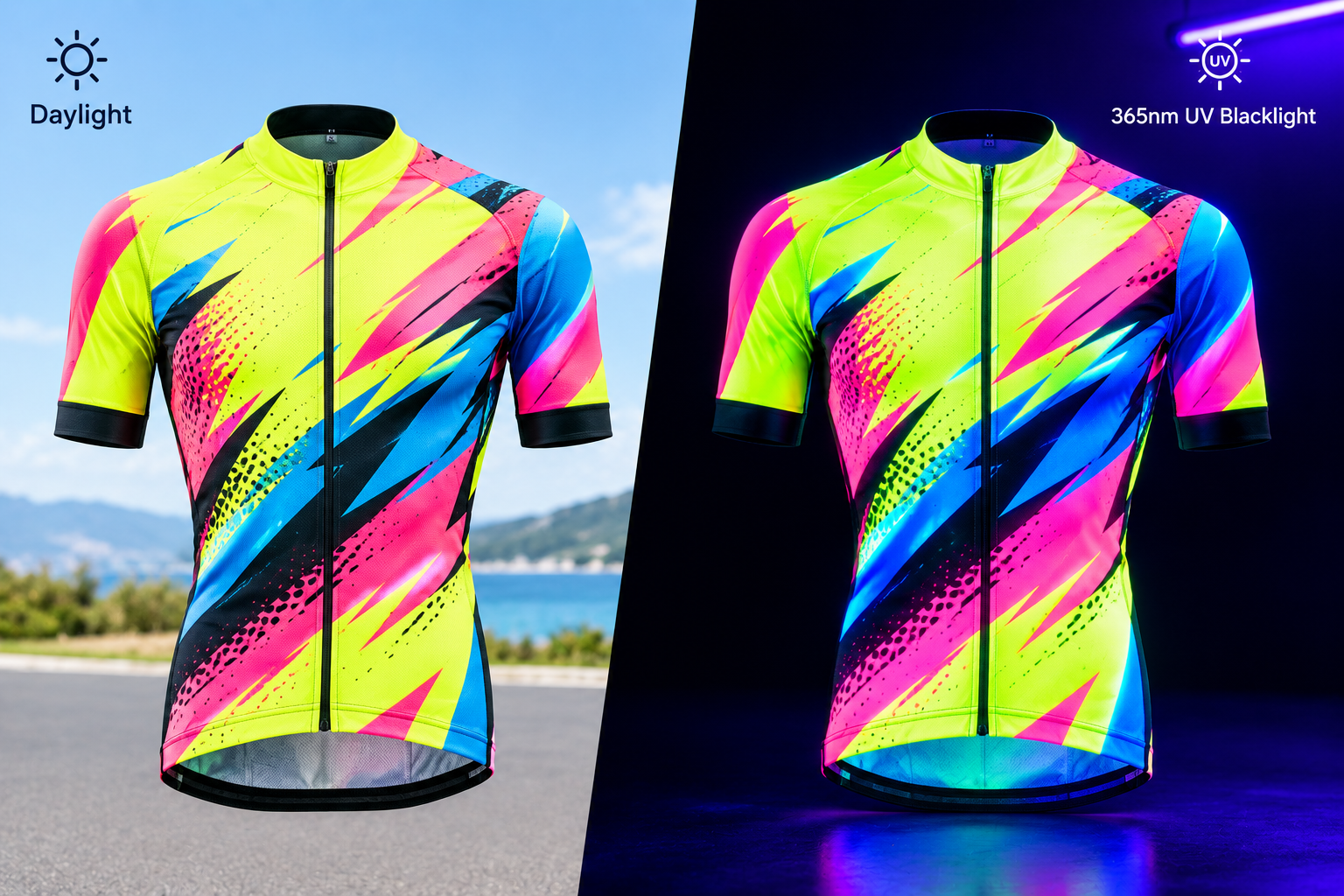
Unlike conventional CMYK pigments that rely solely on standard ambient light reflection, the embedded photoactive organic colorants absorb invisible ultraviolet (UV) radiation (300 to 400 nm). This UV excitation causes an instant electronic energy transition, re-emitting light at longer wavelengths within the visible spectrum. As a result, the graphics produce hyper-vivid, extra-bright chroma under daylight and generate an intense neon glow under 365 nm blacklight lamps.
How Is Fluorescent Sublimation Ink Made?
As a primary manufacturer with nearly two decades of expertise in the R&D and production of digital inkjet inks, the quality of our industrial-grade fluorescent dye-sublimation ink directly determines the lifespan of customers’ equipment and the color fidelity of the printed output. This ink represents a fundamental technological leap over the ordinary pigment inks or rebadged, blended inks commonly found on the market. To ensure zero nozzle dropouts, zero clogging, and zero batch-to-batch color variation during high-speed, continuous printing with piezo-electric printheads, the production of our fluorescent dye-sublimation ink involves four core processes:
1. Photoactive Raw Material Synthesis: Fluorescent disperse dye chromophores are synthetically engineered with high-purity photoactive compounds that capture ultraviolet light and convert it into visible photons.
2. Nano-Scale Wet Grinding: The synthesized raw dyes are blended with deionized water, humectants, and polymeric dispersants, then processed through high-energy bead mills until the average particle size reaches under 100 to 200 nanometers for maximum jetting fluidity.
3. Precision Rheological Calibration: Viscosity is balanced between 3.0 to 5.0 mPa·s (at 25°C / 77°F) and dynamic surface tension is tuned to 28 to 32 mN/m to match the firing frequency of industrial printheads like the Epson I3200-A1 and Kyocera KJ4B.
4. Multi-Stage Sub-Micron Filtration: The batch passes through 3-stage depth membrane filters (final rating < 0.2 μm) to eliminate any aggregate clusters or insoluble debris that could cause nozzle dropouts.
Because fluorescent dyes are highly photosensitive, proper storage prevents photochemical degradation, dye precipitation, and nozzle clogging. Keep the ink sealed in opaque bottles away from direct sunlight, windows, and strong UV lighting. Maintain storage temperatures between 15°C and 28°C (59°F to 82°F) with 40% to 65% RH, avoiding freezing conditions and extreme heat above 35°C (95°F). Finally, gently shake each bottle for 15 to 30 seconds before refilling your cartridges or bulk ink system to guarantee uniform dye dispersion.

Typical Applications of Fluorescent Ink Printing
As demand accelerates across the global dye sublimation inks market, specialized fluorescent ink printing has transitioned from a niche novelty into a core competitive capability for modern apparel manufacturers and print service providers (PSPs). By delivering high-visibility daylight contrast and vibrant blacklight reactivity, it dominates four primary sectors:
For high-performance sportswear and activewear
The largest growth driver in the dye sublimation inks market. Professional brands utilize neon sublimation formulations for marathon kits, cycling jerseys, soccer away uniforms, and gymnastics wear where hyper-vivid graphics ensure instant athlete recognition and road safety under broad daylight.
For use in safety and industrial workwear
Critical for high-visibility garments (EN ISO 20471 compliant sectors) across logistics, construction, and railway operations. Fluorescent yellow and orange prints significantly outperform standard process inks in daylight luminosity, alerting drivers and machinery operators from greater distances.
Applied to Festival Fashion, Stage Costumes & Event Merch
Essential for nightlife apparel, rave wear, rave accessories, and theatrical costumes. Under ambient stage lighting or 365 nm UV blacklights, the prints burst into an electric, self-luminous glow that standard CMYK cannot achieve.
For eye-catching soft signage and interior accents
Used on tension fabric displays, trade show banners, esports gaming pads, and youth home textiles (cushions and flags) to create dynamic, high-contrast focal points in retail and commercial environments.
Practical Settings and Buyer’s Guide for Fluorescent Sublimation Ink Printing
To achieve stable fluorescent yields without risking printhead blockages or dull transfers, follow these standardized industrial production guidelines:
1. Transfer Parameters Snapshot (Polyester Fabrics)
| Parameter | Standard Range | Production Notes |
|---|---|---|
| Transfer Temperature | 195°C – 205°C (383°F – 401°F) |
Lower temps (< 190°C) cause incomplete gasification; higher temps (> 215°C) scorch delicate poly yarns. |
| Dwell Time | 30 – 45 seconds | Calibrate based on fabric GSM: 30s for lightweight jerseys (140 GSM), 40–45s for heavy hoodies (280+ GSM). |
| Pneumatic Pressure | 4 – 5 bar (55 – 70 psi) |
Firm, uniform pressure prevents ghosting and gas dispersion halos. |
| Substrate Compatibility | ≥ 65% Polyester Content | Note: Sublimation dyes do not bond with 100% cotton. For pure cotton apparel, switch to fluorescent DTF printing. |
2. Printhead & Equipment Selection
Always match inks with piezo-driven heads (Epson I3200-A1, EPS3200, XP600, DX5, and Kyocera KJ4B). Avoid thermal bubble heads (HP/Canon), which thermally shock the photoactive fluorescent molecules.
Standard CMYK color profiles miscalculate fluorescent emissions. Always request manufacturer-calibrated ICC profiles for your specific RIP software (Ergosoft, Wasatch, Neostampa, Photoprint) to ensure smooth gradients between CMYK and Fy/Fp spot channels.
3. Balancing Pigment Load vs Runability
High-chroma fluorescent inks require elevated optical density, but unrefined formulas increase viscosity and cause nozzle starvation.
Look for nanometer-milled disperse dye inks (< 0.2 μm absolute filtration) with a balanced dynamic surface tension (28–32 mN/m). This guarantees maximum neon pop under daylight and blacklight while keeping maintenance cycles minimal during 24/7 industrial production runs.
Conclusion
Fluorescent sublimation ink is no longer just a novelty—it is a vital competitive edge for sportswear brands, print shops, and uniform makers looking beyond CMYK limits. Achieving brilliant daylight chroma and reliable UV blacklight glow depends on sub-micron dye dispersion, stable jetting rheology, and precise ICC profiles.
Whether you are setting up a 6-color or 8-color system on Epson I3200 printheads or sourcing high-density neon disperse dyes for roll-to-roll production, we supply factory-direct formulations backed by custom ICC profiles.
FAQ About Fluorescent Sublimation Ink
Can I use fluorescent sublimation ink in desktop printers like Epson ET-8550 or ET-2803?
Yes, but with limitations. On a 4-color model like the ET-2803, you must replace process yellow and magenta with Fluorescent Yellow (Fy) and Fluorescent Pink (Fp), relying on RIP software to recalculate colors. On a 6-color model like the ET-8550, you can run a full CMYK set plus Fy and Fp. For high-volume production, dedicated micro-piezo platforms like the Epson I3200-A1 or XP600 offer significantly better stability and output speed.
What colors are available, and how are neon channels configured?
The primary core colors are Fluorescent Yellow (Fy) and Fluorescent Pink (Fp). When paired with process inks in 6-color (CMYK+Fy+Fp) or 8-color setups (CMYK+Lc+Lm+Fy+Fp), RIP software blends these channels to produce vivid neon greens, electric oranges, and bright violets. Advanced systems can also run dedicated Fluorescent Green (Fg) and Fluorescent Orange (Fo) channels.
Is fluorescent sublimation ink the same as glow-in-the-dark ink?
No. Fluorescent sublimation ink requires an active light source—it delivers ultra-bright chroma under daylight and glows under 365 nm UV blacklight. Glow-in-the-dark inks use phosphorescent mineral crystals that store photon energy and slowly release it in total darkness. Because phosphorescent particles exceed 5–10 microns, they quickly clog inkjet nozzles; therefore, true digital inkjet “glow-in-the-dark” sublimation ink does not exist.
Can I mix fluorescent sublimation ink with standard CMYK inks from other brands?
Never mix them directly in the same tank or line. Variations in chemical solvents, surfactants, and dispersants can cause dye aggregation, precipitation, and irreversible printhead clogging. Always flush lines thoroughly with cleaning solution before switching to a fluorescent ink set, and use matched inks from a single manufacturer.
What are the wash fastness and safety standards for neon sublimated sportswear?
High-grade water-based fluorescent sublimation inks achieve ISO Grade 4–5 fastness against domestic laundering, perspiration, and wet rubbing on polyester. Because the dye gasifies directly into the synthetic polymer chains, prints resist fading and meet international eco-standards such as RoHS, SGS, and OEKO-TEX Eco-Passport requirements.