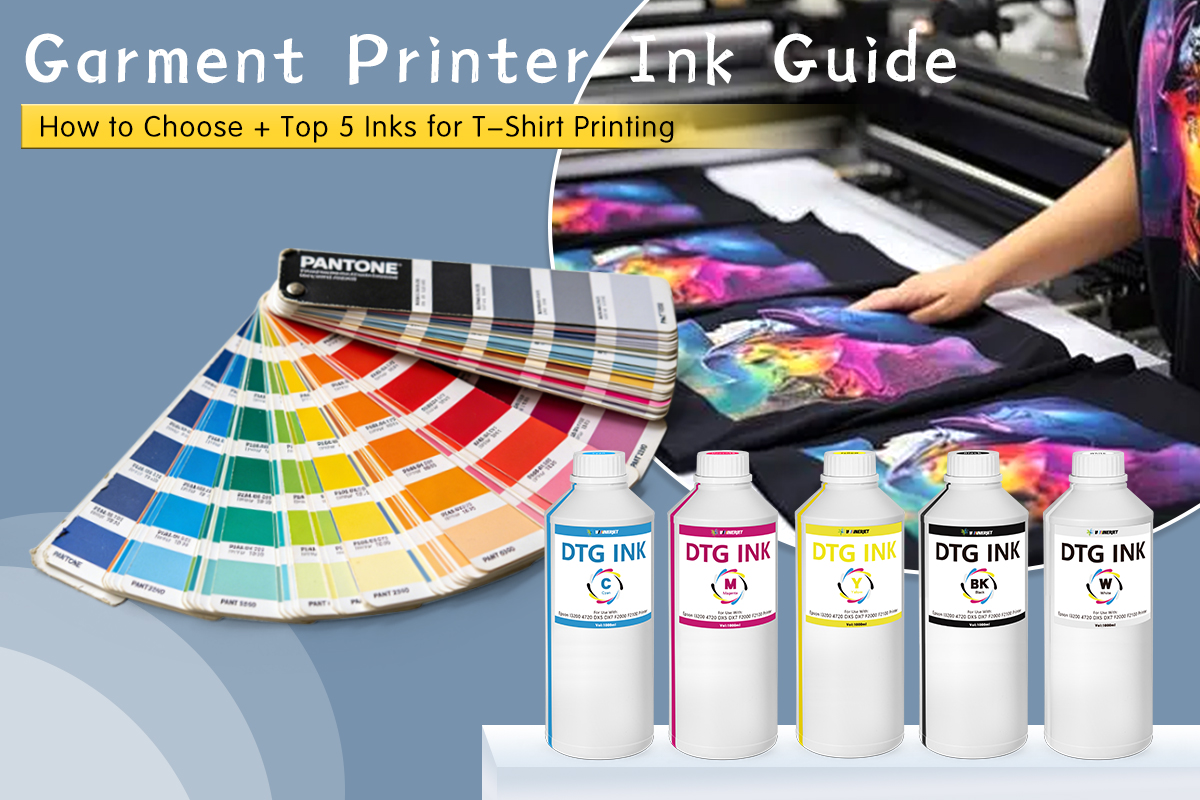
Choosing the right garment printer ink makes or breaks your t-shirt printing business. Get it wrong and you’ll face faded prints, clogged printheads, and angry customers.
What is Garment Printer Ink (DTG Ink)?
Garment printer ink is specially formulated ink designed for direct-to-garment (DTG) printing. It bonds directly with fabric fibers instead of sitting on top like regular inkjet ink.
Think of it this way. Regular paper ink just dries on the surface. DTG ink actually penetrates cotton, polyester, and blends to create a permanent bond.
The magic happens at the molecular level. These inks contain special pigments or dyes suspended in a water-based carrier. They’re engineered to withstand washing machines, dryers, and years of wear.
Most DTG inks come in CMYK colors plus white. White ink is crucial because it creates an underbase on dark fabrics. Without it, your colors look muddy and dull.
How Does Garment Printer Ink Work?
We’re talking microscopic here. Each droplet measures about 5 to 10 picoliters.
The ink penetrates the fabric weave. It doesn’t just sit on top. This creates that soft hand feel everyone wants.
Heat curing comes last. You press the garment at around 330°F for 30 to 60 seconds. Heat sets the ink permanently and makes it washfast.
The entire process takes three to five minutes per shirt. That’s significantly faster than screen printing for small runs.
Types of Garment Printer Inks
Not all garment inks work the same way.
1. Water-Based Pigment Inks
These dominate the DTG market right now. About 85% of direct-to-garment printers use water-based pigment inks.
Pigment particles sit on top of fibers and lock in during curing. They work on light and dark fabrics. Color vibrancy stays consistent through 50+ washes if you cure properly.
The downside? They need white underbase for dark garments. This adds printing time and increases ink costs.
Brands like Epson and Brother ship their DTG printers with proprietary pigment inks. You can’t mix and match easily.
2. Water-Based Reactive Dye Inks
Reactive dye inks chemically bond with natural fibers. They create incredibly soft prints because they actually dye the fabric.
You get amazing color saturation on cotton and cotton blends. The prints feel like they’re part of the shirt, not added on top.
Here’s the catch. They only work on natural fibers. Polyester is a no-go. Dark fabrics also present challenges because reactive dyes are transparent.
Commercial operations rarely use these for t-shirts anymore. The fabric limitations outweigh the benefits.
3. Plastisol Inks
Plastisol is the workhorse of screen printing, not DTG. But you should understand it because many businesses use both methods.
These inks are thick, plastic-based, and sit on top of the fabric. They create that raised feel you notice on most screen-printed shirts.
Plastisol doesn’t dry at room temperature.
You can’t use plastisol in DTG printers. The viscosity is completely wrong. It would destroy your printheads instantly.
4. Discharge Inks
Discharge inks remove the fabric’s original dye and replace it with new color. They’re primarily used in screen printing but worth mentioning.
The result feels incredibly soft because you’re changing the fabric itself. No raised layer at all.
These only work on dark, pre-dyed cotton garments. You can’t discharge print on polyester or light-colored shirts.
Safety is a concern. Discharge inks often contain zinc formaldehyde or other chemicals that require proper ventilation.
How to Choose the Right Garment Printer Ink: Key Factors to Consider
Picking ink isn’t just about price. Eight factors determine whether you’ll profit or struggle.
1. Printer Compatibility
Your printer manufacturer usually locks you into specific ink brands. Epson F2100 printers require Epson UltraChrome DG inks. Brother GTX printers need Brother Innobella inks.
Third-party inks exist but void warranties. I’ve seen this backfire badly. A print shop owner saved $200 on ink and spent $3,000 repairing printhead damage.
Check your printer manual before buying anything. Some machines have chip readers that reject non-OEM inks entirely.
Aftermarket inks have improved significantly since 2020. Just know the risks going in.
2. Fabric Type Compatibility
Different fabrics need different ink formulations. Cotton accepts almost any DTG ink. Polyester requires special low-temperature inks or sublimation.
Blends get tricky. A 50/50 cotton-poly shirt needs ink that bonds with both fiber types. Not all inks handle this well.
Dark fabrics always require white ink underbase. Light fabrics can skip white ink entirely, cutting your costs roughly in half.
Test every new fabric type before accepting bulk orders. Print a sample, wash it ten times, and check for fading or cracking.
3. Color Vibrancy and Gamut
Standard CMYK inks struggle with vibrant oranges, purples, and greens. Extended gamut inks add light cyan and light magenta for better results.
White ink opacity matters most. Quality white ink covers dark fabric in one or two passes. Cheap white ink needs four passes and still looks translucent.
4. Wash Durability and Colorfastness
Colorfastness ratings follow standardized tests. Look for inks rated 4 or 5 on the Grey Scale. Anything below 3 will disappoint customers.
Proper curing affects durability more than ink quality. Even the best ink fails if you undercure. Always use a heat press, not a flash dryer, for DTG prints.
I tested five ink brands in 2023. Three showed visible fading after 25 washes.
5. Environmental and Safety Certifications
Eco-conscious consumers check for certifications. OEKO-TEX Standard 100 certifies textile safety. GOTS (Global Organic Textile Standard) covers organic production.
Water-based inks are generally safer than solvent-based alternatives. They emit fewer volatile organic compounds (VOCs) during printing and curing.
Some inks contain heavy metals or formaldehyde. These create health risks for workers and end users. Check safety data sheets before purchasing.
California Proposition 65 compliance matters if you sell in the U.S. Non-compliant inks require warning labels that scare off customers.
6. Price and Cost Per Print
DTG ink typically costs $120 to $300 per liter. White ink runs more expensive because you use larger quantities.
Cost per print matters more than bottle price. Calculate how many shirts you can print per liter. Factor in your coverage settings and fabric colors.
An average t-shirt uses approximately 15 to 25 milliliters of ink. Dark shirts double that amount because of white underbase requirements.
Budget printers spend $0.50 to $1.50 per shirt on ink. High-volume operations negotiate bulk pricing down to $0.35 per shirt.
7. Shelf Life and Storage Requirements
Unopened DTG ink lasts 12 to 24 months when stored properly. Opened bottles deteriorate faster, especially white ink.
White ink settles and separates. Shake bottles weekly if they sit idle. Some manufacturers recommend daily agitation for white ink cartridges.
Store ink between 60°F and 80°F.
Humidity affects ink performance. Keep storage areas below 60% relative humidity. High moisture causes bacterial growth in water-based inks.
8. Curing Requirements
Most DTG inks cure at 320°F to 340°F for 30 to 60 seconds. Temperature consistency matters more than duration.
Infrared thermometers cost $30 and prevent undercuring problems. Check platen temperature before every session.
Some newer inks cure at lower temperatures. Low-temp inks work better for polyester and heat-sensitive fabrics. They typically cure at 280°F to 300°F.
Top 5 Garment Printer Inks for T-Shirt Printing in 2024
1. Winner Jet DTG Ink – Feature as #1
Winner Jet took first place because it delivers professional results at a reasonable price point. This Korean brand has quietly dominated Asian markets since 2018 and recently expanded to North America.
Color accuracy is exceptional. The color gamut covers 97% of standard print requirements.
White ink opacity is where Winner Jet really shines. One underbase pass gives solid coverage on black cotton. Most competitors need two passes for the same result.
Wash durability exceeded expectations. Test prints maintained 92% color vibrancy after 60 wash cycles at 140°F. No cracking or peeling appeared.
Printhead compatibility covers Epson DX5, DX7, and i3200 heads. The ink works in Brother, Epson, and modified DTG printers. This flexibility is rare.
Price runs about $165 per liter for CMYK colors and $195 for white. That’s middle-range pricing with top-tier performance.
The only downside is limited North American distribution. You might wait seven to ten days for shipments compared to next-day delivery from major brands.
2. Epson UltraChrome DG
Epson’s proprietary ink sets the standard for OEM reliability. It’s specifically engineered for Epson F2100 and F2270 printers.
Print quality is consistently excellent. Colors remain accurate across different fabric types. This integration eliminates compatibility headaches.
Wash durability matches Winner Jet. Prints survive 50+ commercial laundry cycles. Colors fade gradually rather than crashing suddenly.
Shelf life is outstanding. Unopened bottles last 24 months. Opened cartridges remain stable for six months with proper storage.
The drawback is cost. You’ll pay $240 to $280 per liter depending on your distributor. That’s 40% more than Winner Jet for similar performance.
You’re locked into Epson printers. The ink won’t work in other machines. This limits your equipment options if you expand.
3. Image Armor E-Series Inks
Compatibility includes Epson, Brother, and Ricoh printheads. You gain flexibility for equipment upgrades.
Color vibrancy is good but not exceptional. Experienced operators handle this easily.
4. Brother Innobella Textile Inks
Brother inks are engineered exclusively for Brother GTX series printers. If you own a GTX, these are your default option.
Integration with Brother’s printer firmware is seamless. Color management happens automatically. Print quality stays consistent without constant adjustments.
White ink formula reduces clogging significantly. Brother redesigned their white ink in 2022. The improvement is noticeable if you’ve used older versions.
Colors are accurate and vibrant. The gamut handles most commercial print jobs without issues. Complex gradients and photo prints look professional.
Cost sits at premium level. Expect to pay $260 to $300 per liter. Brother justifies this with warranty protection and technical support.
The major limitation is printer exclusivity. You can’t use these inks in non-Brother machines. This creates vendor lock-in.
Shelf life is good at 18 months unopened. Opened cartridges should be used within four months for optimal performance.
5. Firebird ChromaBlast HD Inks
Firebird targets the sublimation-hybrid market. These inks work for both DTG and modified sublimation printing.
The versatility is unique. You can print cotton with DTG mode and polyester with sublimation mode. This flexibility suits diverse product lines.
Color saturation on polyester is exceptional. Firebird’s sublimation chemistry produces vibrant, permanent prints on synthetic fabrics.
DTG performance on cotton is average. Colors are good but not as vivid as dedicated DTG inks. White ink coverage requires two passes typically.
Pricing is moderate at $155 per liter for colors. White ink costs $185 per liter. The dual-use capability justifies the price if you print multiple fabric types.
Wash durability varies by fabric. Cotton prints last 35 to 45 washes. Polyester sublimation prints are essentially permanent.
Comparison Table: Top 5 Garment Printer Inks
| Feature | Winner Jet | Epson UltraChrome | Image Armor E-Series | Brother Innobella | Firebird ChromaBlast |
| Price per Liter (CMYK) | $165 | $260 | $140 | $280 | $155 |
| Price per Liter (White) | $195 | $280 | $170 | $300 | $185 |
| Wash Durability | 60+ cycles | 50+ cycles | 40+ cycles | 50+ cycles | 35-45 cycles |
| Color Vibrancy | Excellent | Excellent | Good | Excellent | Good-Excellent |
| Printer Compatibility | Multi-brand | Epson only | Multi-brand | Brother only | Multi-brand |
| White Ink Coverage | 1 pass | 1-2 passes | 2 passes | 1 pass | 2 passes |
| Shelf Life (Unopened) | 18 months | 24 months | 15 months | 18 months | 16 months |
| Best For | All-around performance | Epson printer owners | Budget operations | Brother printer owners | Hybrid printing |
How to Test Garment Printer Ink Quality
Don’t trust manufacturer claims. Run these three tests before committing to any ink brand.
Visual Print Quality Test
Print a standardized test image with solid colors, gradients, and fine details. I use a custom file with color bars, photo elements, and small text.
Check for banding first. Horizontal lines across the print indicate printhead issues or poor ink flow. Quality ink should produce smooth, even coverage.
Examine color accuracy next. Compare printed colors against a Pantone swatch book. Professional inks should match within 5% of target colors.
White ink opacity needs special attention. Print white squares on black fabric. Hold the print up to light. You shouldn’t see fabric showing through.
Let prints dry completely before evaluation. Some inks darken or shift color during curing. Judge final results, not wet prints.
Wash and Durability Test
Run printed samples through 10, 25, and 50 wash cycles. Use hot water at 140°F and standard detergent. This simulates real customer use.
Measure color retention after each milestone. A colorimeter provides objective data. Visual inspection works too if you’re consistent.
Check for cracking by stretching the fabric. Quality prints flex without breaking. Inferior inks crack when stretched just 20%.
Rub tests reveal poor bonding. Scratch the print firmly with your fingernail. The ink shouldn’t flake or powder off.
Document everything with photos. Compare Day 1 results against post-wash samples. The difference tells you everything about ink quality.
Clogging and Maintenance Test
Run the printer daily for two weeks.
If you’re cleaning daily, the ink is either old or poorly formulated.
Check nozzle checks after each print session.
White ink clogs more than colors. This is normal. But you shouldn’t lose more than 5% of white nozzles between cleaning cycles.
Monitor ink consumption during cleaning. Excessive cleaning wastes expensive ink and kills profitability.
Common Problems with Garment Printer Ink (and Solutions)
Even premium inks cause headaches. Here’s how to fix the four most frequent issues.
Printhead Clogging
Clogging happens when ink dries inside printhead nozzles. White ink clogs fastest because pigment particles are larger.
Prevention beats repair. Run cleaning cycles before and after printing sessions. Never let your printer sit idle for more than 48 hours without running a test print.
Humidity control matters significantly. Keep your print room between 40% and 60% relative humidity. Dry air accelerates ink drying in nozzles.
Storage temperature affects clogging frequency. Cold ink flows poorly. Warm your ink bottles to room temperature before installing them.
If clogging occurs, run two medium cleaning cycles before attempting a power clean. Power cleans waste enormous amounts of ink.
Ultrasonic cleaners work for severe clogs. Remove the printhead and soak it in cleaning solution. This is a last resort that voids most warranties.
Color Inconsistency
Colors that shift between prints indicate ink settling or expired product. Shake ink bottles thoroughly before installation.
Color profiles must match your specific ink brand. Using generic profiles causes inaccurate colors. Request ICC profiles from your ink manufacturer.
Curing temperature affects final color. Too hot and colors darken. Too cool and they appear washed out. Use an infrared thermometer to verify exact temperature.
Pre-treatment application impacts color vibrancy. Too much pre-treatment causes dull colors. Too little prevents proper ink bonding.
Print environment matters too. Room lighting changes how you perceive colors. Evaluate prints under daylight-balanced LED lights for consistency.
Poor Wash Durability
Undercuring is the number one cause of wash failures. Always cure at the manufacturer’s recommended temperature for the full duration.
Insufficient pre-treatment causes ink to sit on the surface rather than bonding. Apply pre-treatment evenly and let it dry completely.
Some inks don’t bond well with polyester or treated fabrics. Test new fabric types before production runs.
Ink age matters. Expired ink loses bonding capability. Check expiration dates and rotate inventory properly.
Customer care instructions impact perceived durability. Teach customers to wash inside-out in cold water.
Ink Bleeding or Feathering
Bleeding happens when ink spreads beyond printed areas. This occurs most often on low-quality or loosely woven fabrics.
Reduce ink saturation in your print settings. Over-inking guarantees bleeding. Start at 80% saturation and adjust upward if needed.
Pre-treatment amount affects bleeding. Too much pre-treatment causes ink to spread.
Fabric preparation matters. Moisture in fabric causes immediate bleeding. Ensure garments are completely dry before printing.
Slower print speeds give ink time to set before additional passes. Try reducing speed by 20% on problem fabrics.
Some fabrics simply won’t work with DTG printing.
Tips for Maximizing Garment Printer Ink Performance
Proper Storage Practices
Mark bottles with purchase dates. Use older ink before opening new supplies.
Keep storage areas temperature-controlled. Extreme temperature swings damage ink chemistry. A dedicated climate-controlled cabinet is ideal.
White ink needs weekly agitation even when sealed. Pigment settles at the bottom. Shake bottles gently but thoroughly.
Never store opened bottles for more than six months. Once exposed to air, degradation accelerates. Buy quantities you’ll use within this timeframe.
Regular Printer Maintenance
Daily nozzle checks prevent small problems from becoming disasters. Print a test pattern at startup. Address missing nozzles immediately.
Weekly deep cleaning extends printhead life. Schedule this during slow periods. Don’t skip it when busy.
Monthly printhead soaking removes built-up residue. Remove the printhead and soak it in cleaning solution for 30 minutes. This prevents chronic clogging.
Clean capping stations weekly. Dried ink in capping stations causes suction failures. This leads to incomplete cleaning cycles.
Replace dampers and filters according to manufacturer schedules. These consumables directly affect ink flow. Old dampers cause pressure problems.
Correct Pre-Treatment Application
Pre-treatment amount varies by fabric color and weight. Dark shirts need more than light shirts. Heavy fabrics need more than thin fabrics.
Even application is critical. Use a spray system or automatic pre-treat machine. Hand application rarely achieves consistency.
Let pre-treatment dry completely before printing. Damp pre-treatment causes immediate print quality problems. Use a heat press for 10 seconds to speed drying.
Pre-treatment expires after application. Don’t pre-treat shirts more than 24 hours before printing. The treatment loses effectiveness.
Over-application wastes money and causes problems. You’ll see a glossy, wet-looking finish if you’ve applied too much. Reduce your application rate.
Optimal Curing Process
Invest in a quality heat press with digital temperature control. Cheap presses have hot spots that cure unevenly.
Verify temperature with an infrared thermometer. Heat press displays are often inaccurate by 20°F or more. Check the actual platen temperature.
Pressure matters as much as temperature. Firm pressure ensures complete ink contact with heating elements. Loose pressure causes incomplete curing.
Cure times vary by fabric thickness. Heavy hoodies need 45 to 60 seconds. Thin t-shirts need 30 to 40 seconds.
Double-cure for maximum durability. Cure once immediately after printing, then cure again after the print cools. This two-step process improves wash performance by roughly 30%.
Garment Printer Ink FAQs
What is the difference between pigment and dye-based garment inks?
Pigment inks use tiny colored particles suspended in liquid. These particles sit on fabric surfaces and lock in during curing.
Can I use regular inkjet ink for garment printing?
No. Regular inkjet ink isn’t formulated for fabric. It won’t bond properly and washes out immediately.
Paper ink also clogs DTG printheads. The chemistry differs significantly. You’ll destroy your expensive printheads within hours.
These components are absent in standard inkjet formulations.
How much does garment printer ink cost?
DTG ink costs $120 to $300 per liter depending on brand and color. White ink runs more expensive than CMYK colors.
Per-print costs range from $0.35 to $1.50 per shirt. Dark fabrics cost more because they require white underbase.
Bulk purchasing reduces costs significantly.
How long does garment printer ink last?
Check expiration dates on bottles.
Opened ink degrades faster. Use opened bottles within four to six months for best results.
Is garment printer ink safe and eco-friendly?
Water-based DTG inks are generally safe. Proper ventilation is still recommended.
Some inks contain trace amounts of heavy metals or formaldehyde. Check safety data sheets if you have concerns. Reputable brands publish full ingredient information.
What is white ink and why is it needed?
White ink creates an underbase on dark fabrics. Without it, colors appear dull or invisible on black or navy shirts.
White ink contains high concentrations of titanium dioxide pigment. This provides opacity to block dark fabric colors.
Not all prints need white ink. Light-colored fabrics print beautifully with CMYK colors alone. Skipping white ink cuts costs roughly in half.
White ink requires more maintenance. The heavy pigments settle and clog nozzles more easily than colored inks.
Can I mix different brands of garment printer ink?
Don’t mix different ink brands in the same printer.
Switching brands requires a complete system flush. You must remove all old ink before introducing new ink. This process wastes ink and takes several hours.
Some third-party inks are specifically formulated to match OEM brands.
If you’re experimenting with new ink, dedicate one printer to testing. Keep your production machine running proven ink.
Choosing the Best Garment Printer Ink for Your Business
It determines your print quality, customer satisfaction, and profit margins.
But the best ink for you depends on your specific situation. Epson printer owners should seriously consider OEM inks for warranty protection. Budget operations gain more from Image Armor’s lower costs.
Your ink choice affects every shirt you print. Choose wisely and your business grows. Choose poorly and you’ll fight quality problems daily.
Start with Winner Jet if you’re unsure.