If your print shop handles regular DTF orders, the right hot peel DTF film roll can make the production process faster and easier to manage. But buying DTF film isn’t just about price. Roll size, printer compatibility, ink absorption, peel performance, static control, and transfer durability can all affect your production results.
This guide explains what to check before buying a hot peel DTF film roll, how hot peel compares with cold peel, and how to test a film before placing a bulk order.
What Is a Hot Peel DTF Film Roll?
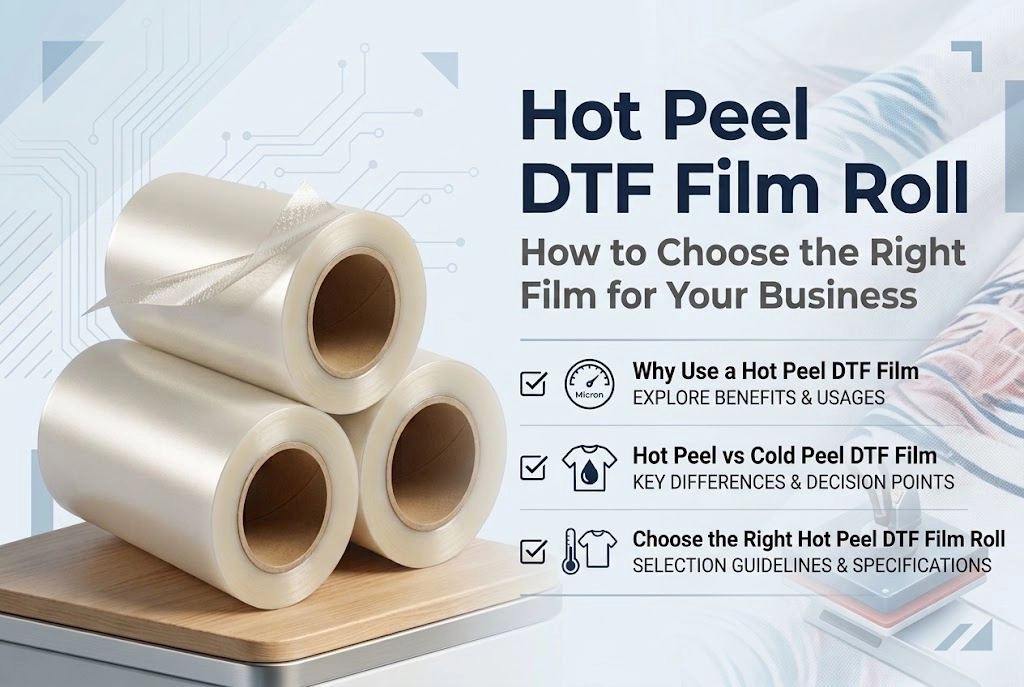
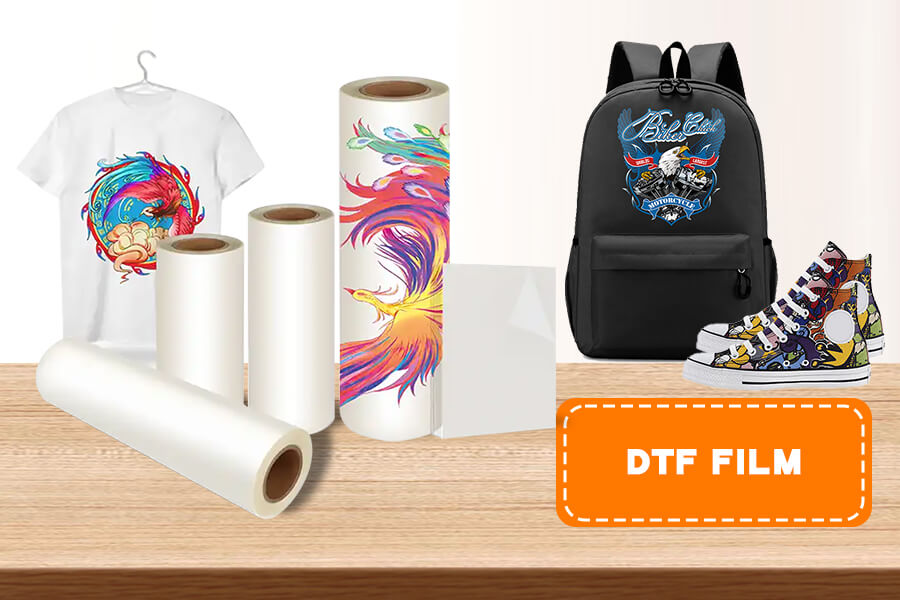
A hot peel DTF film roll is a PET transfer film designed to be peeled shortly after heat pressing. Unlike cold peel film, it does not require the transfer to cool completely before the film is removed.
For a commercial print shop, the main benefit is the production workflow. If the film can be peeled at the recommended time and temperature, the operator can move the finished garment to the next step without waiting for the transfer to cool.
Why Use a Hot Peel DTF Film Roll for DTF Production?
Reduce Waiting Time After Heat Pressing
The main reason businesses choose hot peel film is to reduce the waiting step after pressing.
With a cold peel process, the transfer normally needs to cool before the carrier film is removed. A hot peel process allows the operator to remove the film while it is still hot when the film’s specifications call for it.
For high-volume production, removing one waiting step can make the workflow easier to manage. Commercial DTF film suppliers commonly position instant hot peel products around faster production and immediate peeling.
Improve Production Throughput
Hot peel film can be useful when a print shop needs to process many garments in a limited amount of time. Instead of placing a pressed garment aside to cool, the operator can peel it and continue with the next garment.
The actual production gain depends on the complete workflow. Printer speed, powder application, curing, heat press cycle time, operator handling, and film performance all matter.
For this reason, it is better to evaluate hot peel film by usable production output rather than assuming that a faster peel alone will automatically make the whole operation faster.
Make High-Volume Orders Easier to Handle
Roll film is especially useful for businesses producing repeated orders because it provides a continuous film format instead of requiring individual sheets.
For example, Winnerjet offers 30 cm × 100 m, 33 cm × 100 m, and 60 cm × 100 m DTF film rolls, along with customized sizes. This gives print businesses more options when matching film width to their equipment and production volume.
Hot Peel vs Cold Peel DTF Film: Which Is Right for Your Business?
The main difference between hot peel and cold peel DTF film is when the carrier film is removed after heat pressing. That small difference can affect how quickly your operator can move to the next garment, how much space you need for cooling, and how the peeling step fits into your production process.
For a business buying DTF film in bulk, it is worth looking beyond the peel time itself. You also need to consider your production volume, operator workflow, and how much control you need during the peeling process. The table below shows the main differences to consider before choosing a film.
| Factor | Hot Peel DTF Film | Cold Peel DTF Film |
|---|---|---|
| Peeling time | Shortly after pressing, according to film instructions | After the transfer cools |
| Production workflow | Less waiting between pressing and peeling | Requires a cooling step |
| Production volume | Useful for fast, repeated production | Suitable when cooling time is acceptable |
| Process control | Requires correct heat, pressure, and peel timing | Requires correct cooling before peeling |
| Main buying concern | Clean and consistent hot peel | Consistent release after cooling |
When to Choose Hot Peel DTF Film
Hot peel is worth considering when your business handles frequent orders and wants to reduce the time between pressing and peeling.
It can be particularly useful when operators need a simple, repeatable workflow. But the film should be tested with the actual printer, DTF ink, powder, heat press, and fabrics used in production.
When to Choose Cold Peel DTF Film
Cold peel may make sense when your existing workflow already includes a cooling stage or when a particular film and production process performs better with cold peeling.
The important point is to follow the film manufacturer’s specifications rather than treating hot peel or cold peel as a universal rule.
Read More: Best DTF Film: Hot vs Cold Peel Guide
How to Choose the Right Hot Peel DTF Film Roll
Choosing the right roll starts with your equipment and production process, not the price tag.
Choose the Right Roll Width for Your DTF Printer
The right roll width depends on your printer’s printable width and how you use film in daily production. Before ordering, compare these key points:
| What to Check | Example |
|---|---|
| Print width | A 330 mm printer can use 30 cm or 33 cm film, depending on its media setup. |
| Feed width | If your printer supports media up to 330 mm, a 60 cm roll is not a practical match. |
| Roll core | Winnerjet rolls use 2-inch or 3-inch cores, so check your roll holder before ordering. |
| Roll length | Winnerjet offers 100 m rolls in 30, 33, and 60 cm widths for regular production. |
| Feeding method | A roll-fed printer needs a compatible roll format; a sheet-fed setup may require sheets instead. |
| Available space | A 60 cm roll needs more room around the printer than a 30 cm roll. |
Winnerjet currently offers 30 cm, 33 cm, 60 cm, and 120 cm DTF rolls, with custom sizes also available. Its 30 cm, 33 cm, and 60 cm rolls are available in 100 m lengths and 2-inch or 3-inch cores.
The key is to match the film to your actual printable width and feeding system, rather than simply choosing the widest roll available. For example, Winnerjet’s WT301 supports a maximum print width of 330 mm, while its I3200 DTF printer supports media up to 620 mm.
Check Printer and Ink Compatibility
DTF film needs to work with the whole printing process. Before buying, check these key points:
| What to Check | Example |
|---|---|
| Printer | A 60 cm printer with a 620 mm media width can use a 60 cm film roll. |
| Printhead | Winnerjet's film is tested with Epson i3200 and 4720 printheads. |
| DTF ink | Winnerjet's DTF ink is designed for Epson i3200, XP600, and other common DTF printheads. |
| DTF powder | The film should hold the powder evenly without excess powder sticking to blank areas. |
| Powder shaker | An automatic shaker should spread powder evenly across the printed area and remove excess powder. |
| Curing system | The curing oven needs to melt the powder fully before heat pressing. |
| Heat press | Test the film with your actual press settings to confirm clean peeling and transfer. |
For example, Winnerjet’s 60 cm DTF printer uses Epson i3200 printheads, supports up to 620 mm media, and includes automatic powder shaking and curing functions. Its DTF film is listed as compatible with Epson i3200 and 4720 systems.
The safest approach is to test the printer + ink + film + powder + curing + heat press as one system before placing a bulk film order. A film that works well with one setup may still need different settings on another machine.
Read More: DTF Transfer Film for Inkjet Printer: Choosing Sheets, Rolls, and the Right Size
Check Ink Absorption and Print Quality
The film needs to hold the printed image properly during printing and powder application.
Poor ink absorption can lead to issues such as ink spreading, uneven edges, or inconsistent white ink coverage. For a commercial printer, these problems can create waste and slow down production.
Do not judge a film only by how it looks before printing. Print real designs with your normal ink settings and check small text, fine lines, large color areas, and white ink.
Check Anti-Static Performance
Static can become a practical production problem, especially when film runs through a printer or automatic powder system.
A suitable anti-static coating can help reduce problems related to static during film feeding and powder application.
Winnerjet’s DTF film specifications include anti-static treatment, and its product range is designed for roll-based DTF production and automatic powder-shaking workflows.
Check Peel Performance
For hot peel film, peeling performance is one of the most important things to test.
The film should release cleanly at the recommended settings without pulling the design away from the garment. ASTM D903 provides a standardized method for comparing peel or stripping strength under defined test conditions, although a supplier’s laboratory peel result should not be treated as a guarantee for every printer, garment, or production setup.
Your own production test is still important.
How Much Does a Hot Peel DTF Film Roll Cost?
For a 100 m (328 ft) DTF film roll, current U.S. retail listings show a wide price range depending on roll width and film type. For example, Screen Print Direct lists 11.8-inch rolls from about $54, 13-inch rolls from $55, 14.5-inch rolls from $66, and 23.6-inch rolls from $108. DTG Pro lists instant hot peel rolls at about $70 for 30 cm × 100 m, $76 for 33 cm × 100 m, and $135 for 60 cm × 100 m.
Winnerjet’s current listings are about $80 for 30 cm × 100 m and 33 cm × 100 m rolls, and $150 for a 60 cm × 100 m roll. These prices provide a useful reference when estimating the retail cost of a standard 100 m roll.
| Roll Size | Example Retail Price | Approx. Price per Meter |
|---|---|---|
| 30 cm × 100 m | $80 | $0.80 |
| 33 cm × 100 m | $80 | $0.80 |
| 60 cm × 100 m | $150 | $1.50 |
These are retail examples, not a fixed market price. Wholesale, bulk orders, shipping, film specifications, and custom sizes can change the final cost.
What Affects Hot Peel DTF Film Roll Price?
The biggest price differences usually come from roll width, film construction, and order quantity.
For example, a 30 cm × 100 m roll uses roughly half the film area of a 60 cm × 100 m roll, so comparing only the price per roll can be misleading. A better comparison is the cost of the film area you actually use.
How to Compare Film Cost for Bulk Production
For B2B purchasing, compare both price per meter and price per square meter.
For example, a $80 roll that is 30 cm wide contains about 30 m² of film, or about $2.67 per m². A $150 roll that is 60 cm wide contains about 60 m², or about $2.50 per m².
This shows why a higher-priced roll is not necessarily more expensive when you compare the amount of usable film.
You should also consider waste. If one film feeds consistently and produces fewer failed transfers, its usable cost may be lower even if the initial roll price is slightly higher.
For a bulk order, ask the supplier for the roll price, price per meter or square meter, shipping cost, and bulk discount. Then test a sample with your own printer, ink, powder, and heat press before committing to a large quantity.

How to Test a Hot Peel DTF Film Roll Before Buying in Bulk
Before committing to a large order, request a sample and test it with the same equipment and materials used in production.
Test Print Quality and Ink Absorption
Print several different designs instead of testing only one simple graphic.
Check:
- Fine lines
- Small text
- Large solid areas
- White ink coverage
- Color consistency
- Ink spreading
- Ink drying
Keep the printer and RIP settings consistent so you can compare different films fairly.
Test Powder Adhesion
Run the printed film through your normal powder application process.
Check whether the powder sticks mainly to the printed area and whether excess powder remains on blank parts of the film.
This test is especially important if your shop uses an automatic powder shaker.
Test Heat Pressing and Peeling
Use the temperature, pressure, and time recommended for the film as your starting point.
Winnerjet’s current technical reference gives a heat-transfer range of 140–180°C and recommends testing around 160°C, while its product pages provide more specific settings for individual films. The correct settings should always be adjusted to the film, garment, powder, and heat press being used.
After pressing, peel according to the film’s hot-peel instructions. If the design lifts, tears, or remains attached to the film, do not simply assume the film is defective. Check heat, pressure, curing, powder coverage, and peel timing as well.
Test Transfer Durability
A transfer that looks good immediately after pressing may still fail during washing or normal use.
Test the finished garment under conditions that match your customers’ applications.
For more formal testing, textile laboratories can use standardized methods. For example, AATCC TM135 provides a standardized method for evaluating dimensional changes in fabrics after home laundering.
Common Hot Peel DTF Film Roll Problems
The Film Does Not Peel Cleanly
Check whether you are peeling at the correct time and temperature. Also check whether the DTF powder was properly melted and whether the transfer received enough heat and pressure.
Part of the Design Sticks to the Film
This can result from insufficient bonding, incorrect heat press settings, incomplete powder curing, or a mismatch between the film and the production process.
Test one variable at a time instead of changing several settings at once.
Static Causes Feeding Problems
Static can affect film feeding and powder handling. Check the film’s anti-static properties and make sure the roll is installed with the correct tension.
The Film Shrinks or Warps During Heating
Thermal stability matters when film is exposed to high temperatures. Winnerjet’s published technical data includes a thermal-shrinkage specification and identifies ISO-based testing for relevant film properties.
For production use, test the film under the same heat and curing conditions used in your shop.
Hot Peel DTF Film Roll Buying Checklist
Before placing a bulk order, confirm:
| What to Check | Why It Matters |
|---|---|
| Roll width and length | Must fit your printer and production volume |
| Peel type | Determines the peeling workflow |
| Printer compatibility | Helps prevent feeding and printing problems |
| Ink compatibility | Affects image quality and adhesion |
| Anti-static performance | Helps with film feeding and powder handling |
| Film thickness | Affects handling and physical properties |
| Heat-transfer settings | Helps establish a repeatable production process |
| Peel performance | Reduces failed transfers |
| Wash durability | Important for finished garment quality |
| Sample testing | Reduces the risk of a poor bulk purchase |
For businesses buying DTF film regularly, it is also worth asking the supplier about bulk pricing, custom roll sizes, OEM packaging, lead times, and sample testing before placing a large order. Winnerjet currently offers wholesale and OEM supply, custom sizes, and free sample testing for its DTF film range.