How to Dry Pigment Ink: A Comprehensive Guide

Pigment ink drying process on various paper types
After printing with pigment ink, we all want it to dry and set quickly, leading us to wonder: how to dry pigment ink? As a manufacturer with years of experience in researching and producing pigment ink, we have extensive knowledge on this topic:
Heat drying is the most effective option. The core principle is to accelerate solvent evaporation through external heating, but temperature must be controlled to avoid damaging the substrate or pigment. Heat drying is fast (3-5 times quicker than air drying).
Adsorption drying is also a good way to speed up pigment ink drying. It is often used in combination with air drying or low-temperature heating to provide "auxiliary acceleration."
Below, we will delve into these methods for accelerating pigment ink drying and their key operational points.
Understanding Pigment Ink: Core Drying Principles and Influencing Factors
To master pigment ink drying techniques, we first need to understand its core drying principles. There are fundamental differences between the drying mechanisms of pigment ink and dye ink, which is crucial in determining appropriate drying methods.
Composition and Drying Nature of Pigment Ink
Pigment ink consists of four components: pigment particles, dispersants, resins, and solvents (water or organic solvents):
- Pigment particles are the color carriers, typically 0.1-10 microns in diameter. They cannot dissolve in solvents and can only be uniformly suspended through dispersants.
- Resins (also called film formers) determine the ink's adhesion and water resistance. When dry, they form a transparent film that fixes pigment particles on the substrate surface.
- Solvents transport pigments and resins to the substrate. The essence of drying is the process of solvent evaporation plus resin curing. As the solvent (such as water) evaporates, the resin gradually transforms from liquid to solid, ultimately locking pigment particles firmly on surfaces like paper.
In contrast, dye ink pigments can directly dissolve in water, so drying only requires waiting for water evaporation, resulting in faster drying. However, without resin protection, their water resistance and lightfastness are far inferior to pigment ink. This means pigment ink drying requires both "rapid solvent evaporation" and "sufficient resin curing," making the process more complex.
Key Factors Affecting Pigment Ink Drying Speed
Regardless of the substrate, pigment ink drying speed is influenced by these 5 factors. Understanding them helps you adjust drying strategies more flexibly:
- Solvent type: Pigment inks are either water-based (water as solvent) or oil-based (organic solvents like ethanol, ethyl acetate). Water-based inks depend on water evaporation and are greatly affected by environmental humidity. Oil-based inks with organic solvents evaporate faster (ethanol boils at 172.4°F/78°C, water at 212°F/100°C), typically drying 1-2 times faster than water-based inks. However, proper ventilation is necessary.
- Environmental temperature and humidity: Higher temperatures increase solvent molecule movement and evaporation rate (e.g., water evaporates 1.5 times faster at 77°F/25°C than at 59°F/15°C). Lower humidity allows more solvent molecules in the air, accelerating evaporation (drying is twice as fast at 30% humidity compared to 70%).
- Ink thickness and coverage: Thicker ink layers and higher coverage (like solid black backgrounds) contain more solvent, requiring longer drying times. For example, a 0.1mm thick layer of water-based pigment ink (100% coverage) on A4 paper may need 2-3 hours to air dry, while a 0.01mm thin layer (10% coverage) can dry within 30 minutes.
- Substrate characteristics: Taking paper as an example, different papers' water absorption and breathability directly affect drying speed. Highly absorbent papers quickly absorb ink moisture, drying faster but potentially causing pigment particle precipitation and color fading. Less absorbent papers hardly absorb moisture, relying entirely on natural solvent evaporation.
- Ventilation: Airflow carries away evaporated solvent molecules from the substrate surface, preventing local high solvent concentration and accelerating drying. For example, water-based pigment ink dries 30%-50% faster in well-ventilated environments compared to enclosed spaces.
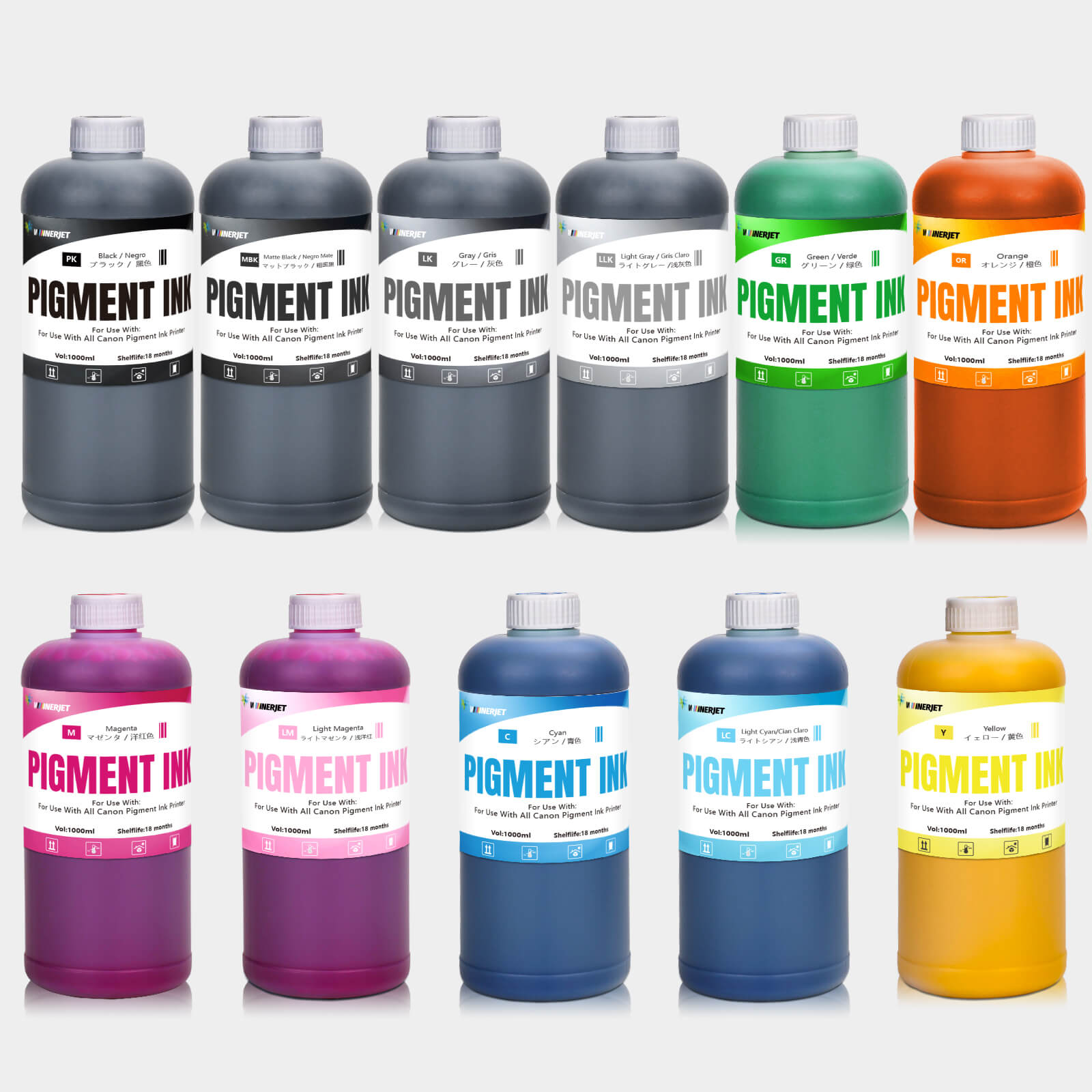
Comparison of different pigment ink drying methods
General Scenarios: How to Efficiently Dry Pigment Ink?
Beyond paper, pigment ink may be used on substrates like fabric, plastic, and metal. Drying methods should be adjusted based on substrate characteristics, but these "universal drying methods" work for most scenarios and are simple to operate.
Air Drying: The Safest Basic Method
Air drying uses environmental temperature, humidity, and ventilation to naturally evaporate ink solvents. It works for all substrates, especially temperature-sensitive materials (like thin paper, fabric).
Operating steps:
- Choose an appropriate environment: Place pigment ink prints in an area with temperature 68-86°F (20-30°C), humidity 30%-60%, and good ventilation. Avoid direct sunlight and dusty areas.
- Proper placement: For paper or thin materials, lay flat on a clean table with absorbent paper underneath. For three-dimensional objects, use a stand to suspend them, ensuring all ink-covered areas contact air.
- Be patient: Drying time depends on ink type, thickness, and environmental conditions. To check if dry: gently touch the ink surface with clean tissue. If no color transfers and the surface feels non-sticky, it's dry.
Precautions: Not recommended in humid weather (humidity >70%) or enclosed environments. To speed up, use dehumidifiers or fans on low speed.
Heat Drying: The Core Method for Fast Drying
When air drying is too slow (like for batch printing or urgent projects), heat drying is most effective. It accelerates solvent evaporation through external heating, but temperature must be controlled to avoid damaging substrates or pigments.
1. Low-temperature heating: Suitable for sensitive substrates (paper, fabric)
Low-temperature heating is typically 104-140°F (40-60°C), accelerating solvent evaporation without causing paper warping, fabric shrinkage, or pigment discoloration.
Hair dryer operation:
- Set the hair dryer to low heat, medium speed. Keep the air outlet 6-8 inches (15-20cm) from the work surface.
- Move the hair dryer steadily in one direction, avoiding staying in one spot for more than 3 seconds.
- Heat for 1 minute, then pause for 20 seconds. Lightly touch the surface to check dryness.
- For paper works, flatten after heating with heavy books to prevent warping.
2. Medium to high-temperature heating: Suitable for heat-resistant substrates
For heat-resistant substrates like plastic, metal, and ceramic, 140-248°F (60-120°C) heating can further shorten drying time while promoting complete resin curing.
Precautions: Adjust temperature based on substrate heat resistance. Maintain ventilation. Avoid repeated heating.
Adsorption Drying: A Practical Auxiliary Acceleration Technique
Adsorption drying uses water-absorbent materials to absorb ink solvents. It works well for thick ink layers or low-absorbency substrates, often combined with air drying or low-temperature heating.
Key Scenarios: How to Dry Pigment Ink on Paper?
Paper is the most common substrate for pigment ink, but different papers have significantly different characteristics requiring targeted drying methods. Below are specific drying solutions for 4 common paper types.
Absorbent Paper: Rice Paper, Sketch Paper, Watercolor Paper
Absorbent paper has loose fibers and large pores that quickly absorb ink moisture, drying faster but prone to "pigment precipitation and color fading."
Low-Absorbency Paper: Coated Paper, Glossy Art Paper, Photo Paper
Low-absorbency paper has a smooth coating that hardly absorbs moisture. Ink dries solely through natural solvent evaporation, which is slow and prone to "smudging and fingerprint marks."
After understanding these accelerated drying methods and principles for pigment ink, you should have a deeper understanding of how to dry pigment ink. We hope our experience helps you.
If you have more questions about using pigment ink, please feel free to contact us for advice.