When vetting industrial inkjet printer manufacturers, enterprise buyers should look beyond surface-level machine specifications. Instead, the focus must be on three critical pillars: underlying printhead integration, chemical compatibility between hardware and ink, and global supply chain responsiveness. A truly professional manufacturer doesn’t just sell hardware; they provide a comprehensive production system designed to ensure long-term profitability.

Top 5 Industrial Inkjet Printer Manufacturers Comparison (2026 Edition)
When scouting for industrial inkjet printer manufacturers, the “best” choice depends on your specific production volume, substrate type, and budget. To assist you in making this decision, we have compared industry leaders against flexible and highly cost-effective suppliers.
| Manufacturer | Core Technology | Best For | Global Support |
|---|---|---|---|
| HP (PageWide) | Thermal Inkjet (TIJ) | High-speed packaging. | World-class |
| Epson | Micro Piezo | Textile & label printing. | Excellent |
| Videojet | Continuous Inkjet (CIJ) | Fast coding & pharma. | Industry-leading |
| Domino | i-Tech Cleaning | Heavy industrial marking. | Specialized |
| Winnerjet | Hybrid Compatibility | SME customization & cost-effective. | Highly Flexible |
💡 Why This Comparison Is Crucial for Your Business
Selecting a manufacturer involves more than just choosing the equipment itself; it is fundamentally about the “Total Cost of Ownership” (TCO). While industry giants like HP and Videojet boast robust global service networks, their products often come with steep maintenance costs and a “closed” ecosystem for consumables.
In contrast, manufacturers like Winnerjet prioritize system integration and flexibility, enabling businesses to significantly reduce operating expenses—by utilizing compatible, high-performance inks and components—without compromising on print quality.
Expert Tip: Before signing a contract, be sure to request a print sample test on your specific substrate materials (such as plastic, metal, or porous paper) to ensure that the ink’s adhesion meets your durability standards.
I. Technical Depth: Evaluating the Relationship with Top-Tier Printhead Makers
In the industrial printing world, the printhead is the “heart” of the machine, dictating nearly 90% of its performance ceiling. However, simply having a high-end printhead isn’t enough; the real competitive edge lies in the manufacturer’s ability to integrate and master that technology.
1. Identifying the “Heart”: Deep Integration Capabilities
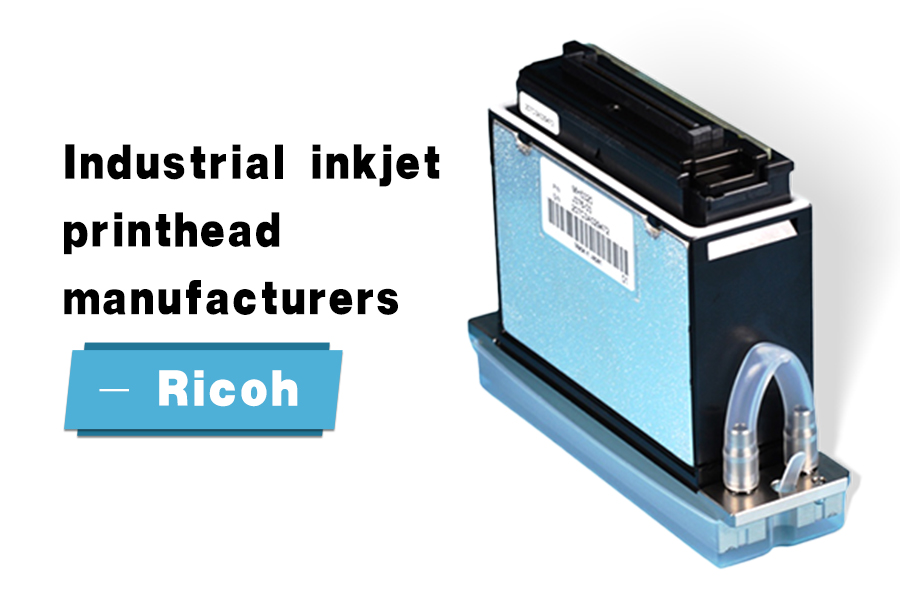
A leading inkjet printer manufacturer typically maintains deep technical collaboration with world-class inkjet printhead manufacturers such as Ricoh, Kyocera, and Epson.
Red Flag: Many low-tier manufacturers merely purchase generic control boards and perform “shell assembly.”
The Professional Standard: You need to ask if the manufacturer has the capability to independently develop printhead drive circuits (Waveforms). The drive waveform determines the precision of the piezo-electric ink droplet ejection. Only manufacturers with this level of R&D can optimize ejection for varying ink densities, which fundamentally extends printhead life and ensures stability during high-intensity, long-shift operations.

When evaluating the technical prowess of industrial inkjet printer manufacturers, observing their application of core technology is vital. For instance, in our [2026 Global Top Supplier Watchlist], we analyze how Epson and Kyocera solve industrial pain points through these technical iterations.
2. Supply Chain Scrutiny: Systemic Closed-Loop Capabilities
Mature industrial inkjet printer manufacturers sell complete production solutions, not just hardware. This requires exceptional integration skills, particularly regarding precise control of the ink delivery system.
Technical Extension: Stable negative pressure systems, advanced filtration, and strict control over consumables (ink) are the safeguards of uninterrupted industrial printing.
Supplier Value: Often, buyers acquire equipment through a professional industrial inkjet printer supplier. The value of a premium supplier lies in their ability to integrate upstream and downstream advantages—providing “full lifecycle” services from installation and process tuning to consumable matching. This localized, long-term support is often the “lifeline” for a factory’s continuous production.
3. Verifying Stability: Focusing on ROI (Return on Investment)
In business, any parameter that doesn’t translate into profit is meaningless. A manufacturer confident in their stability must withstand real-world testing.
Selection Advice: Always insist on “on-site sampling” and “continuous run tests” using your specific materials to observe performance under high-intensity simulation.
Key Metric: Look at real-world case studies within your industry. Prioritize manufacturers with equipment that has been running stably for over three years at client sites. Only those who have survived market cycles can ensure your investment doesn’t become a “sunk cost” due to frequent breakdowns and expensive repairs.
II. Systems Engineering: Assessing Collaborative R&D of Hardware and Consumables
If the drive circuit is the “brain,” then ink is the “blood.” Industrial printing is not just mechanical movement; it is a sophisticated marriage of precision chemistry and advanced mechanics. Many buyers fall into the financial trap of “affordable to buy, impossible to run” because they overlook the synergy between the hardware and the consumables.
1. Avoiding “Fragmented” Sourcing Risks
During the vetting process, you must verify if the manufacturer possesses the capability to simultaneously develop or supply inks and consumables. Buying a machine from Company A and ink from Company B to save on initial costs often leads to extreme performance instability.
The Technical Pain Point: The viscosity, surface tension, and pigment particle size of industrial inks must precisely match the printhead’s firing frequency and the pressure of the ink delivery system.
R&D Depth: An elite inkjet printer manufacturer fine-tunes ink formulas specifically for their hardware. This “hardware-software integrated” R&D model prevents common issues like nozzle clogging, ink misting, or inaccurate color reproduction at the source.
2. The Core Value of “Single-Source Hardware and Ink”
Choosing an industrial inkjet printer supplier with in-house production capabilities offers distinct commercial advantages:
Minimal Communication Costs: If the production line experiences issues like streaking or ink breakage, you won’t have to mediate between a hardware vendor and an ink supplier who are blaming each other. A unified supplier has closed-loop data to quickly identify if the issue is mechanical or chemical.
Reduced Downtime Risk: Inks that have undergone rigorous Matching Tests maximize the protection of expensive printheads from corrosion or sediment. This results in higher Uptime and a more stable ROI.
3. Selection Metric: Look for a “Lab,” Not a “Warehouse”
When evaluating an industrial inkjet printer supplier, check if they have their own ink adaptation lab. An agent that only sells off-the-shelf cartridges cannot compare to a professional supplier who can adjust ink chemistry based on your specific substrate. Ensuring the “blood” is compatible with the “heart” is the only way to win the industrial marathon.
III. Deep Customization: OEM Capabilities as a Benchmark for R&D Strength
In the diverse world of industrial applications, standard machines rarely cover every specific detail. For buyers seeking a competitive edge, OEM customization capability is the ultimate “litmus test” for a manufacturer’s R&D strength.
1. Beyond “Private Labeling”: Technical Sovereignty
True OEM service is not just changing a logo; it is deep secondary development based on specific client needs.
Technical Manifestation: If a manufacturer can customize print widths, adjust the corrosion resistance of the ink system, or rewrite control software for specialized materials, it proves they have full technical sovereignty over their source code and mechanical structure.
Buyer Value: Choosing an inkjet printer manufacturer with a strong R&D background means your equipment can “evolve” through software updates or modular retrofits as your processes upgrade, preventing the entire production line from becoming obsolete as technology advances.
2. Scenario Adaptation: Solving “The Last Mile”
Industrial environments vary wildly—from high-humidity food packaging to high-speed online coding. A professional industrial inkjet printer supplier uses their OEM experience to provide tailored solutions, such as specialized pre-treatment systems for unique substrates or mechanical interfaces for automated assembly lines. Their flexibility ensures the equipment fits your production chain, rather than forcing your process to adapt to the machine.
3. Brand Premium and Market Competitiveness
For distributors or large industrial groups looking to establish their own brands, a manufacturer’s OEM ecosystem provides a powerful backbone. Reliable manufacturers offer one-stop customization—from industrial design and UI interfaces to specific performance parameters. This reduces your R&D risk and leverages the manufacturer’s deep roots (such as Winnerjet’s nearly 20 years of expertise) to turn mature technology into your brand advantage.
IV. Global Response: Evaluating Support Density and Logistics
Once the “what to buy” and “how to build” questions are answered, the final line of defense is: Who can get the production line running fastest when a fault occurs?
Core Standard: You must investigate the supplier’s global service network. A true industrial inkjet printer supplier doesn’t just ship products; they establish a support system of “Spare Parts Warehousing + Remote Diagnostics.”
Response Time: Inquire about the inventory depth of critical components (pumps, sensors, motherboards) and the efficiency of cross-border logistics. In the industrial sector, a 24-hour delay often results in losses several times the cost of the equipment itself.
Conclusion: Securing a Long-Term Strategic Partner
Finding a reliable industrial inkjet printer manufacturer is essentially finding a partner for long-term growth. From printhead drive technology to collaborative ink R&D and deep OEM strength, every link is interconnected.
With nearly 20 years of experience in industrial inkjet innovation, Winnerjet integrates “precision mechanics, expert chemistry, and timely service” into a one-stop solution. We understand the pain points of enterprise buyers and are committed to using our global vision and technical depth to build the most stable production engine for your business.