As a professional ink manufacturer and solution provider, we are frequently asked a core question: “Is pigment ink permanent?”
Yes, pigment ink is permanent. Unlike dye-based inks, pigment ink is composed of solid particles that sit on top of the paper, making it highly resistant to UV rays, water, and fading over time. Please note that “permanence” does not refer to absolute never-fading, but rather the ability of the print to maintain color stability for decades or even longer under reasonable preservation conditions. This is the core definition of professional pigment ink durability according to international standards.
Winnerjet consistently uses scientific data as a foundation to provide global users with pigment ink solutions that offer both durability and practicality. Today, we will start with the technical principles, discuss influencing factors, and provide professional assurance solutions to help you establish a professional understanding of pigment ink’s “permanence”.
Technical Principle of Pigment Ink
The exceptional durability of pigment ink stems from its unique coloring mechanism, which is fundamentally different from easily-fading dye-based inks.
Pigment ink uses solid pigment particles, ground to a nano-scale, as the coloring core, which are stably suspended in an aqueous vehicle by special dispersants. During printing, the ink vehicle evaporates, and the solid pigment particles tightly adhere to the surface of the printing medium, forming a firm color film.
Physical Adhesion and Color Lock: This characteristic of “physical adhesion + particle color lock” helps avoid the flaw of “molecular penetration and easy decomposition” seen in dye-based inks. This inherently provides the ink with fundamental resistance to UV light, water, and oxidation. It is this chemical inertness that gives pigment ink a powerful ability to resist environmental erosion.
Core Applications of Pigment Ink
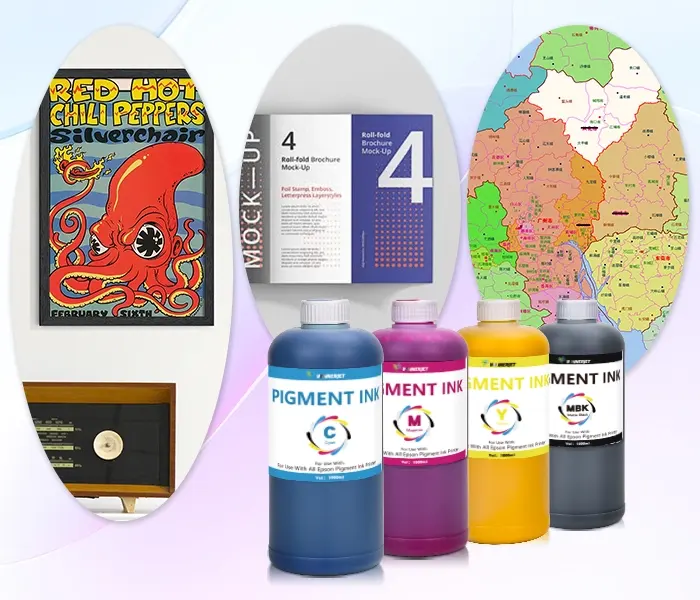
By virtue of its core advantages in excellent lightfastness, water resistance, and oxidation resistance, pigment ink applications are concentrated in all scenarios that have clear requirements for print durability. Pigment ink mainly serves the following major areas:
Professional Imagery and Art: Used for photography output and Giclée art prints. When paired with coated photo paper, art paper, and other specialized media, the finished prints can achieve museum-grade long-term preservation, meeting the stringent demands of collection, exhibition, and archival retention.
Outdoor Advertising Signage: Used for producing outdoor posters, light box graphics, car wraps, hoarding advertisements, etc.. Its ability to withstand sun and rain exposure and temperature variations effectively prevents fading and smearing, offering a much longer service life than traditional dye-printed materials.
Office and Archival Filing: Used for printing contracts, certificates, technical drawings, and historical archives. Pigment ink resists blurring when wet and does not yellow during long-term storage, fully meeting international standards for various file long-term archiving.
Industrial and Specialty Printing: Widely applied in textile fabric printing, building material surface spraying, and packaging marking. It can adapt to various non-paper substrates, maintaining clear and firm patterns even in complex environments.
What Makes Ink Permanent
Pigment ink does not exist in isolation; the final durability of the print is the result of multiple factors working together. The permanence (i.e., the effect and duration of preservation) of pigment ink is mainly influenced by three types of key factors:
| Key Factor | Impact Mechanism | Winnerjet Tip |
|---|---|---|
| Printing Medium (Substrate) | Coated specialty media (photo paper, art paper) can tightly absorb and fix pigment particles, providing the foundation for durability. Ordinary uncoated paper lacks this fixing capability, making prints prone to wear and fading. | Always select professional media compatible with pigment ink that features a high-density coating. |
| Storage Environment | Light exposure, extreme temperature/humidity, and pollutants accelerate aging. UV rays and contact with acids or alkalis can cause pigment decomposition or detachment from the surface. | Keep prints away from direct light. Store in a dry, room-temperature environment to maximize the print’s lifespan. |
| Ink Quality | Premium inks feature ultra-fine particles and superior dispersibility. They contain professional lightfast and anti-oxidation components, resulting in significantly stronger durability. | Avoid cheap, non-professional inks. Poor stability will shorten preservation time even on high-end media, resulting in a poor ROI. |
Pigment Ink vs Dye Ink: Which lasts longer?
When it comes to longevity, pigment ink is the clear winner. While dye inks are prized for their vibrant colors and wide gamut, they are composed of dissolved molecules that are highly susceptible to “bleeding” and fading when exposed to UV light or moisture. In contrast, pigment ink consists of tiny, solid suspended particles that bond to the surface of the medium. These particles are naturally more stable and chemically resistant to environmental factors. On professional-grade archival paper, a pigment-based print can remain vibrant for up to 100–200 years, whereas a standard dye-based print may begin to noticeably fade within just a few years under similar conditions. For professionals seeking “museum-quality” durability and lightfastness, pigment ink is the indispensable choice.
Maintenance Guide: Maximizing the Durability of Pigment Ink
To ensure pigment ink and finished prints achieve their maximum designed durability, professional management is required in two aspects: ink storage maintenance and finished print care:
1. Maintenance of Ink and Printing Equipment
Ink Storage: Ink must be stored in a dark, cool, and dry environment (Suggested Temperature:5 – 25℃). Unopened ink should be protected from squeezing, and opened ink bottles must be tightly capped immediately to prevent solvent volatilization and air entry.
Equipment Maintenance: The printer should not be left idle for long periods. It is recommended to perform a print head cleaning or print a test page at least once a month to prevent pigment particle sedimentation from clogging the print head. When replacing ink, ensure the operating environment is dust-free to avoid contaminating the ink.
Consistency: Always use high-quality ink compatible with the printer model. Strictly prohibit mixing inks from different brands or chemical systems to maintain the ink’s dispersion stability.
2. Care of Finished Prints
Media Selection and Drying: Prioritize the use of professional media such as coated photo paper and Giclée art paper. After printing, the finished product needs to be air-dried in a dust-free, ventilated environment for 24 hours to ensure the ink is completely cured.
Physical Protection: Finished prints must be protected from light, moisture, and high temperatures. It is recommended to place them in moisture-proof bags, archival folders, or use professional photo frames with UV-protective glass.
Avoid Contact: Avoid directly touching the image surface, and keep away from chemical environments like acids, alkalis, or oil fumes that could potentially corrode the pigment layer.
Winnerjet Solution: Making “Durability” Controllable, Measurable, and Trustworthy
As a professional ink supplier, Winnerjet not only provides high-quality pigment ink but is also committed to making “durability” a tangible and trustworthy attribute for users.
- Full-Scenario Product Matrix: Targeting different durability needs such as image archiving, outdoor advertising, and office filing, we launch specialized pigment ink series. For example, archival-grade ink contains extra lightfast factors, and outdoor-grade ink features reinforced waterproof coating compatibility, ensuring that durability demands for various scenarios are precisely met.
- Authoritative Testing and Certification: All Winnerjet pigment inks pass authoritative tests such as SGS lightfastness testing and ISO water resistance certification. Each batch of product comes with detailed test reports, making durability data transparent and verifiable, eliminating user doubts.
- Full-Chain Technical Support: We provide users with an integrated “ink-media-equipment” compatibility solution. We also offer professional print preservation guidance, guaranteeing the long-term durability of prints from initial product selection to subsequent care.
Summary: Choose the Right Ink, Make “Long-Lasting” the Standard
Returning to the question of “Is pigment ink permanent?”, the answer is: under the combined effect of professional ink quality, compatible media, and scientific preservation, the “long-term durability” of pigment ink is fully achievable and can surpass the expectations of most users.
For over a decade, we have consistently focused on the technological upgrade of pigment inks, from particle grinding to formula optimization, from product supply to service support. We are a trustworthy pigment ink manufacturer, offering bulk supply solutions for ink wholesalers, distributors, brand resellers, and print shops. We are also an OEM branding option for ink distributors.
If you have specific scenario durability requirements, you are welcome to contact the Winnerjet technical team anytime to obtain an exclusive solution.