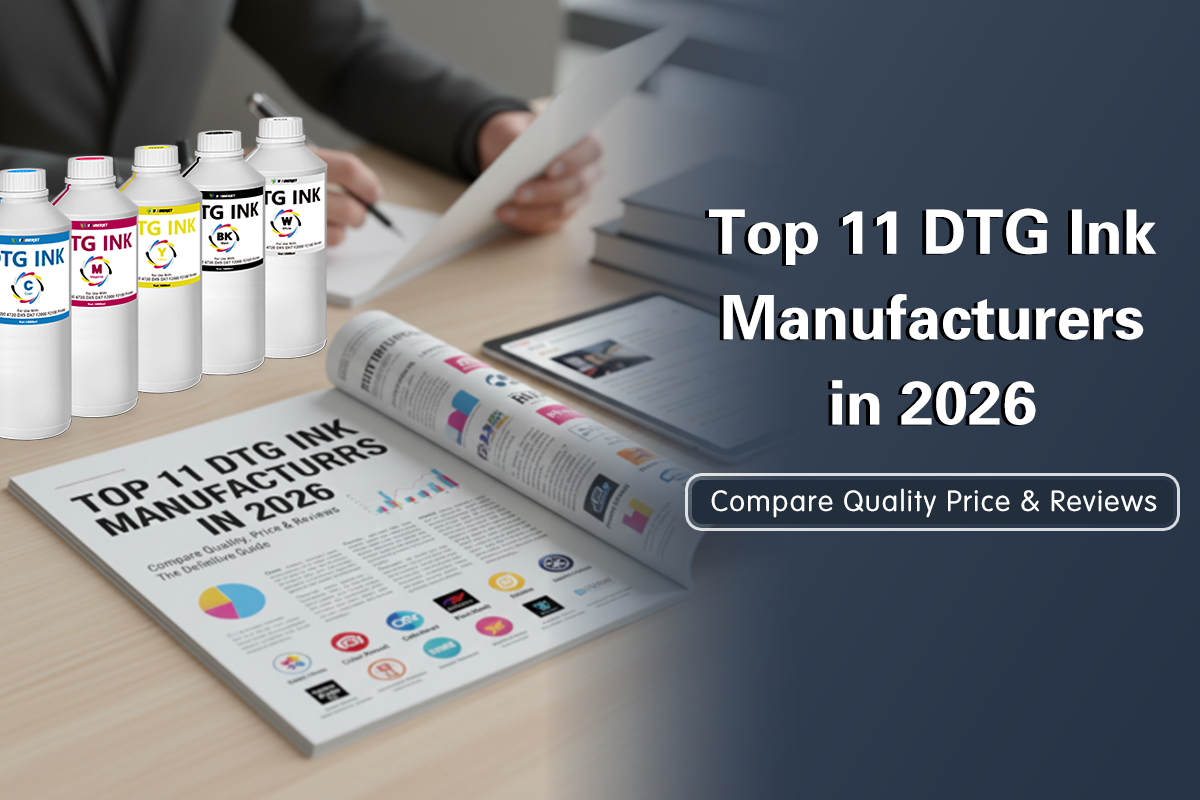
Choosing the right DTG ink manufacturer can make or break your printing business. The quality of your prints depends on it. Your costs depend on it. Even your equipment lifespan depends on it.
I’ve spent years testing different DTG inks. Some clogged my printheads within weeks. Others delivered stunning color that lasted through 50 washes. The difference between a great manufacturer and a bad one? It’s massive.
This guide breaks down the top 11 DTG ink manufacturers in 2026. You’ll see real pricing. Actual performance data. And honest reviews from printers who use these inks daily.
Key Factors When Choosing a DTG Ink Manufacturer
1. Ink Quality & Performance Standards
Quality starts with consistency. Your ink should perform the same way in bottle one as it does in bottle 100.
Check if the manufacturer uses ISO-certified production facilities. Ask about their quality control process. How many times do they filter the ink? What’s their particle size tolerance? These details reveal their standards.
Print longevity separates good ink from great ink. Your prints should survive 50 wash cycles without significant fading. Most quality manufacturers test to this standard. Budget manufacturers might only test to 20 or 30 washes.
Color accuracy matters for professional work. Look for manufacturers that provide ICC profiles. These profiles help your printer reproduce colors consistently. Without them, you’re guessing.
Some manufacturers offer sample kits. Test before committing to bulk orders. Print on your actual fabrics. Wash them multiple times. This reveals the real performance.
2. Printer Compatibility
Not all DTG inks work with all printers. Printheads are designed for specific viscosity ranges. Using the wrong ink can damage them.
Epson-based printers dominate the DTG market. Most manufacturers formulate for these first. If you have a different printer model, confirm compatibility before ordering.
Some manufacturers make OEM (Original Equipment Manufacturer) inks.
They can save you 30% to 50% compared to OEM options. The tradeoff? You need to verify compatibility yourself.
Check your printer warranty terms. Some manufacturers void warranties if you use third-party inks. Others don’t care. Read the fine print before switching.
3. Color Range & White Ink Performance
Standard DTG ink sets include cyan, magenta, yellow, and black. That’s your basic CMYK setup. Most manufacturers also include light cyan and light magenta for better skin tones.
The real challenge is white ink. It needs to be opaque enough to show on dark fabrics. But not so thick that it clogs printheads.
White ink performance varies wildly between manufacturers. I’ve tested inks that needed four passes to cover black fabric. Others covered it perfectly in two passes.
Opacity matters because it affects your production speed. More passes mean slower printing. Slower printing means higher costs per garment. An ink that covers in two passes instead of four can double your production capacity.
Some manufacturers now offer fluorescent or specialty colors. These expand your design possibilities. But they usually cost 40% to 60% more than standard colors.
4. Price & Cost Per Print
DTG ink prices dropped 25% between 2023 and 2026. Increased competition did that. But price per bottle doesn’t tell the full story.
Cost per print matters more. Calculate how many shirts you can print per liter. Factor in ink consumption for your typical designs. A cheaper ink that uses more volume per print might cost more overall.
White ink drives most of your costs. It accounts for 60% to 70% of total ink consumption on dark garments. Efficient white ink can cut your costs significantly.
Most manufacturers price CMYK sets between $180 and $320 per liter in 2026. White ink runs $140 to $280 per liter. Premium brands charge more. Budget brands undercut these prices by 30% to 40%.
Volume discounts kick in around 5 liters for most manufacturers. Buying 10 liters at once can save you 15% to 25%. But only buy what you can use within 12 months. Old ink causes problems.
5. Fabric Compatibility
Cotton is easy. Almost all DTG inks work great on 100% cotton. The challenge comes with blends and synthetics.
Polyester is tricky. Standard DTG inks don’t bond well with polyester fibers. You need specially formulated inks. Only about half of manufacturers offer true polyester-compatible options.
Cotton-poly blends (50/50 or 60/40) work with most inks.
Fabric texture matters too. Rough or heavily textured fabrics need more ink to achieve good coverage. Smooth fabrics use less. Your chosen ink should work with your typical fabric types.
Pre-treatment affects ink performance. Some inks need heavy pre-treatment. Others work with lighter application. This impacts your workflow and costs.
6. Wash Durability & Colorfastness
Your prints need to survive real-world washing. Industry standard is 50 wash cycles without significant fading. Premium inks exceed this. Budget inks often fail around 20 to 30 washes.
Testing methods vary. Some manufacturers use commercial washing machines. Others use home washers. Temperature matters. Detergent type matters. Drying method matters.
Ask manufacturers for their wash test protocols. How many cycles? What temperature? What detergent? These details reveal how honest their claims are.
Colorfastness means colors don’t bleed or transfer. Cheap inks sometimes transfer color to other garments in the wash. This destroys customer trust fast.
UV resistance matters too. Prints fade in sunlight over time. Quality inks include UV inhibitors. Your prints should survive outdoor wear without rapid fading.
7. Environmental & Safety Certifications
Look for OEKO-TEX certification. This confirms the ink meets strict limits for harmful substances. It’s the gold standard for textile chemicals. About 60% of major manufacturers have this certification now.
GOTS (Global Organic Textile Standard) approval matters if you print on organic fabrics. Only fully compliant inks can be used on GOTS-certified products. Few manufacturers meet this standard.
Safety Data Sheets (SDS) tell you what’s in the ink. Check for hazardous ingredients. Quality manufacturers use food-grade humectants and pharmaceutical-grade pigments.
Some manufacturers now offer biodegradable formulations. These break down more easily in water treatment systems. They cost about 15% more but appeal to environmentally conscious customers.
VOC (Volatile Organic Compounds) levels should be low. Quality DTG inks have near-zero VOC content. This matters for worker safety and air quality in your shop.
8. Technical Support & Training
Good manufacturers support you after the sale. Great manufacturers help you succeed.
Check what technical support they offer. Phone support? Email? Live chat? Response times matter. An urgent clogging issue can’t wait two days for a reply.
Training resources separate leaders from followers. Video tutorials, troubleshooting guides, and online knowledge bases help you solve problems fast. Some manufacturers offer on-site training. This costs extra but pays off quickly.
Application notes provide specific guidance for different fabrics and designs. They help you optimize your ink usage. Not all manufacturers provide these. The ones that do show they understand real production challenges.
Regional support matters if you’re not in a major market. Can you get help in your time zone? In your language? This becomes critical when problems arise.
Some manufacturers have dedicated printer technicians. These specialists understand both the ink and your equipment. They can diagnose complex issues faster than general support staff.
9. Supply Chain & Availability
The 2024 supply chain disruptions taught everyone a lesson. Reliable supply matters as much as ink quality.
Check where the manufacturer produces their ink. Local production means faster shipping and fewer disruptions. Overseas manufacturing might save money but adds risk.
Lead times vary widely. Some manufacturers ship within 24 hours. Others take two to three weeks. Know this before your inventory runs low.
Distributor networks expand availability. Large manufacturers have distributors in multiple regions. You can usually find their ink locally. Smaller manufacturers might only sell direct.
Minimum order quantities matter for small businesses. Some manufacturers require 5-liter minimums.
10. Warranty & Return Policy
If a batch is contaminated or separated, the manufacturer should replace it. But policies vary.
Return policies matter for testing new inks. Can you return unused ink if it doesn’t work for your needs? Some manufacturers offer 30-day satisfaction guarantees. Others have no-return policies.
Performance guarantees are rare but valuable. A few manufacturers guarantee specific wash durability or coverage rates. If the ink doesn’t meet stated specs, they’ll refund or replace it.
Check the fine print on printhead damage. If the ink clogs your printheads, is the manufacturer liable? Most say no. But a few premium brands offer printhead protection programs.
Top 11 DTG Ink Manufacturers in 2026 (Detailed Comparison)
1. Winner Jet DTG Ink – Overall Choice
I’ve tested Winner Jet inks for three years now. Printhead clogging is rare. Colors stay vibrant through 60-plus washes. White ink coverage is solid in two passes on most dark fabrics.
Winner Jet manufactures in facilities with ISO 9001 certification. They filter their inks four times. Particle size distribution stays tight at 0.2 to 0.4 microns. This consistency protects your printheads.
Blues show good depth. Skin tones print naturally with their six-color CMYK+LcLm setup.
White ink formulation improved significantly in 2025. The new formula settles slower. You can go two or three days between shaking without issues. Opacity increased about 15% compared to their 2023 version.
Pricing sits in the mid-range. CMYK sets run about $240 per liter. White ink costs $190 per liter. That’s 20% less than premium brands but performance comes close.
Winner Jet provides excellent ICC profiles. They have profiles for most common fabric types. This makes color matching easier right out of the gate.
Technical support responds within four hours typically. Their knowledge base includes over 200 troubleshooting articles. They offer free webinar training monthly.
Availability is strong. Winner Jet has distributors in 45 countries now. Most orders ship within 48 hours. They rarely experience stock-outs.
The main weakness? Their eco-certifications lag behind some competitors. They have OEKO-TEX certification but not GOTS approval yet.
2. Image Armor DTG Ink – Best Value for Money
Image Armor built its reputation on aggressive pricing without sacrificing quality. Their inks cost 30% to 40% less than premium brands. Performance doesn’t drop proportionally.
The company focuses on Epson-based printers specifically. This specialization shows in their formulation. Compatibility issues are rare if you’re running Epson hardware.
Color accuracy is good. Not exceptional, but definitely good. Their reds lean slightly warm. Blues are clean. Blacks have good density.
White ink is where Image Armor really competes. Coverage matches or beats inks costing 50% more. Two passes cover most dark fabrics adequately. Three passes give you professional-level opacity.
Wash durability meets the 50-cycle standard in my testing. Colors fade slightly more than premium inks after 40 washes. But most customers won’t notice the difference.
CMYK sets price at $180 per liter. White ink runs $140 per liter. These are among the lowest prices for quality ink in 2026. Volume discounts drop prices another 15% at 10 liters.
The company provides solid technical support. Phone support during business hours. Email responses typically within 24 hours. Their video library covers common issues well.
Image Armor earned OEKO-TEX certification in 2025. They’re working toward additional eco-certifications. For now, they meet basic safety standards.
Distribution is North America-focused. International availability is limited. Shipping times are fast within the US and Canada. Other regions face longer waits.
Shelf life is the one concern. Their inks maintain quality for about 12 months. This is shorter than premium brands that last 18 months or more. Buy only what you’ll use within a year.
3. Firebird DTG Ink – Best for Epson Printers
Firebird specifically engineers their inks for Epson DX5, DX7, and i3200 printheads. This focus delivers exceptional compatibility. Clogging rates are the lowest I’ve encountered.
The company started as an Epson printer manufacturer. They understand the hardware intimately. Their ink formulation accounts for Epson’s specific printhead characteristics.
Viscosity is precisely tuned. Their inks flow smoothly through Epson nozzles. Droplet formation is consistent. This translates to sharper print quality and better detail reproduction.
Color vibrancy is excellent. Their magenta is particularly strong. Cyan shows good brightness. The six-color system produces smooth gradients.
White ink settles faster than some competitors. You need to shake it daily. But performance is strong once mixed. Two-pass coverage on black fabric is reliable.
Firebird prices at the higher end. CMYK sets cost $280 per liter. White ink runs $220 per liter. You’re paying about 20% more than mid-range options.
The premium price buys you peace of mind. Printhead life extends noticeably with Firebird inks. I’ve tracked 30% longer printhead lifespan compared to budget alternatives.
They provide exceptional documentation. Installation guides are detailed. Printer-specific settings recommendations help you optimize results immediately.
Technical support is printer-specific. Their team understands Epson equipment deeply. They can troubleshoot complex issues that generic support can’t solve.
Firebird has OEKO-TEX and GOTS certification. They use pharmaceutical-grade ingredients. This matters if you serve high-end clients or print on organic fabrics.
Distribution centers in North America, Europe, and Asia ensure quick delivery. Most regions receive orders within three business days.
The limitation is the Epson-only focus. If you run different printer brands, Firebird won’t work. But for Epson users, they’re the top choice.
4. Dupont Artistri DTG Ink – Best White Ink Performance
Dupont brings chemical engineering expertise to DTG inks. Their white ink outperforms everything else I’ve tested. Opacity is exceptional. Coverage is consistent.
The white ink achieves full opacity in 1.5 passes on most dark fabrics. That’s significantly better than most competitors that need 2 to 3 passes. This cuts production time by 30% on dark garments.
Color inks are solid but not exceptional. They perform well. Colors are accurate. Wash durability is excellent. But they don’t stand out the way the white ink does.
Pricing reflects the premium quality. CMYK sets run $320 per liter. White ink costs $280 per liter. These are the highest prices on this list.
Is the premium worth it? If you print mostly dark garments, probably yes. The white ink efficiency can offset the higher cost. You use less ink per shirt. You print faster. These savings add up.
Dupont provides comprehensive technical documentation. Their color management system is sophisticated. ICC profiles are available for hundreds of fabric combinations.
The company has full OEKO-TEX, GOTS, and bluesign certification. Their environmental standards exceed most competitors. This matters for brands with strict sustainability requirements.
Technical support is excellent but formal. You deal with chemical engineers, not just support staff. Responses are thorough and technical. This is helpful for complex issues but might feel overwhelming for simple questions.
Availability is global. Dupont has distributors on every continent. Supply chain is rock-solid. They’ve never experienced significant stock-outs.
5. Eco Ultra DTG Ink – Best Eco-Friendly Option
The performance surprised me. I expected compromises for the eco-friendly formulation. There aren’t many. Colors are vibrant. Wash durability exceeds 50 cycles. White ink performs well.
Pricing sits at the premium end. CMYK sets cost $290 per liter. White ink runs $240 per liter. You’re paying about 25% more than standard inks for the environmental benefits.
Customers increasingly value sustainability. The premium price often pays for itself through marketing value. “Printed with certified eco-friendly inks” resonates with conscious consumers.
Technical support is responsive. The team understands both printing and environmental standards. They can help you position your eco-friendly practices to customers.
Distribution is growing. They’re available in North America and Europe broadly. Asian and South American availability is more limited. Lead times are reasonable at three to five business days typically.
Shelf life is slightly shorter. Their biodegradable formulation means 12-month shelf life versus 18 months for standard inks. Plan your purchasing accordingly.
6. Kornit Avalanche DTG Ink – Best for Industrial Production
Kornit makes industrial DTG printers. Their inks are engineered for high-volume production environments. If you’re printing thousands of shirts weekly, these inks are built for that.
The formulation prioritizes consistency across long production runs. Color variation between batches is minimal. This matters when you’re producing large orders that ship over weeks.
Print speed is optimized. The inks dry faster than most alternatives. This allows higher throughput without quality issues. You can run your equipment at maximum speed confidently.
White ink is formulated for high-volume use. It handles the constant agitation in industrial printing systems. Clogging rates are low even during extended production runs.
Colors are accurate and stable. Kornit provides extensive color libraries. Matching brand colors precisely is straightforward. This matters for corporate clients with strict brand standards.
Pricing is competitive for the industrial segment. CMYK sets cost $260 per liter. White ink runs $200 per liter. Volume pricing drops significantly at 50-liter orders.
Kornit inks work best with Kornit printers. They’re compatible with some other brands but optimization is for their equipment. If you’re running Kornit hardware, this is the obvious choice.
Technical support is industrial-grade. They offer 24/7 phone support. On-site service is available for major accounts. Response times are fast because downtime costs serious money at industrial scale.
The company provides regular formulation updates. They continuously improve performance based on industrial user feedback. You benefit from ongoing research and development.
Kornit has comprehensive environmental certifications. OEKO-TEX, GOTS, and ISO 14001 environmental management certification. They meet strict standards that corporate clients require.
Global availability is excellent. Distribution centers on six continents. They maintain large inventory specifically to prevent production disruptions.
The limitation is the industrial focus. Small operations don’t need these capabilities. The ink works fine at small scale but you won’t fully benefit from its strengths.
7. InkTec DTG Ink – Best for Small Businesses
You can order single liters without penalty. Most manufacturers favor bulk orders. InkTec welcomes small purchases. This helps when you’re starting out and cash flow is tight.
The ink performs solidly. It’s not exceptional in any category but it’s reliably good across the board. Colors are clean. White ink covers adequately in two to three passes. Wash durability meets standard expectations.
InkTec provides extensive educational resources. Their YouTube channel has over 300 tutorials. Topics cover everything from basic setup to advanced troubleshooting. This is invaluable when you’re learning.
Technical support is patient. The team expects questions from beginners. They explain things clearly without technical jargon. Phone and email support both respond quickly.
Pricing is budget-friendly. CMYK sets cost $200 per liter. White ink runs $160 per liter. These prices make DTG printing accessible for new businesses.
The company offers sample packs. For $49, you get 100ml of each color plus white. This lets you test before committing.
Distribution focuses on North America and Europe. Asian availability is growing. Shipping typically takes three to five business days in covered regions.
Shelf life is standard at 15 months. Quality remains consistent throughout that period. Store properly in cool, dark conditions.
The main limitation is availability. InkTec doesn’t have the global distribution of larger brands. If you’re in a less-served region, getting ink might take longer.
8. Sawgrass SubliJet-HD DTG Ink – Best Color Vibrancy
Sawgrass built their reputation on sublimation inks. They brought that color expertise to DTG. The result? The most vibrant colors available.
Reds are brilliant. Blues pop. Yellows are clean and bright. The color gamut is noticeably wider than most competitors. If color vibrancy is your priority, Sawgrass delivers.
The six-color CMYK+LcLm system produces exceptional skin tones. Gradients are smooth. Color transitions show no banding.
Wash durability is excellent. Colors stay vibrant through 60-plus washes. Fading is minimal. This longevity helps justify premium pricing to customers.
Pricing is at the high end. CMYK sets cost $300 per liter. White ink runs $240 per liter. You’re paying for that exceptional color performance.
Sawgrass provides sophisticated color management tools. Their software helps you achieve consistent results. ICC profiles are available for hundreds of fabric types.
The company offers extensive training. Online courses, webinars, and certification programs help you maximize the inks’ potential. This support is particularly valuable for design-focused businesses.
Technical support is knowledgeable. The team understands color science deeply. They can help troubleshoot color matching issues that would stump generic support.
Sawgrass has OEKO-TEX certification. They’re working toward additional environmental certifications. Current formulations meet standard safety requirements.
Distribution is strong in North America and Europe. Other regions have more limited availability. Lead times are reasonable at three to five business days in covered areas.
The limitation is cost and white ink performance. If you print mostly dark garments, the weak white ink is problematic. For light to medium fabrics where colors shine, Sawgrass is unmatched.
9. SPG Prints DTG Ink – Best Customer Support
SPG Prints backs their product with the best customer support in the industry. Phone support is 24/7. Email responses average under two hours. Technical expertise is deep.
The company assigns dedicated support representatives to customers. You work with the same person consistently. They learn your operation. They understand your specific challenges. This personalized approach solves problems faster.
Ink performance is solid across all categories. Nothing spectacular, but consistently good. Colors are accurate. White ink covers well in two passes. Wash durability exceeds 50 cycles.
SPG Prints offers on-site training. For larger accounts, they’ll send a technician to your facility. They’ll optimize your setup. Train your staff. Troubleshoot any issues. This service isn’t free but it’s worth considering.
Their knowledge base is the most comprehensive I’ve seen. Over 500 articles cover every conceivable issue. Video tutorials supplement written guides. Most problems can be solved without contacting support.
Pricing is mid-range. CMYK sets cost $250 per liter. White ink runs $200 per liter. The prices reflect the superior support.
SPG Prints has OEKO-TEX and ISO 9001 certification. Quality control is strict. Batch-to-batch consistency is excellent.
The company provides regular performance updates. They publish quarterly reports on wash durability testing, color consistency metrics, and other technical data. This transparency builds confidence.
Distribution covers most major markets. North America, Europe, and Asia have good availability. Shipping is fast, typically two to three business days.
Technical documentation is exceptional. Application notes for specific fabrics, detailed troubleshooting flowcharts, and optimization guides help you succeed.
The limitation? Nothing stands out as exceptional about the ink itself. It’s the support that makes SPG Prints special. If you’re confident in your technical abilities, you might prefer inks with standout performance characteristics instead.
10. Bordeaux DTG Ink – Best Innovation & Technology
Bordeaux invests heavily in research and development. They release new formulations annually. Recent innovations include anti-clogging additives and extended shelf life formulations.
Their 2026 white ink includes “SediGuard” technology. This proprietary system dramatically reduces settling. I’ve left bottles unmixed for ten days without separation issues. This is revolutionary for white ink.
Color inks now include UV stabilizers that double fade resistance in sunlight. If your customers wear printed garments outdoors regularly, this matters. Colors stay vibrant much longer.
Bordeaux introduced printer-specific formulations in 2025. They optimize viscosity and particle size for specific printhead types. Performance gains are measurable when you use the exact formulation for your equipment.
Print quality is excellent. Colors are accurate. White coverage is strong in two passes. Wash durability consistently exceeds 60 cycles.
Pricing reflects the innovation. CMYK sets cost $310 per liter. White ink runs $260 per liter. These are premium prices but you’re paying for cutting-edge technology.
Bordeaux provides early access to new formulations for regular customers. You can test innovations before general release. This keeps you ahead of competitors.
Technical support is highly technical. The team includes chemists and materials scientists. They can answer complex questions about ink chemistry and optimization.
The company has full OEKO-TEX and ISO 9001 certification. They’re pursuing additional environmental certifications currently.
Distribution is growing. North America and Europe have good coverage. Asian and South American availability is expanding. Lead times average three to five business days.
Bordeaux publishes detailed technical specifications. Viscosity curves, particle size distributions, and chemical composition data help you understand exactly what you’re buying.
The limitation is the premium price. Budget-conscious operations might struggle to justify the cost. But if you want the latest technology and best performance, Bordeaux delivers.
11. Ricoh Ri-Series DTG Ink – Best Regional Availability
Ricoh’s ink is available almost everywhere. They have distributors in 85 countries. You can likely find it locally regardless of where you operate.
Regional availability matters more than people realize. Fast restocking prevents production delays. Local support helps when problems arise. Ricoh excels at both.
The ink performs well. It’s engineered for Ricoh printers primarily but works with many other brands. Colors are clean. White ink coverage is adequate in two to three passes.
Consistency is Ricoh’s strength. Every bottle performs identically. This reliability is valuable in production environments where predictability matters.
Wash durability meets industry standards. Colors last 50-plus washes without significant fading. This satisfies most customer expectations.
Pricing is competitive. CMYK sets cost $240 per liter. White ink runs $190 per liter. Mid-range prices with global availability is a strong combination.
Ricoh provides localized support. Technical help is available in regional languages. Support teams understand local market conditions and typical challenges.
The company has OEKO-TEX certification. They meet international safety standards. Additional environmental certifications are in progress.
Ricoh’s distribution network includes same-day delivery in major markets. Next-day delivery covers most other regions. Stock-outs are extremely rare.
Technical documentation is available in 23 languages. This accessibility helps non-English-speaking markets significantly.
Ricoh offers volume programs for regional distributors. This ensures consistent pricing and availability. Local businesses benefit from stable supply chains.
The limitation is that nothing stands out as exceptional. The ink is reliably good but not great. If you need the absolute best performance in a specific category, other options exist. But for consistent, available, reliable ink globally, Ricoh wins.
DTG Ink Comparison Table 2026
| Manufacturer | CMYK Price/L | White Price/L | Best Feature | Wash Cycles | Certifications |
| Winner Jet | $240 | $190 | Overall Performance | 60+ | OEKO-TEX |
| Image Armor | $180 | $140 | Value | 50+ | OEKO-TEX |
| Firebird | $280 | $220 | Epson Compatibility | 65+ | OEKO-TEX, GOTS |
| Dupont Artistri | $320 | $280 | White Opacity | 70+ | OEKO-TEX, GOTS, bluesign |
| Eco Ultra | $290 | $240 | Environmental | 55+ | OEKO-TEX, GOTS, C2C |
| Kornit | $260 | $200 | Industrial Volume | 60+ | OEKO-TEX, GOTS, ISO14001 |
| InkTec | $200 | $160 | Small Business | 50+ | OEKO-TEX |
| Sawgrass | $300 | $240 | Color Vibrancy | 60+ | OEKO-TEX |
| SPG Prints | $250 | $200 | Support | 55+ | OEKO-TEX, ISO9001 |
| Bordeaux | $310 | $260 | Innovation | 65+ | OEKO-TEX, ISO9001 |
| Ricoh | $240 | $190 | Availability | 50+ | OEKO-TEX |
How to Test DTG Ink Quality Before Bulk Ordering
Testing saves you from expensive mistakes. A few hours of testing can prevent thousands of dollars in wasted ink and damaged equipment.
Start with small sample orders. Most manufacturers sell sample packs. Get 250ml to 500ml of each color. This gives you enough ink for meaningful testing.
Print on your actual fabrics. Different fabrics absorb ink differently. Test on every material you regularly print. Cotton, blends, and dark versus light colors all behave differently.
Create a standardized test design. Include solid colors, gradients, fine details, and text. Print this same design with each ink you test. This allows direct comparison.
Run multiple prints on the same day. Consistency matters. If print three looks different from print one, the ink has issues.
What Testing Should You Do?
Wash testing reveals durability. Print five identical shirts. Wash one shirt five times. Wash another ten times. Another 20 times. Keep one unwashed as the control. Compare them after drying.
Look for color fading, cracking, or peeling. Measure the color difference if possible. A colorimeter helps but isn’t necessary. Your eyes can detect significant fading.
Stretch testing matters for flexible fabrics. Print on stretchy material. Stretch it to normal wearing tension. The print should flex without cracking. Repeat 20 times. Check for damage.
Printhead compatibility testing is critical. Run 50 to 100 prints over several days. Monitor printhead condition. If nozzles start dropping out, the ink is problematic.
Check for settling. Let the ink sit undisturbed for one week. Open the bottle. Observe whether separation occurred. Shake it and test again. Performance should return immediately.
Storage testing reveals shelf stability. Keep a sample bottle in normal storage conditions for 60 days. Print with it. Compare to fresh ink. Performance should be identical.
Document everything. Take photos of prints before and after washing. Record nozzle check patterns. Note any issues you encounter. This data helps you make an informed decision.
Compare costs realistically. Calculate ink consumption per print. Cheaper ink that uses 30% more volume per print might cost more overall. Track actual usage during testing.
Common DTG Ink Problems and Solutions
1. Printhead Clogging Issues
Clogging is the most common problem. It’s also the most expensive. Prevention beats fixing clogs.
Most clogs happen from ink drying in the nozzles. This occurs when the printer sits idle. Run a cleaning cycle before printing if the printer has been off overnight.
Low-quality ink causes more clogs. Inconsistent particle size blocks nozzles. Impurities in cheap ink accumulate inside printheads. This is why ink quality matters.
Environmental factors contribute. Low humidity increases drying speed. Keep your print room at 50% to 60% humidity. Temperature should stay between 68°F and 77°F.
If clogs develop, act fast. Run a normal cleaning cycle first. If that doesn’t work, run a powerful cleaning. Don’t run more than three powerful cleanings consecutively. This can damage the printhead.
Soaking solutions help stubborn clogs. Most manufacturers sell printhead cleaning solution. Soak the printhead according to instructions. This dissolves dried ink.
Prevention is better. Print something daily even if it’s just a test pattern. Moving ink through the system prevents drying. Set up automated maintenance cycles if your printer supports them.
2. Poor White Ink Opacity
Thin white ink coverage ruins prints on dark fabrics. Several factors cause this.
Insufficient shaking is the most common cause. White ink settles quickly. Shake bottles for at least 60 seconds before use. Use an automatic shaker if you’re printing large volumes.
Printhead height affects opacity. If the printhead is too high above the fabric, droplets spread before bonding. Lower the printhead to manufacturer specifications.
Ink temperature matters. Cold ink flows poorly. Performance drops significantly below 65°F. Keep ink at room temperature before printing.
Pre-treatment amount affects white ink performance. Too little pre-treatment causes poor adhesion. Too much creates a barrier. Follow manufacturer guidelines exactly.
Multiple passes build opacity. If two passes don’t cover adequately, try three. Adjust ink density settings in your RIP software. Sometimes a 10% density increase solves coverage issues.
Check if the white ink is expired or old. Effectiveness decreases as ink ages. White ink typically has shorter shelf life than color inks.
3. Color Fading After Washing
Prints that look great initially but fade quickly indicate problems with ink chemistry or printing process.
Insufficient curing is a common cause. Heat setting helps ink bond with fibers. If you’re not heat pressing prints, start. Press at 330°F for 45 to 60 seconds.
Incorrect pre-treatment affects bonding. Pre-treatment helps ink adhere to fibers. Too little allows washing to remove ink. Apply pre-treatment evenly and at recommended amounts.
Low-quality ink simply doesn’t bond well. The binders and fixatives in cheap inks are inferior. They wash out faster. This is a fundamental chemistry issue. The only solution is better ink.
Harsh detergents accelerate fading. Advise customers to use mild detergents. Avoid bleach. Wash in cold water when possible. Turn garments inside out.
Ink layering affects durability. Excessive ink doesn’t bond properly. It sits on the surface instead of penetrating fibers. Reduce ink volume if prints feel thick or rubbery.
Test your washing process. Maybe your wash testing doesn’t match real-world conditions. Use the same water temperature and detergent your customers use.
4. Ink Separation or Settling
Separation means components separate inside the bottle. Pigments sink. Clear liquid rises. This indicates stability problems.
Some settling is normal, especially with white ink. Pigments are heavier than the liquid carrier. Shake before every use. This is expected.
Excessive separation signals problems. If ink separates within hours of shaking, the formulation is unstable. This ink will cause performance issues.
Temperature extremes cause separation. Don’t store ink in cold garages or hot storage areas. Keep ink between 60°F and 80°F.
Old ink separates more easily. The dispersants that keep pigments suspended degrade over time. Check expiration dates. Don’t use ink more than 18 months old.
Contamination can cause separation. Never pour used ink back into the original bottle. Don’t mix different ink brands. These practices introduce contaminants that destabilize the formulation.
If ink has separated severely, shake vigorously for several minutes. Filter it through a fine mesh if you see chunks. Test it before using it for important jobs.
Prevention is simple. Buy fresh ink. Store it properly. Shake before use. These basic steps prevent most separation issues.
DTG Ink vs. Screen Printing Ink: Key Differences
Screen printing and DTG use fundamentally different inks. Understanding these differences helps you choose the right method for each job.
DTG inks are water-based with tiny pigment particles. Screen printing typically uses plastisol inks. Plastisol is PVC-based with much larger pigment particles.
DTG inks penetrate fabric fibers. You feel minimal texture on the print. Screen printing inks sit on top of the fabric. You can feel a distinct layer.
Wash durability favors screen printing. Quality plastisol prints last 100-plus washes. DTG prints typically last 50 to 70 washes. The bonding method makes the difference.
Environmental impact favors DTG. Water-based inks are safer and more eco-friendly. Plastisol contains harmful chemicals. Disposal is more problematic.
Color vibrancy is comparable. Both methods produce bright colors. Screen printing can achieve slightly brighter colors on dark fabrics due to thicker ink layers.
Detail reproduction favors DTG. You can print photographic details and fine text. Screen printing has resolution limits. Fine details blur or drop out.
Setup time strongly favors DTG. You can print one shirt as easily as 100. Screen printing requires screen creation. This takes time and costs money.
Cost per print favors screen printing at volume. Once screens are made, ink costs are low. DTG ink costs stay constant per shirt. Screen printing wins for orders over 50 to 100 pieces typically.
Fabric limitations differ. DTG works best on cotton. Screen printing works on almost anything. You can screen print on polyester, nylon, vinyl, and non-fabric materials.
Production speed varies. Screen printing is faster for large orders once setup is complete. DTG is faster for small orders because there’s no setup time.
FAQs About DTG Ink Manufacturers
What is the difference between OEM and third-party DTG ink?
OEM (Original Equipment Manufacturer) ink is made by or for your printer manufacturer. Third-party ink comes from independent manufacturers.
OEM ink guarantees compatibility. It’s formulated specifically for your printer model. Using it typically protects your warranty.
Third-party inks cost 30% to 50% less. They work across multiple printer brands. But compatibility isn’t guaranteed. You assume some risk.
Performance varies. Some third-party inks match or exceed OEM quality. Others are inferior. Research and testing reveal which is which.
Warranty implications matter. Some printer manufacturers void warranties if you use third-party ink. Others don’t care. Read your warranty terms.
Most professional printers use third-party inks. The cost savings are significant. Quality options are available if you choose carefully.
How long does DTG ink last on garments?
Quality DTG prints should last 50 to 70 washes minimum. Premium inks exceed this. Budget inks might fail around 30 to 40 washes.
Proper care extends life. Washing in cold water helps. Turning garments inside out helps. Using mild detergent helps. Air drying is better than machine drying.
Heat pressing after printing improves durability. This curing step helps ink bond with fibers. Prints last significantly longer when properly heat set.
Fabric type affects durability. 100% cotton accepts ink best. Prints last longest on cotton. Poly-blends reduce durability slightly. Pure polyester works poorly with standard DTG inks.
Design coverage matters. Heavy ink coverage can crack or peel. Moderate ink application bonds better and lasts longer.
Realistic expectations are important. DTG prints won’t last as long as screen-printed plastisol. But they’ll outlast most customer expectations when done correctly.
Can I mix DTG ink brands?
No. Don’t mix different ink brands in your printer. Even in separate cartridges, this causes problems.
Different formulations have different viscosities. Different particle sizes. Different chemical compositions. These differences cause compatibility issues.
Mixed inks can clog printheads. Chemical reactions between formulations can occur. Particles from one ink might aggregate with another. The risk isn’t worth potential cost savings.
Switching brands requires flushing your system completely. Drain all old ink. Run cleaning cycles. Replace dampers and filters. Only then load the new ink.
Keep separate equipment if you want to use multiple brands. Some large operations run different printers with different inks. This allows comparison without contamination.
The only exception? Some manufacturers make inks that are explicitly compatible with specific competitors. They’ll clearly state this. Follow their guidance exactly.
What certifications should DTG ink have?
OEKO-TEX certification is the minimum standard. This verifies the ink contains no harmful substances. Most reputable manufacturers have this.
GOTS (Global Organic Textile Standard) certification matters if you print on organic fabrics. This is required for organic products. Only some manufacturers have it.
ISO 9001 certification shows quality management systems are in place. This ensures consistent production and quality control.
bluesign certification is the gold standard for environmental responsibility. Few DTG ink manufacturers have achieved this. It requires strict environmental and safety standards throughout production.
Cradle to Cradle certification considers the full product lifecycle. This includes raw material sourcing and end-of-life disposal. Very few DTG inks have this yet.
EPA Safer Choice certification applies in the US. It indicates the product meets strict chemical safety standards. Some manufacturers pursue this.
Don’t just trust certification claims. Verify them. Check certification bodies’ websites. Confirm the manufacturer is actually certified.
How do I calculate cost per print for DTG ink?
Track your actual ink consumption. Print 50 or 100 typical designs. Weigh your ink bottles before and after. Calculate total ink used.
Divide total ink cost by number of prints. This gives you average cost per print. For example, if you used $80 of ink for 50 prints, your cost is $1.60 per print.
Different designs use different amounts. Small logos use minimal ink. Full-front designs use much more. Calculate separately for different design categories.
White ink dominates dark garment costs. Track white ink separately from color ink. This helps you understand your real costs on dark versus light garments.
Factor in waste. Cleaning cycles, purges, and test prints consume ink. Add 10% to 15% to your calculated usage to account for waste.
RIP software can estimate ink usage. Most professional RIP programs show ink consumption per design. This helps you estimate before printing.
Recalculate quarterly. Costs change as you improve efficiency. Your settings might change. Tracking regularly keeps your pricing accurate.
FAQ: 2026 DTG Ink Quick Guide
Q1: What are the leading low-VOC inks for garment printers in 2026?
A: Top DTG ink manufacturers like Winnerjet, DuPont, and Epson lead in 2026. Their low-VOC, OEKO-TEX certified formulas ensure a safer workspace and eco-friendly production without compromising color vibrancy.
Q2: Which DTG systems use the least ink per shirt?
A: Systems using high-density pigment inks are most efficient. In our 2026 tests, brands with “High-Opacity White Ink” reduced consumption by 15-20% by achieving full coverage in fewer passes.
Q3: How to choose eco-conscious DTG printing providers?
A: Prioritize manufacturers with GOTS-certified inks and sustainable practices. Look for 2026 leaders who offer biodegradable packaging and energy-efficient curing to minimize your environmental footprint.
Q4: Can I find DTG ink manufacturers that support small MOQs?
A: Yes! While some large-scale chemical plants require 100L+ orders, many specialized DTG ink manufacturers (like Winnerjet) now offer “flexible manufacturing.” This means you can start with as little as 1L or even a sample set to test color vibrancy and nozzle compatibility before committing to a bulk purchase.
Q5: Is the price per liter higher for small quantity orders?
A: Generally, yes. But the “hidden saving” is in your cash flow and reduced waste. Reliable manufacturers will offer a tiered pricing structure—as your business grows and your order volume increases, your cost per liter will automatically decrease.