Before choosing or evaluating a DTG printing solution, it is crucial to understand the type of ink being used. The properties of DTG ink(direct to garment ink) directly affect print stability, finished product quality, and the overall production process. This article will approach from a practical application perspective to help you determine whether DTG ink is suitable for your garment printing needs.
1. What is DTG Ink?
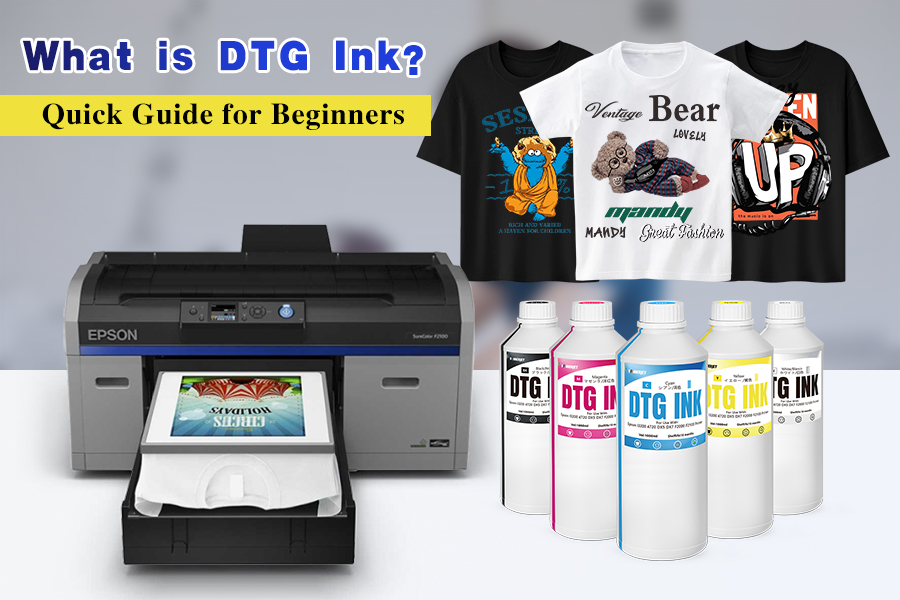
DTG ink is specifically developed for DTG printing technology. It is a water-based textile ink that allows designs to be printed directly onto garments using a DTG printer, without the need for transfer films or cutting materials.
In simple terms, DTG printer ink is a water-based ink specially designed for direct printing on cotton and high-cotton-content garments. Because it is water-based, many people wonder about its safety and suitability for direct skin contact. The answer is yes — DTG ink is primarily water-based, has low odor, is user-friendly in operation, is not solvent- or oil-based, and complies with mainstream textile environmental standards (such as OEKO-TEX and REACH).
These properties make DTG ink not only capable of producing highly detailed, accurate prints but also highly suitable for T-shirts, custom garments, and other personalized printing applications that require comfort and safety.
Not sure if DTG is right for you? Read our latest DTG vs Heat Press comparison to see which fits your production cost better.
2. What is DTG Ink Mainly Used For?
DTG ink is widely used in garment printing, especially for small-batch and personalized orders. It is typically used for custom T-shirts, short-run garments, and designs requiring photo-quality color effects.
Additionally, DTG ink is valuable for sample prints, quick turnaround custom orders, and e-commerce POD (Print on Demand) business, providing flexible and efficient printing solutions.
Compared to other printing methods, DTG technology’s main advantage is not speed, but the ability to reproduce every detail and color accurately. Whether it’s small text, complex gradients, high-resolution images, or multi-color designs, DTG ink delivers precise results.
This high fidelity and detail reproduction make DTG ink the top choice for small custom factories, independent brands, and personalized e-commerce sellers. It ensures vibrant patterns while maintaining high-quality output in small-batch, multi-style production, outperforming traditional transfer or screen printing in complex designs and short-run production, allowing businesses to flexibly meet customer demand.
3. What Fabrics Can DTG Ink Print On?
One of the most common questions for new merchants is: Which fabrics is DTG ink suitable for? Fabric choice directly affects print quality, color performance, and durability.
Overall, DTG ink is best suited for cotton and high-cotton-content blended fabrics:
- 100% Cotton
- Cotton fibers have the best absorption for water-based ink, ensuring strong adhesion.
- Prints are vibrant and detailed, remaining stable even after multiple washes.
- Ideal for gradients, high-resolution images, and multi-color complex patterns.
- High Cotton Blends (80%+)
- Cotton blended with other fibers still maintains good ink absorption.
- Slightly lower print quality than pure cotton but suitable for small-batch and POD business.
- Dark-Colored Garments
- Pretreatment is usually required to ensure an even white ink layer.
- Improves print vibrancy, making colors brighter and more durable.
- Non-Cotton Fabrics (Polyester, Nylon, etc.)
- Synthetic fabrics absorb water-based ink poorly, resulting in weaker adhesion, print quality, and durability.
- If your business mainly uses polyester, DTG may not be the optimal solution; consider other printing methods.
By choosing fabrics wisely and using proper pretreatment, you can maximize print quality and ensure high-quality output for small-batch, multi-style custom garments.
4. How is DTG Ink Different from Other Printing Inks?
Many merchants compare ink types based on detail reproduction, fabric compatibility, and production efficiency:
- Directly prints on garments without transfer film.
- Ideal for small-batch, multi-design custom orders.
- Accurately reproduces small text, gradients, and high-resolution images.
- Suitable for cotton and high-cotton blends; dark garments require pretreatment.

- Prints on transfer film first, then heat-transfers to garments.
- More versatile across fabrics (cotton, polyester, nylon).
- Better for batch production and large orders.

- Only for light-colored polyester and specific fabrics.
- Transfers ink via high-temperature sublimation.
- Produces vibrant and permeating colors but not suitable for cotton or dark fabrics.

- UV-cured printing on various materials (textiles, plastics, wood, metal).
- Less strict on fabric type, but may affect softness/flexibility on garments.
- Better for personalized hard goods or crafts, not primarily for bulk garment production.

If you’re deciding between high-detail prints and fabric versatility:
- DTG ink favors precision and color fidelity
- DTF favors fabric compatibility and batch production
- Sublimation favors light polyester prints
- UV ink favors hard or non-traditional materials
For merchants pursuing small-batch, multi-design, high-precision prints, using high-quality DTG ink (such as Winnerjet DTG series) ensures clear patterns, vibrant colors, and smoother printing workflow.
5. What Equipment Does DTG Ink Require?
DTG ink cannot be used on ordinary inkjet printers. Proper equipment ensures optimal print quality, color stability, and printer longevity.
DTG ink typically requires:
- Dedicated DTG Printers
- Designed for textile direct printing with suitable printhead structures, ink channels, and white ink systems.
- Supports small-batch, multi-design customization, ensuring detail and gradient fidelity.
- Modified or Industrial Epson Printing Platforms
- Examples: i3200, 4720 industrial printhead solutions, which can be converted for DTG use.
- Suitable for medium to large-scale custom factories, supporting stable white ink circulation and stirring systems to reduce clogging and maintenance.
- Stable White Ink Circulation and Stirring Systems
- White ink sedimentation is a common issue for water-based DTG ink.
- Proper circulation and stirring ensure even white ink concentration, prevent clogging, and maintain color consistency and durability.
Common applications include:
- Epson F-Series DTG printers – suitable for small-scale custom and POD business
- i3200 / 4720 industrial DTG solutions – suitable for batch production and factory-grade printing
6. Who is Best Suited for Using DTG Ink?
DTG ink is ideal for users pursuing small-batch, personalized, and high-precision printing. It is particularly suitable if you:
- Are new to garment digital printing
- DTG is relatively easy to operate, no prior screen printing or transfer film experience needed.
- Enables new merchants to start custom printing with small batches.
- Plan for small-batch or POD orders
- Flexible for limited quantity, multiple designs without large inventory.
- Ensures print quality and color consistency even for small runs.
- Value pattern detail and color fidelity
- DTG ink reproduces fine text, gradients, high-resolution images, and complex multi-color designs.
- Perfect for independent brands or custom sellers seeking high fidelity.
- Don’t want to stock large inventory
- Print on demand, no need for pre-stocking garments or transfer films.
- Reduces inventory pressure and capital tied up.
Conversely, if your business focuses on:
- Large-scale production
- Extremely low per-unit cost
- Universal fabric compatibility
DTG may not be the best choice; consider DTF, sublimation, or other industrial printing processes.
Conclusion:
Cost Analysis: DTG Ink Consumption Per T-Shirt
For small businesses, cost is everything. On average, a full-size A4 color print on a dark T-shirt (requiring white ink underbase) uses about 1.5 ml to 2 ml of DTG ink.
Ink Cost: Depending on the brand, the ink cost per shirt typically ranges from $0.30 to $0.60.
Pro Tip: To maximize ROI in 2026, use high-quality RIP software to precisely control ink droplets and reduce waste by up to 15%.
Compatibility: Best Printheads for DTG Ink
DTG ink is water-based and requires specific hardware to ensure longevity.
Top Choice:Epson i3200-A1 and Epson L1800/XP600 remain the industry standards for small to medium DTG setups due to their excellent color reproduction.
Stability: Ensure your ink is specifically formulated for your printhead model to avoid chemical reactions that can cause internal damage.
Maintenance: How to Prevent Clogged Nozzles
Clogging is the biggest challenge for DTG users. Follow these three rules to keep your printer healthy:
- Daily Agitation: White DTG ink contains titanium dioxide, which settles quickly. Shake your ink tanks gently every morning for 30 seconds.
- Humidity Control: Keep your workspace humidity between 40% and 60%. If the air is too dry, ink will dry inside the nozzles instantly.
- Wet Capping: Always perform a “wet cap” procedure or a daily nozzle check. Never let the printer sit idle for more than 48 hours without a cleaning cycle.
FAQ
Does DTG ink require pretreatment?
Dark garments usually require pretreatment; light-colored cotton is optional.
Are DTG prints washable?
With correct pretreatment and curing, wash resistance meets commercial requirements.
Can DTG ink be used with DTF ink?
No. The two inks have completely different formulations, rheology, and applications.
Is DTG ink suitable for beginners?
Yes, but understanding pretreatment and white ink maintenance is necessary.
Can DTG ink print on dark garments?
Yes, but it depends on the white ink layer and pretreatment quality.
Is DTG ink water-based?
Yes, professional DTG inks are water-based pigmented inks. They are specifically formulated to bind with natural fibers like 100% cotton, ensuring a soft hand-feel, excellent breathability, and compliance with eco-friendly production standards.