When setting up a small studio, choosing an A4 DTF printer is about reliability, not just size. As the 2026 DTF printer price trends show, A4 remains the top choice because it covers most designs without straining your cash flow.
However, the price of an A4 DTF printer can be misleading. A ‘cheap’ machine often conceals high maintenance costs and unreliable white ink systems. This guide cuts through the noise to show you: current market pricing for 2026 and configurations that actually save you money.

2026 A4 DTF Printer Price Range
In 2026, A4 DTF printer prices can roughly be divided into entry-level and mid-range categories. Not only do the listed prices vary significantly, but more importantly, there are substantial differences in stability, white ink circulation, consumable compatibility, and subsequent maintenance costs. For small entrepreneurs or studios, simply comparing prices can easily overlook long-term costs. We will analyze from three dimensions: price, target users, and actual pros and cons, and provide practical references.
Entry-Level A4 DTF Printer Prices
Entry-level A4 DTF printers generally fall into two types: converted models around USD 300–800 and low-cost native desktop models around USD 500–1,000. This price range is mainly targeted at side-business sellers, beginners, or small studios with low or occasional order volumes. They are usually modified from ordinary inkjet printers, or use low-cost native desktop designs. White ink is mostly passively stirred or simply circulated. Printing speed and continuous work capacity are limited, and most devices still require drying and powder-shaking equipment to complete the entire DTF transfer process.
Although entry-level models have a low initial investment, there are some potential issues in actual use: white ink settles quickly, clogging risk is high, compatibility with ink and film is demanding, continuous printing capacity is weak, maintenance is frequent, and long-term use can easily lead to unstable colors or high waste rates. Therefore, when purchasing, you should consider not only the listed price but also long-term stability and consumable compatibility.
Among many entry-level models, the Prestige A4 DTF Printer (Epson L805 desktop series) is a typical choice. Its white ink circulation system is relatively complete, clogging risk is low, compact, and easy to use, making it very suitable for beginners or side-business users with small order volumes. Its drawbacks are moderate printing speed, still requiring drying and powder-shaking equipment, and some reliance on consumables. The reference price is about USD 1,700–2,000, slightly higher than basic converted models, but more stable and worry-free in long-term use.
Mid-Range A4 DTF Printer Prices
Mid-range A4 DTF printers are generally priced at USD 1,200–2,500, mainly aimed at small studios, long-term operating businesses, and custom orders with stable volume. Compared with entry-level machines, mid-range models are usually native DTF desktop designs, equipped with automatic white ink circulation and stable motherboards, better consumable compatibility, and capable of continuous printing, making them more suitable for daily order production.
The pros and cons of mid-range models are clear. Advantages: high equipment stability, low maintenance frequency, strong continuous printing capability, wide consumable compatibility, and more controllable long-term costs. Disadvantages: higher initial investment than entry-level models, and still require basic accessories such as drying and powder-shaking equipment.
In the market, the Galaxy F8 Panda A4 DTF Printer is a typical mid-range choice. Reference price: USD 1,200–1,500.
Pros: stable continuous printing, complete white ink circulation system, suitable for studios with frequent orders.
Cons: moderate printing speed, still cautious when using low-quality consumables.
While a dtf printer under $500 is tempting for beginners, these modified units often hide high costs in frequent head clogs and wasted ink. Investing in a stable, professional A4 system is a smarter business move—it trades a slightly higher upfront price for the reliability and “plug-and-play” performance you need to actually stay profitable.
A4 DTF Printer + True Cost of Accessories
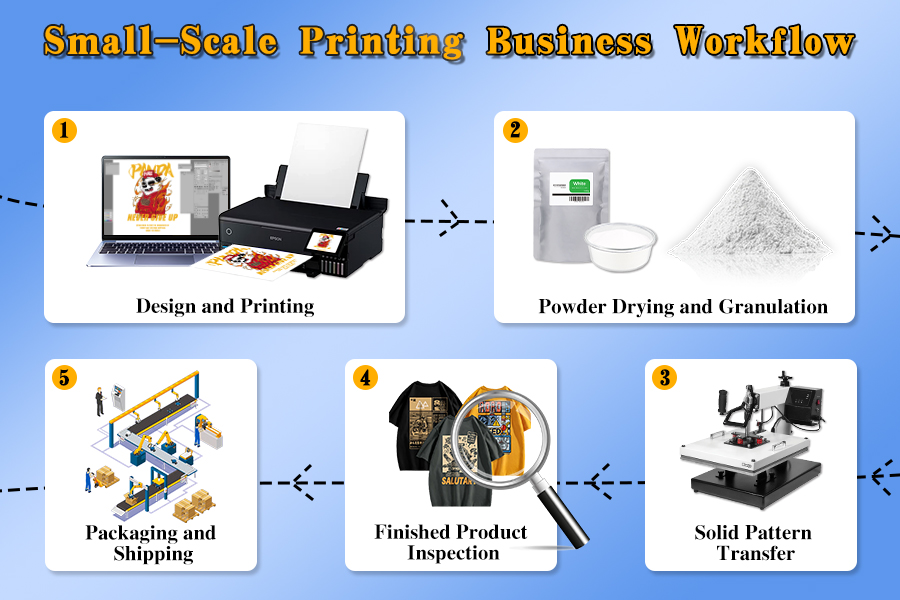
Many buyers focus only on A4 DTF printer price, overlooking the actual cost of completing the DTF process. In addition to the printer itself, actual investment includes:
- Drying / powder-shaking equipment
- DTF ink (CMYK + White)
- DTF transfer films
- Hot melt glue powder
Different product types have obvious differences in requirements for accessories and consumables:
- Entry-level converted machines: cheap equipment, but high consumable compatibility requirements, frequent maintenance, limited long-term stability
- Native entry-level / mid-range machines: slightly more expensive equipment, but good compatibility, stable output, lower long-term cost
The following table provides a clearer comparison of initial investment and long-term costs for different product types:
| Product Type | Machine Price (USD) | Recommended Use | Pros | Cons | Estimated Total Investment (incl. consumables & equipment) |
|---|---|---|---|---|---|
| Entry-level Converted | 300–800 | Side business / beginners | Low initial investment | High clog risk, weak stability | 500–1,000 |
| Low-cost Native | 500–1,000 | Small order studio | Easy to use, moderate stability | Limited continuous printing | 800–1,500 |
| Mid-range | 1,200–2,500 | Stable small studio | High stability, low maintenance | High initial investment | 1,500–3,000 |
From the table, the entry-level converted machine with the lowest initial investment is not necessarily the most economical due to high maintenance and strict consumable requirements. Mid-range machines, although higher upfront, clearly have advantages in stability and long-term cost, making them more suitable for small studios with stable orders.
For instance, if you are scaling your business in the South Asian market, understanding the latest dtf printer price in pakistan is crucial for budgeting, as localized logistics and duty structures play a huge role in your final ROI. Similarly, for entrepreneurs in the Middle East looking for high-end stability, checking the current dtf printer price in qatar will help you compare international industrial standards against local retail offers.
By comparing these regional benchmarks, you can better identify if a local deal is a bargain or a hidden trap.
What Counts as “Best Value” for Small Businesses?
When selecting an A4 DTF printer, many small businesses focus solely on “price” and overlook core factors that affect cost and efficiency. Best value is not the cheapest, but a printer that allows smooth production, minimizes downtime, and earns long-term profit. Small studios can evaluate using these key dimensions:
- Printing stability: Can it work continuously, and are colors consistent? Even a low-priced machine can cost more in the long run if it frequently malfunctions.
- White ink system: Automatic circulation or manual stirring? White ink settling and clogging directly affect efficiency and waste.
- Maintenance & downtime cost: Cleaning, waste handling, and equipment failure. Small businesses fear “machine downtime.”
- Ease of use: Beginner-friendliness matters. Complex machines can increase learning curve and trial costs.
- Technical & after-sales support: Can the supplier provide timely support and consumable compatibility advice? Experience shows that reliable support can save significant time and costs.
From our experience supplying DTF ink and consumables to small studios, stability is more important than specs. A printer with slightly higher initial cost but stable, low-maintenance, and consistent output can save more time, consumables, and labor over six months or a year than a cheap machine that frequently stops working.
Best value for small businesses means “easy to use, consistent output, long-term worry-free,” not simply the lowest price.
A4 vs A3 DTF Printers: Which is Better for Small Businesses?
The main difference between A4 and A3 DTF printers is print size and order handling capacity. A3 can print larger items, but costs, consumables, and operational complexity are higher. A4 printers are smaller, cheaper, and more flexible for small studios.
Initial investment: A3 printers are more expensive and require more supporting drying and powder equipment. A4 machines are lighter on hardware investment, suitable for small-budget or early-stage businesses.
Order type & size: If your main orders are T-shirts, tote bags, or small personalized gifts, A4 is sufficient. A3 is more suitable for large batches or oversized items, but less advantageous for small or varied orders.
Space, power, and complexity: A3 printers require larger workspace and stable power, with more complex operation and maintenance. A4 printers are desktop-friendly, simpler to operate, and easier to maintain.
When A4 is more rational:
- Small or irregular order volume
- Main product size within A4
- Limited space and budget
- Quick start, minimal training required
Overall, for most small or early-stage custom printing businesses, A4 DTF printers are the most rational and cost-effective choice, balancing cost, operational convenience, and maintenance while meeting most daily order needs.
Hidden Costs of A4 DTF Printers
When buying A4 DTF printers, many small studios focus only on price, ignoring hidden factors affecting cost and efficiency. Low-priced machines often incur extra expenses, making long-term cost higher than the initial investment. Key hidden costs include:
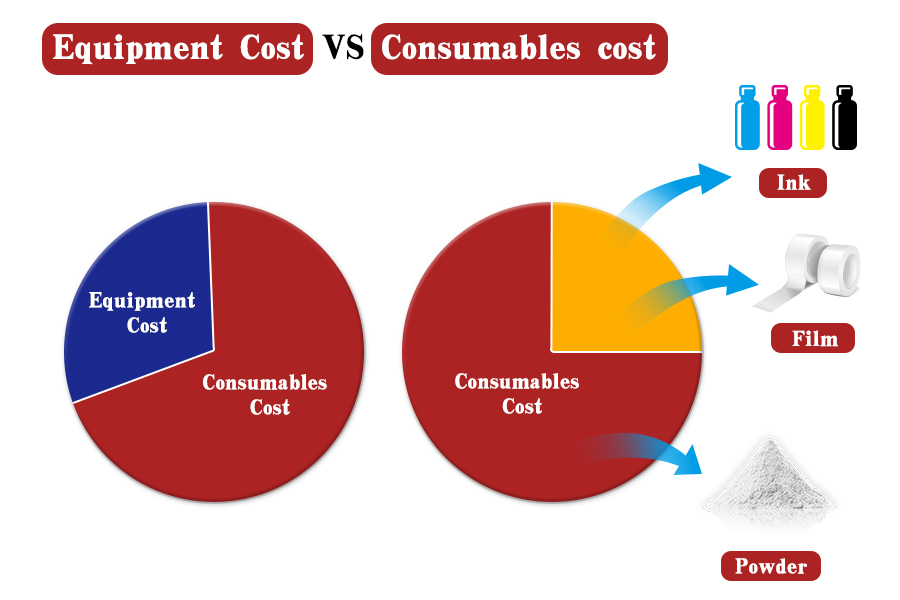
- Ink stability affecting nozzle life: White ink settling or coarse particles can clog nozzles, causing frequent cleaning, downtime, or equipment damage. Stable ink ensures print quality and longer nozzle life, reducing unexpected maintenance costs.
- Film compatibility affecting waste: Incompatible transfer films can peel, produce unclear patterns, or cause color deviation, increasing waste and rework. Choosing compatible films reduces loss and saves time.
- Cleaning, maintenance, and downtime: Entry-level machines require frequent cleaning and maintenance, taking up time and potentially delaying orders.
- Low-priced equipment ≠ low long-term cost: Machines with unstable performance or poor consumable compatibility may generate higher consumable, repair, and labor costs over time.
In practice, consumable selection and maintenance practices are often more important than machine price. A slightly more expensive printer with stable ink, compatible films, and easy maintenance provides controllable long-term costs and allows small studios to focus on orders and output rather than equipment problems.
Choosing A4 DTF Printers for Different Business Stages
Different stages of small printing businesses have different A4 DTF printer needs. Choosing the right equipment helps control cost and improve efficiency and output stability.
Beginners / Side Hustlers
- Avoid large upfront investment
- Prioritize easy-to-use, low-maintenance printers with reliable white ink
- Moderate speed is acceptable for small orders
Small Printing Studios
- Stability and consistency are priorities
- Mid-range A4 printers with auto white ink circulation, continuous printing, and good consumable compatibility are suitable
- Don’t be misled by “high-speed” specs if they lead to high waste or downtime
Sample / OEM Customers
- High color accuracy and repeatability required
- Choose mid-range or native desktop models with stable output and complete white ink circulation
- Reduces rework and waste, improves customer satisfaction, lowers long-term operational risk
Tip: Core principle is “invest according to needs, maintain stable output, long-term worry-free.” Beginners: low-cost, easy-to-use; small studios: continuous printing, consumable compatibility; OEM: color accuracy and repeatability. Understanding your business stage ensures the right machine purchase, not blindly chasing price or specs.
Common Mistakes When Buying A4 DTF Printers
- Comparing only price, ignoring consumable cost: Cheap machines can have high waste and consumable expenses
- Ignoring after-sales and technical support: Downtime delays production
- Underestimating white ink maintenance: White ink settles quickly, clogs easily; many low-priced machines lack auto circulation, causing frequent cleaning and downtime
- Buying oversized machines before business stabilizes: High-end or large-format machines may not match actual order volume, leading to low usage and slow ROI
Experience summary: Selecting A4 DTF printers requires considering price, consumable cost, maintenance convenience, after-sales support, and actual order needs. Understanding these common mistakes helps small studios avoid pitfalls and maximize ROI.
Conclusion & Recommendations: Choosing the Right A4 DTF Printer for Your Small Business
As analyzed, A4 DTF printers generally range USD 300–1,000 (entry-level) and USD 1,200–2,500 (mid-range). The key point: best value ≠ lowest price, but a combination of stability, reliable white ink, consumable compatibility, and long-term operational cost. Only machines that produce consistently and match consumables can truly bring profit.
Recommendations for different stages:
- Control risk: choose stable, easy-to-use models first
- Upgrade gradually: consider high-end or larger formats after orders stabilize
- Focus on long-term cost: consider consumables and maintenance, not just machine price
📌 Take action:
- Request free DTF ink samples
- Consult consumables suitable for your printer
- Get A4 DTF printing cost evaluation sheet
Choosing the right equipment ensures every investment delivers maximum value.We offer international shipping, including to Qatar and the Middle East.
2026 Market Outlook: A4 DTF Printer Price Trends
As we head into 2026, the A4 DTF market is shifting toward higher automation at lower costs. Here’s what to expect:
Price Drop: Increased competition is expected to bring entry-level A4 DTF bundle prices down by 10-15%.
Tech Upgrade: “All-in-one” mini systems with integrated powder shaking will become the new standard for small businesses.
Lower Running Costs: Advancements in ink efficiency and film coating will further reduce the cost per print in 2026.