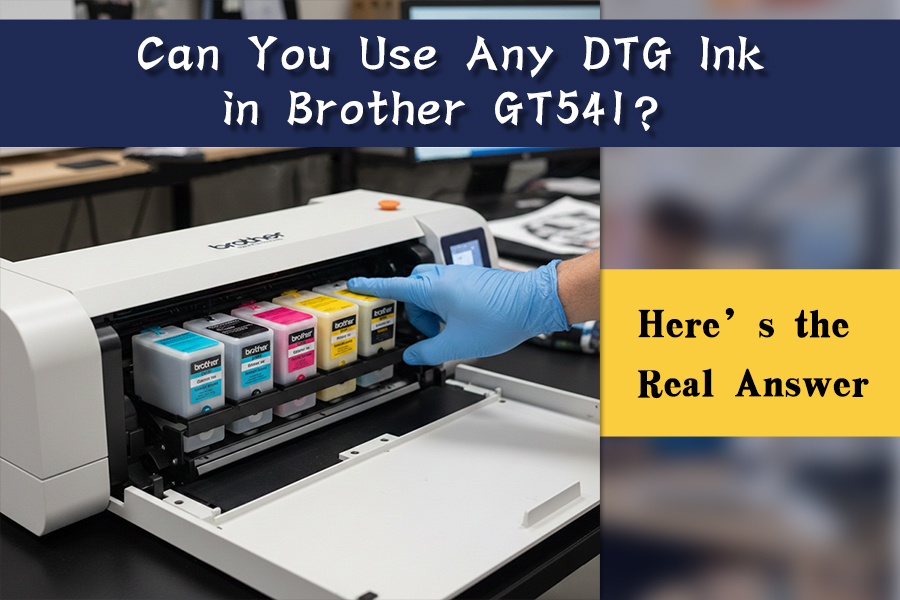
Brother GT541 cannot use “any” DTG ink. Even though they are all called DTG ink, it does not mean they can be freely swapped or mixed. This is not a matter of brand preference, but a clear compatibility issue—determined by the GT541’s ink supply system design, printhead tolerance, and differences in ink formulation. Ignoring this may allow short-term printing, but in the long run, risks usually manifest as printhead damage, increased maintenance costs, or even equipment failure.
We will help you answer a core question by examining the physical properties of DTG inks and their practical consequences: Can Brother GT541 really use “any DTG ink”?
Why, if they are all DTG inks, can’t GT541 use them freely?
Many users are confused: if they are all called DTG ink, why is there a distinction between usable and non-usable inks? The key reason is that DTG ink is not a highly standardized consumable category. In practical industrial use, different brands or types of DTG ink differ significantly in core physical parameters, such as viscosity range, pigment particle size and distribution stability, dispersant and anti-settling system design, printhead pass-through capability, and long-term retention risk.
The Brother GT541 is not an open ink platform. From the beginning, it was designed assuming the ink used would remain within a very narrow physical range, which is why original inks are stable, and using other brands carries high risk. In other words, even if other inks are called DTG ink, if their viscosity, dispersant system, or settling characteristics fall outside the GT541’s design window, they can cause printhead clogging, ink path contamination, or unstable print quality.
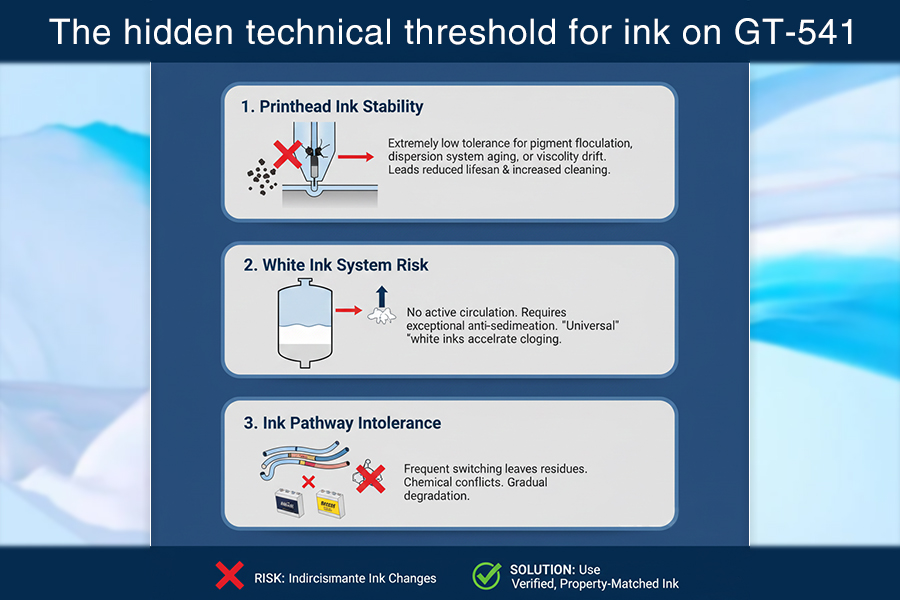
The hidden technical threshold for ink on GT541
The reason GT541 cannot freely use other DTG inks lies in its strict requirements for ink physical properties, which most users and even many sellers do not explicitly mention. The printhead has very low tolerance for ink instability. The GT541 printhead system is calibrated for early DTG architectures and is extremely sensitive to slight pigment flocculation, aging of the dispersant system, or viscosity drift during downtime. Even if these issues do not immediately cause printing interruptions or clogs, they gradually shorten printhead lifespan and increase cleaning and maintenance frequency.
The white ink system is the highest-risk component. Unlike color inks, it lacks active circulation or continuous stirring, so white ink must have strong anti-settling ability. Many “universal” DTG white inks on the market are designed for newer machines with white ink circulation. Using them in a GT541 often accelerates settling, clogs white printheads first, increases cleaning frequency, and may lead to irreversible damage to the white printhead.
The ink path design of GT541 is also not suitable for frequent switching between different ink systems. Using incompatible inks can leave residual dispersants, and different ink systems may chemically interact, with cleaning solutions unable to completely remove hidden deposits. These problems may not trigger immediate alarms but accumulate over months, eventually affecting print quality and machine longevity.
The hidden technical threshold of GT541 manifests in three areas: strict printhead tolerance for ink stability, dependence of the white ink system on anti-settling properties, and low tolerance of the ink path for different ink systems. This explains why original inks are stable while random replacement with other DTG inks carries high risk. Understanding these limitations is essential to prevent equipment damage and production risk from blind ink substitution.
Why short-term usability does not equal safety
Many users see others swapping DTG inks and still printing normally, mistakenly believing “compatibility is fine,” which is a dangerous misconception. GT541’s ink compatibility issues usually present as cumulative damage, not immediate failure. Short-term printing may appear fine, printheads may not clog, and prints may look acceptable, but over time, problems gradually emerge.
Symptoms include white ink clogging first, uneven or broken printing from printheads, increased cleaning frequency, and gradual deposition inside ink paths and cartridges, eventually causing permanent printhead damage. Even if no obvious issues appear in the first weeks or months, internal damage may already be occurring, often irreversible, and may result in production downtime, higher maintenance costs, or complete machine failure.
Therefore, “short-term usability” cannot be taken as a safety indicator. GT541 was designed for long-term use within a specific ink property range, not for frequent experimentation or random brand changes. Understanding this is critical for protecting device lifespan, reducing maintenance costs, and ensuring long-term production stability.
Safe operation and feasible solutions for GT541
For GT541 users, the main concern is how to reduce costs while ensuring long-term machine stability. GT541 is not an open ink platform, and it performs best with inks within a specific physical range. Long-term testing and extensive user feedback show that Winnerjet’s compatible DTG inks can run stably in the GT541’s printheads and ink paths, maintaining consistent performance for both color and white inks, making them a reliable choice for small factories and custom studios.
Practically, it is recommended to adopt a phased ink replacement approach. Start with compatible color inks, monitor printhead status, cleaning frequency, and print quality, and then decide whether to switch white ink. Winnerjet inks have proven stable under continuous testing, significantly reducing the risk of printhead clogs or ink path contamination, providing predictable machine longevity. Long-term operating studios confirm that printing quality remains consistent while overall maintenance costs decrease.
Additionally, some seemingly cost-saving practices are actually high-risk, including mixing different brands, adding new ink without completely flushing old ink, choosing solely by price without considering physical compatibility, or ignoring white ink requirements. Using verified Winnerjet inks avoids these hidden risks, allowing GT541 to run stably, balancing production efficiency and cost, and protecting machine longevity.
In summary, the core principle for GT541’s safe operation is: use only verified, physically compatible inks and operate in phases. Following this principle extends machine lifespan and ensures printing stability and long-term production efficiency.
Original vs Winnerjet Compatible Ink
The GT541 is a workhorse, but its non-circulating system demands ink with perfect viscosity and stability. Here is how we bridge the gap between “budget” and “premium quality.”
1. The Real Margin Booster
Switching to Winnerjet’s specialized GT-series ink allows you to slash your consumable costs by 40% to 60%. In the competitive DTG market of 2026, these savings are what turn a “break-even” month into a “high-profit” month.
2. Why Trust Winnerjet? (15+ Years of R&D)
Not all compatible inks are created equal. Winnerjet sets the standard through:
Nano-Grade Filtration: Our ink particles are strictly kept under 100nm, ensuring zero clogging for the sensitive 600dpi Brother heads.
Plug-and-Play Color: Formulated with premium imported pigments, our ink matches the OEM color gamut by over 98%. No new ICC profiles needed.
Industrial Wash Fastness: Tested to exceed Level 4 washability, ensuring your prints stay vibrant after dozens of laundry cycles.
3. Comparison: OEM vs Winnerjet
Pro Tip from Winnerjet: For out-of-warranty GT541 units, the “Budget Approach” is a no-brainer. The savings generated within 6 months of using Winnerjet ink are often enough to pay for a brand-new replacement printhead if needed. Maximize your ROI, not your expenses.
Summary and action suggestions
For GT541 users, stable, compatible inks matter more than having more brand choices. Random ink swapping may work short-term but increases printhead and ink path wear, affecting print quality and machine lifespan. Winnerjet compatible DTG inks, rigorously tested and validated by repeat users, run stably on GT541, ensuring color and white ink performance while reducing risk.
To extend machine life and maintain production efficiency, it is recommended to use verified compatible inks, replace inks in phases, and define GT541’s core applications. You can Request a Sample or Contact Winnerjet for Ink Compatibility Advice to get professional guidance and safe solutions.