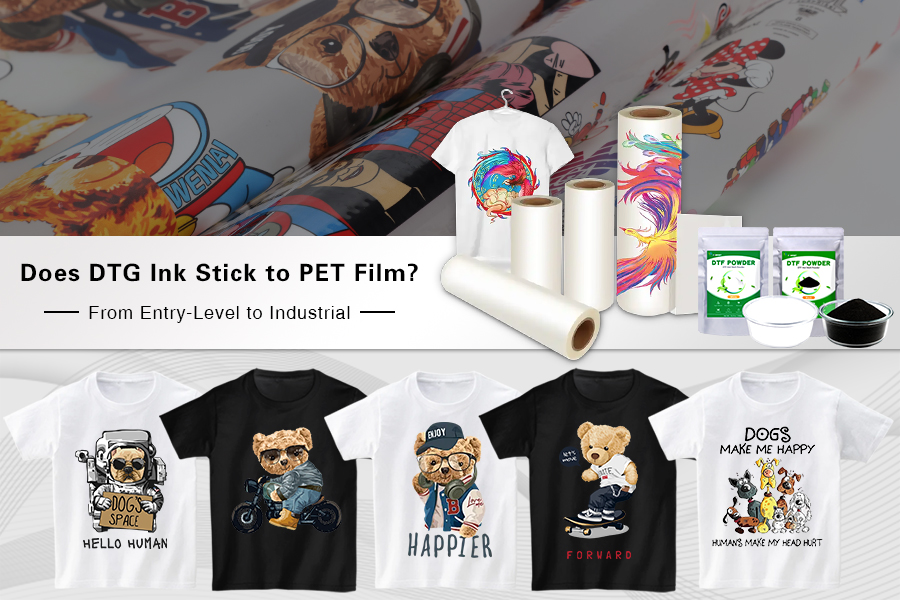
Does DTG ink really stick to PET film? The answer is: Yes—but it requires technique.
Many DTG users (especially those using Epson or Brother platforms) are breaking the “cotton-only” curse by adopting a hybrid process known as DTG-to-Film. However, the water-based nature of DTG ink means it can easily bleed or fail to grab the powder when applied to plastic film. This guide provides a complete, commercial-grade roadmap to help you avoid common pitfalls, covering everything from ICC profile calibration to lab-tested washability, ensuring a low-cost yet high-quality technical upgrade.
I. Unlocking a New Skill (Beginner Tier)
If you are just starting out, you first need to understand the physical properties of DTG ink: it is water-based, specifically designed to be absorbed into cotton fibers. PET film, on the other hand, is plastic. These two are naturally incompatible. Therefore, you need two “secret media” to build a stable bonding layer:
Dedicated DTF Coated Film: Forget standard plastic films. You must use PET film with a high-molecular weight ink-absorbent coating. This coating acts like billions of microscopic sponges, instantly locking in the wet DTG ink to prevent bleeding.
TPU-Grade Hot Melt Powder: This is the “bridge” that grafts the ink to the garment. High-quality TPU powder liquefies quickly at medium temperatures and provides excellent elasticity once cured.
Simple Workflow:
- Mirror Printing: Enable mirror mode in your RIP software.
- Powdering: Immediately after printing, evenly apply the hot melt powder while the ink is still wet, ensuring the white ink layer is completely covered.
- Curing: Bake in an oven at 140°C–150°C (285°F–300°F) for approximately 2 minutes, or until the powder reaches a semi-transparent “orange peel” texture.
- Heat Transfer: Press at 160°C (320°F) for 15 seconds. Allow it to cool completely before performing a slow cold peel.
💡 Pro Tip: The biggest draw of this process is Zero Pre-treatment! This means you can print high-definition graphics directly onto dark polyester, canvas bags, or even difficult spots like hoodie “dead zones” without leaving awkward press marks or pretreatment stains.
II. Precision & Waste Control in Mass Production (Professional Tier)
For print shops chasing ROI (Return on Investment), stability and color standards are the lifelines. When utilizing existing DTG equipment for transfers, you must compensate for the following two technical factors:
1. The “Critical Threshold” of White Ink Density
DTG white ink is typically thinner (lower viscosity and titanium dioxide content) than dedicated DTF inks to ensure it can penetrate fabric fibers.
- Expert Advice: When printing on film, increase your White Ink Layer to 160% – 200%. Sufficient white ink thickness is necessary not just for vibrant color, but to provide enough “capture depth” for the powder. If the white layer is too thin, you will encounter “pinhole” spotting or peeling after washing.
2. Secondary ICC Profile Calibration
Ink looks different on semi-transparent film than it does on matte cotton fibers.
- Technical Detail: Our testing shows that because PET film is non-absorbent, colors can often appear oversaturated or dark. Professionals should adjust the RIP settings to reduce Cyan and Yellow by 5%–8%. This effectively eliminates common hybrid issues like “reddish skin tones” or loss of detail in highlight areas.
III. Winnerjet Laboratory Data Sharing
The following data is based on 50 standard machine wash cycles, intended to provide you with an authentic production reference.
💡 The Secret to 22% Better Durability: Secondary Pressing
Many users complain that transfers feel stiff or crack after washing. Our lab comparison found a solution:
The Finding: After peeling off the PET film, cover the image with a Teflon sheet or parchment paper and perform a 6-second secondary press.
The Science: The secondary press drives the already-melted TPU powder deeper into the fabric weave. Tests show this step improves color fastness by an average of 22% while making the hand-feel significantly softer.
💡 Humidity: The Invisible “Bleeding” Factor
If you notice ink “puddling” or gathering in beads on the film, it is often not an ink quality issue.
Practical Warning: When ambient humidity exceeds 65%, the static conductivity and drying rate of the PET coating drop significantly.
Professional Solution: Before printing, place the PET film on the open heat press platen (about 4 inches away) for 3–5 seconds to pre-warm. This quickly evaporates latent moisture in the coating, ensuring razor-sharp ink drops.
IV. Decision Reference: DTG Direct vs Hybrid Transfer
In real-world production, the choice isn’t always black and white. We analyze the differences between DTG Direct and Hybrid Transfer (DTG-to-Film) across three dimensions:
1. Process & Fabric Compatibility Table
| Evaluation Metric | Traditional DTG Direct | Hybrid Transfer (DTG-to-Film) | Expert Insights |
|---|---|---|---|
| Fabric Compatibility | Limited to 80%+ high-cotton blends | All Materials (Cotton, Poly, Nylon, Blends) | Hybrid solves the dye migration issue on polyester by using TPU powder to lock the ink. |
| Pre-treatment | Required (Tedious & leaves marks) | Zero (Plug-and-play) | Skipping pretreatment saves an average of 1.5–2 mins per garment and avoids “box” marks on dark fabric. |
| Color Performance | Affected by fabric color and texture | Extremely Stable (High-opacity white base) | Film transfers offer more controllable color accuracy for brand orders with strict Pantone requirements. |
| Print Placement | Limited by platen and garment size | Unlimited (Cut and place anywhere) | Solves the difficulty of printing on sleeves, collars, and zipper edges. |
2. Deep Dive: Why Professional Shops Prefer the Hybrid Solution
Beyond the physical specs, the Hybrid solution offers two revolutionary changes in business operations:
From “Labor Intensive” to “Automated”: Traditional DTG relies heavily on manual labor for pretreatment and alignment. Hybrid allows you to decouple printing from pressing. You can batch-print films at night and finish the orders with a heat press during peak hours.
Restructuring Inventory Logic: With DTG, you need the garment on hand to start. Hybrid allows you to pre-print popular designs and store them as “transfer stickers” (shelf life up to 12 months). When an order arrives, production takes only 5 seconds, drastically reducing cash flow pressure.
3. Wearer Experience: Hand-feel vs Durability
Hand-feel: DTG Direct has the “Zero-feel” advantage, as ink integrates into the fibers—perfect for lightweight summer tees. Hybrid transfers have a very thin, elastic film feel. Thanks to our Winnerjet Nano-grade TPU powder, this feel is minimized and remains crack-resistant under tension.
Durability: Direct prints fade as fibers wear down; Hybrid transfers maintain over 90% color saturation after 50 washes, provided the secondary press technique is used.
V. Storage & Environmental Recommendations
In the Hybrid process, the high water content of DTG ink makes it far more sensitive to the environment than traditional methods. Here are three core dimensions for maintaining high-quality output:
1. Long-term Storage of Semi-finished Transfers
How long can a printed, powdered, and cured film be stored?
Shelf Life: In a controlled environment (humidity <50%), cured PET films can be stored for 6–12 months without degrading.
The Pain Point—Moisture & Bubbling: Both the powder and the coating are hydrophilic. If exposed to humid air, the powder absorbs moisture. During heat pressing, this moisture vaporizes, leading to bubbles or peeling.
Expert Advice: Once cooled, store films in airtight, light-proof bags with desiccant packets. Store them away from floors or water sources to prevent condensation caused by temperature swings.
2. The “Golden Rule” for Temp & Humidity
The inkjet system inside a DTG printer is highly sensitive to temperature, which directly affects ink fluid dynamics.
Optimal Temperature (20°C – 28°C / 68°F – 82°F):
Too Low: Ink viscosity increases, putting a heavy load on the piezo printhead, leading to “clogging” or misfiring.
Too High: Water evaporates too quickly, which can cause ink to film over on the nozzle surface and prevent the powder from properly sticking to the coating on the film, resulting in “pinholes.”
Optimal Humidity (40% – 60%): Low humidity causes ink to dry out; high humidity makes the PET coating “tacky,” reducing print precision.
3. Static Management: Killing the “Scattered Powder” & “Deflection” Issues
PET film is an insulator and easily generates static electricity during the feeding process, especially in dry seasons.
The Dangers of Static:
Ink Deflection: Static interferes with the flight path of tiny ink droplets, causing “burrs” or ghosting on edges.
Powder Residue: Static causes powder to stick to non-printed (blank) areas. Even after shaking, you may see “speckles” on the final garment.
Professional Solutions:
Hardware: Use Winnerjet Double-sided Coated Film; the anti-static coating on the back helps discharge friction-built static.
Environment: Place an industrial humidifier near the printer intake to maintain air conductivity.
Grounding: Ensure your DTG equipment is properly grounded to help discharge static safely.
DTG vs DTF Ink Compatibility: Can They Be Swapped?
Chemical Composition Comparison: DTG ink is typically a water-based pigment ink specifically designed for cotton fibers; DTF ink, while also a water-based pigment, contains a higher proportion of resins and binding agents in its formulation to ensure adhesion to PET film and hot-melt powder.
Physical Properties: DTG ink tends to “retract” or “bead up” on PET film, as its surface tension is engineered to penetrate fibers rather than to adhere to smooth film surfaces.
| Features | DTG Ink | DTF Ink |
|---|---|---|
| Primary Use | Direct printing on cotton fabrics | Printing on PET release films |
| Film Adhesion | Weak (prone to beading or peeling) | Strong (specifically for film coating) |
| Stretchability | Extremely High (soaks into fibers) | High (forms a flexible thin layer) |
| Color Saturation | Depends on pretreatment liquid | Extremely vivid without pretreatment |
| Compatibility Result | Not recommended for PET Film | Perfectly optimized for PET Film |
If you are considering upgrading your existing equipment, you can refer to our “Which Printers Can Be Converted to DTF? — A Complete Guide” to learn about the conversion potential of various printer models.
Conclusion: Is This Method Worth It?
For Hobbyists/Startups: This is the most cost-effective way to pivot. You don’t need to invest in a full DTF setup; just swap your film and powder to start taking orders for polyester jerseys, nylon bags, and high-margin custom gear.
For Professional Print Shops: This is the perfect process supplement. It solves the “cotton-only” weakness of DTG machines for small-run, difficult placement, or dark polyester orders. By utilizing idle capacity for pre-printing films, you can significantly increase production flexibility.
🚀 Ready to upgrade your printing game? Don’t settle for “good enough”—strive for commercial-grade perfection.