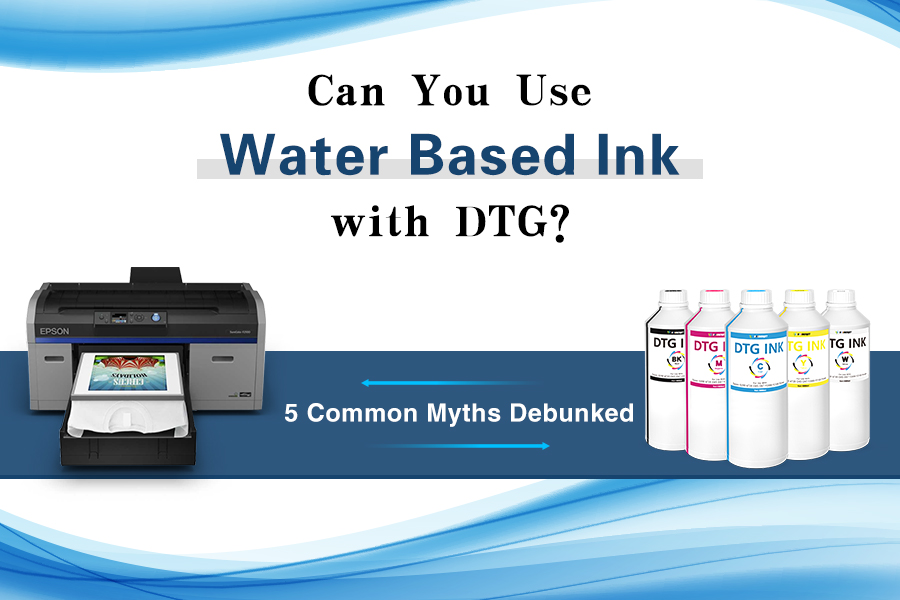
Yes! DTG printing is specifically designed for water-based pigment inks. It offers the best soft-hand feel and eco-friendly results for 100% cotton garments.
DTG inks are industrial-grade aqueous pigment inks specifically engineered for inkjet printheads. They differ fundamentally from ordinary water-based inks in terms of particle size, viscosity, stability, and white ink management. Misunderstanding these differences often leads to more than just poor results—it leads to printhead damage and skyrocketing long-term maintenance costs.
Below, we will break down common myths and real-world scenarios to explain why standard water-based inks aren’t suitable for DTG. We will also provide a practical guide for choosing DTG inks and suppliers to help you avoid costly mistakes.
Myth 1: DTG ink is the same as all water-based inks
Common Question: “Since DTG uses water-based ink, can I just use any water-based ink interchangeably?”
Professional Verdict:
❌ Not Interchangeable
✔ DTG ink is a specialized aqueous pigment ink developed specifically for inkjet printing systems, not a general-purpose water-based ink.
Although DTG ink is water-based in terms of its solvent system, its formula is designed around printhead safety and continuous jetting. It must simultaneously meet strict requirements for particle size control, fluidity, long-term stability, and white ink sedimentation management. These are factors that standard water-based inks (such as those for screen printing or art) simply do not account for.
Differences in Key Parameters:
| Ink Type | Pigment Particle Size | Viscosity | Suitable for Inkjet Heads? |
|---|---|---|---|
| Specialized DTG Ink | Ultra-fine (Inkjet grade) | Low & Stable | ✔ Yes |
| Screen Printing Ink | Coarse | High | ✘ No |
| Artistic Water-Based Ink | Unstable | Uncontrollable | ✘ No |
Myth 2: Water-based screen printing ink can be a temporary substitute for DTG ink
Common Thought: “I already have water-based screen printing ink. Can I use it in my DTG printer just for a bit?”
Professional Verdict:
❌ Cannot be substituted
✔ The design logic behind screen printing ink and DTG ink is completely different.
Screen printing ink relies on a “squeegee push + mesh transfer” process and does not need to be fired through microscopic nozzles. Consequently, its formula typically features:
- Larger pigment particles
- Higher viscosity
- Zero requirement for jetting stability
In contrast, DTG printers use microporous piezoelectric printheads that require extreme fluidity, uniformity, and long-term stability.
Actual risks include:
- Rapid printhead clogging
- Contamination of the ink lines (extremely difficult to clean)
- White ink system failure
- Immediate voiding of official warranties
Core Reminder: 👉 Any water-based ink not explicitly labeled as DTG Ink should never enter a DTG ink system.
Which inkjet printheads support both water-based and dye-based inks?
In the fields of digital and industrial inkjet printing, only industrial-grade printheads featuring internal components made of highly chemical-resistant materials—such as stainless steel flow channels, specialized isolation polymers, and piezoelectric ceramic coatings (e.g., Epson i3200-A1/XP600, Ricoh G5/G6, and Kyocera KJ4B series)—can safely be used interchangeably between water-based pigment inks (DTG/DTF) and dye inks (dye-sublimation). However, in actual operation, a thorough chemical flushing process is mandatory to prevent the two ink types from mixing and causing instantaneous coagulation or clumping; furthermore, both ink types must meet three-stage, nanoscale filtration standards to completely eliminate physical and chemical clogging and ensure the longevity of the printhead.
Myth 3: Water-based ink is more eco-friendly and safer for equipment
Common Misconception: “Since it’s water-based and lacks harsh solvents, it should be friendlier to the printhead, right?”
Professional Verdict:
❌ Safety is not directly related to being “water-based”
✔ Printhead safety is determined by whether the ink uses an inkjet-grade formula.
Many water-based inks not intended for DTG:
- Do not control for conductivity or impurity levels.
- Use additives unsuitable for high-frequency jetting.
- Become unstable under circulation or heat.
These issues may not be obvious in the short term, but during continuous production, they manifest as nozzle dropouts, color shifts, and total nozzle failure.
Core Reminder: 👉 For DTG equipment, “Specialized” is more important than “Water-based.”
Myth 4: If it prints, the ink is fine
Common Judgment: “I’ve test-printed a few shirts and they look okay, so there shouldn’t be a risk.”
Professional Verdict:
❌ This is one of the most dangerous assumptions in DTG.
DTG ink issues rarely explode instantly; they are usually “delayed risks”:
- Normal at first → Nozzle dropouts later.
- Stable for a few days → White ink begins to sediment/settle.
- Single test is fine → Long-term operation gradually damages the printhead.
By the time the problem becomes visible, it is often difficult to trace it back to the “unsuitable ink used weeks ago.”
Core Reminder: 👉 The risk of DTG ink isn’t in the first print; it’s in the 100th print.
Myth 5: All DTG ink brands are essentially the same
Common Perception: “As long as it’s DTG water-based ink, switching brands shouldn’t matter much.”
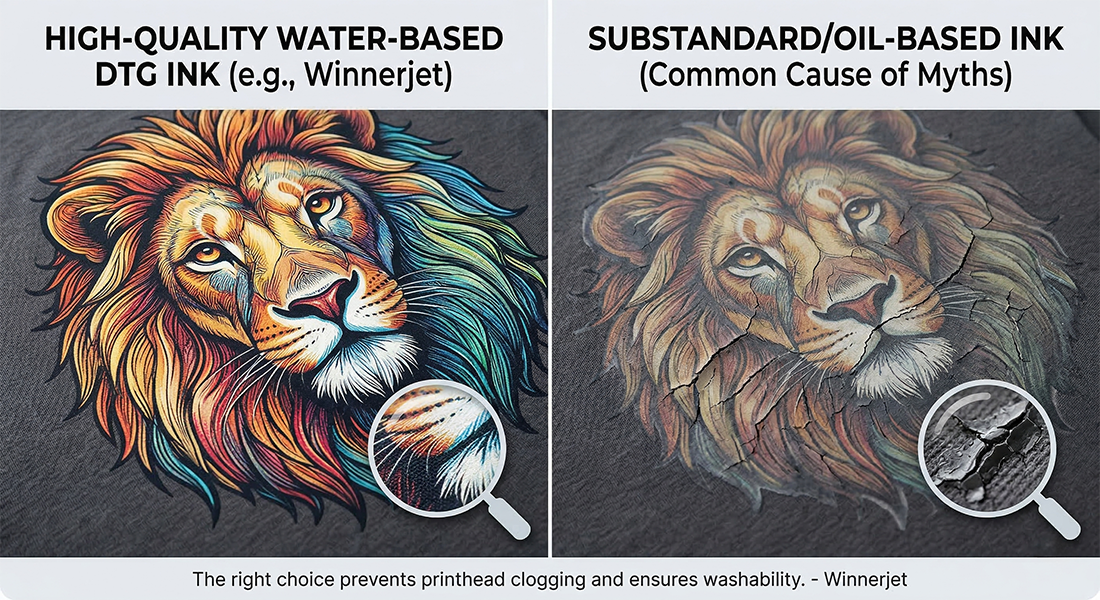
Professional Verdict:
❌ There are huge differences
✔ Different DTG inks vary significantly in their technical focus.
Even among aqueous pigment inks for DTG, brands differ in:
- Compatibility with specific printhead models (Epson / Brother / GTX, etc.)
- White ink anti-settling technology
- Color density and ICC profile matching
- Curing temperature windows
- Stability on dark vs. light fabrics
Choosing the wrong ink might not cause an immediate breakdown, but it directly impacts long-term stability and maintenance costs.
Core Reminder: 👉 Choosing a DTG ink is essentially choosing long-term stability, not just a one-time visual result.
Recommended Premium DTG Water-Based Ink Suppliers
Once you realize you can’t use regular water-based ink, the question becomes: “Which DTG ink should I choose, and how do I pick a supplier?”
Different users have different priorities. These recommendations are based on stability, compatibility, and long-term cost.
1. Winnerjet Specialized DTG Ink (Rating: ★★★★★)
Why we recommend it:
- Specifically developed for DTG systems; highly compatible with mainstream printheads. Excellent performance on both dark and light fabrics.
- Outstanding white ink stability; resistant to sedimentation during long runs, which is vital for continuous production.
- High color saturation and consistent output, ideal for high-quality orders.
- Offers bulk supply, machine-specific matching advice, and technical support—very friendly for factory-level users.
Best for: DTG factories with stable order volumes and users who prioritize color consistency and equipment uptime.
2. Epson Original DTG Ink (Rating: ★★★★☆)
Why we recommend it:
- Genuine OEM ink; offers the most reliable compatibility and stability for Epson DTG machines.
- Accurate color reproduction for users requiring standardized output.
- Helps maintain the original factory warranty.
Best for: Users with Epson DTG printers who want to minimize compatibility risks and prefer “peace of mind” over cost-cutting.
Note: Prices are higher, which can create cost pressure during high-volume production.
3. Third-Party Compatible DTG Inks (e.g., Polyprint / INKSYSTEMS) (Rating: ★★★☆☆)
Why we recommend it:
- More budget-friendly than OEM inks.
- Covers a wide range of DTG models.
Best for: Small to medium shops on a tight budget or startups with fluctuating order volumes.
Advice: Performance can vary by batch. Always perform sample tests for nozzle compatibility and white ink stability before full-scale use.
Pre-Printing Considerations:
Pre-treatment: “Proper pre-treatment is the key to achieving vibrant, eye-catching results with water-based inks on dark-colored garments.”
Curing Process: “A curing process conducted at 160°C ensures that the resins within the ink form a permanent bond with the cotton fibers.”
Nozzle Clogging Prevention: “High-quality water-based inks contain advanced humectants that effectively prevent nozzle clogging during periods of inactivity.”
Durability and Washability: “Proper heat-pressing ensures that the printed design possesses long-lasting durability and exceptional wash resistance.”
Practical Summary: How to choose the right DTG ink and avoid pitfalls?
Only specialized, tested DTG inks can ensure the long-term health of your equipment. The core principle is: Don’t just choose “water-based”—choose “inkjet-ready water-based ink designed for long-term stability.”
Follow this checklist when purchasing:
- Confirm Printhead Type: Epson, Ricoh, and Konica heads have different formula requirements. Know your hardware first.
- Check Supplier Specialization: Reliable suppliers will have case studies for your specific machine and provide technical data.
- Request Samples for Testing: Real-world prints and continuous production runs reveal more about stability than a spec sheet ever will.
- Evaluate White Ink Stability: Ask about anti-settling technology to prevent clogged lines and color fading.
- Confirm Technical Support & Supply: Timely support is crucial when troubleshooting; ensure the supplier has stable pricing and stock to avoid production halts.
For serious DTG businesses, stability and compatibility are far more important than the initial purchase price.
Ready to upgrade your production? If you are looking for long-term stability or need technical advice and sample testing, contact a specialized ink supplier today.
Need a specific recommendation based on your printer model? Tell me your machine model, and I’ll provide a custom list for you.
📌 FAQs – About DTG Water-Based Inks
Can I dilute DTG ink with water?
Not recommended. Inkjet systems require precise viscosity. Dilution destroys the chemical stability and jetting performance.
Are all water-based inks suitable for DTG?
No. Only specialized DTG aqueous pigment inks.
What should I do about heavy white ink sedimentation?
Choose inks with anti-settling technology and ensure your machine’s circulation system is running regularly.
Any recommendations for inks that work across multiple printhead brands?
Winnerjet provides compatible solutions tailored to various specific printhead structures.
What else should I look for when buying ink?
Sample testing, technical service, and supply chain reliability.