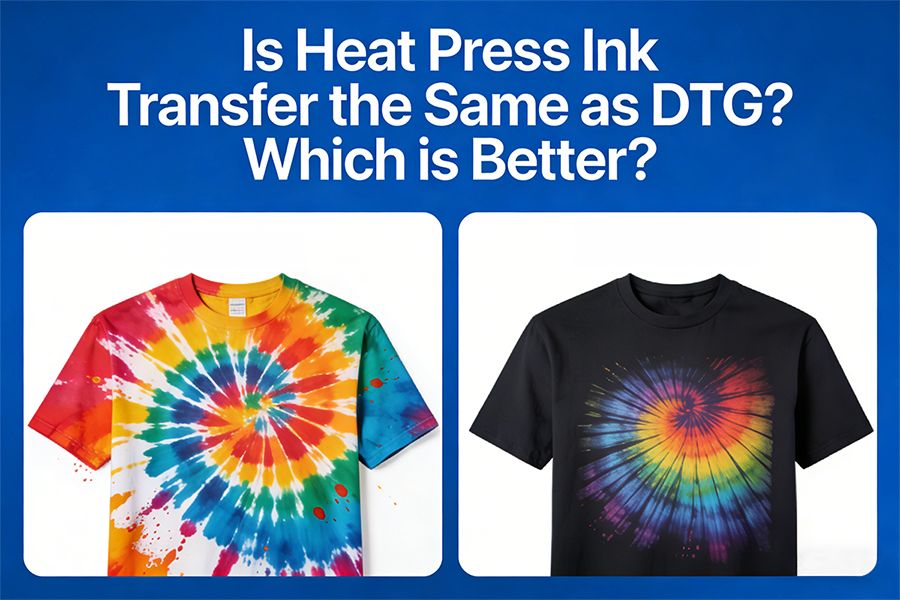
Is heat press ink transfer the same as DTG? The short answer is no.
The main difference between DTG and heat transfer is that DTG injects ink directly into the fabric, making it perfect for soft, detailed designs, while heat transfer uses heat and pressure to apply pre-printed films onto the garment, which is more cost-effective for small batches.
To help you avoid these expensive mistakes, this article breaks down the fundamental differences across three core dimensions: equipment investment, consumable consumption, and real-world applications.
Defining DTG vs Heat Press Transfer
DTG (Direct to Garment): As the name suggests, this is a “direct-to-fabric” process. It works much like a standard inkjet printer, where ink is fired through printheads directly onto the fabric, soaking into the fibers.
Heat Press Transfer (Currently dominated by DTF): This is a versatile, “two-step” process. First, the design is printed in reverse onto a special coated film. After applying a layer of hot-melt adhesive powder, a heat press is used to “transfer” the entire design onto the garment’s surface.
Core Comparison: Is Heat Press Ink Transfer the Same as DTG?
While both can produce full-color prints, they perform very differently in a production environment:
heat transfer vs dtg
| Dimension | DTG (Direct to Garment) | Heat Press Transfer (DTF) |
|---|---|---|
| Fabric Versatility | Limited. Best for 100% cotton or high-cotton blends. Performs poorly on polyester. | Universal. Works on polyester, nylon, canvas, and blends. Almost no fabric restrictions. |
| Feel & Durability | Zero "hand" feel. Highly breathable. Ink melds with fibers, but may fade naturally after many washes. | Light "plastic" feel. Highly durable; can withstand 50+ industrial washes without peeling. |
| Color Vibrancy | Soft/Vintage look. Heavily affected by fabric color; requires tedious pre-treatment for dark garments. | Extremely Vivid. Independent film layer allows for higher white ink saturation, even on dark fabrics. |
What About DTF? How Does it Compare?
While comparing Heat Press Ink Transfer vs DTG , many professionals now ask about DTF. DTF has become a middle ground, offering the durability of screen printing with the flexibility of digital. Unlike traditional heat transfers, DTF uses a specialized PET film and adhesive powder, providing a more “breathable” feel than thick vinyl but without the high machine maintenance of DTG.
Swipe left/right to view full table →
| Feature | DTG (Direct-to-Garment) | Heat Press (Transfer) | DTF (Direct-to-Film) |
|---|---|---|---|
| Initial Cost | High (Expensive Machinery) | Low (Heat Press + Paper) | Medium (Printer + Oven) |
| Print Quality | Highest (Photorealistic) | Good (Solid Colors) | Very High (Vibrant) |
| Durability | Good (Soft hand feel) | Moderate (May crack/peel) | Excellent (Stretchable) |
| Hand Feel | Very Soft (Ink in fabric) | Thicker (Plastic feel) | Soft & Flexible |
| Best For | 100% Cotton, Small runs | Simple logos, DIY | All fabrics, Any color |
| Production Speed | Slow | Fast | Medium-Fast |
Which One is Right for Your Business?
In the custom apparel industry, choosing the right technology determines your Return on Investment (ROI), overhead costs, and customer loyalty. Different business scales have fundamentally different requirements:
A. Entrepreneurs & Small Studios: Low Barrier to Entry
Business Needs: Limited budget ($1,000 – $5,000), small workspace, and a need for low-maintenance equipment.
Selection Logic: Compared to DTG—which requires strict humidity control (40%-60%) and expensive pre-treatment liquids—Heat Press Transfer (DTF) is far more forgiving.
Core Advantage: A desktop transfer setup handles more than just T-shirts; it easily manages hats, canvas bags, and small custom items. For small-scale operations, the lack of a pre-treatment step means faster turnaround times.
B. Traditional Print Shops & Transitioning Factories: Capacity & Versatility
Business Needs: Complex orders (polyester jerseys, workwear), high wash-fastness requirements, and 24/7 production capability.
Selection Logic: When shop owners ask if heat press is the same as DTG, their real concern is fabric compatibility.
Core Advantage: DTG struggles on dark polyester. In contrast, industrial DTF solutions paired with high-elasticity powder perform exceptionally well in stretch and wash tests. For high-volume production using roll-to-roll media, the cost per print is significantly lower than traditional DTG.
C. Brand Owners & Corporate Buyers: Consistency & Global Compliance
Business Needs: Color consistency across multiple production sites and eco-friendly certifications (like OEKO-TEX).
Selection Logic: Brands focus on visual impact. Because the ink layer sits independently on the film before transfer, heat press technology provides more stable and vibrant color reproduction than DTG.
Core Advantage: Partnering with a supplier that has global reach is vital. This ensures that no matter where the factory is located, the ink formulas and print quality remain identical.
Summary: Which One Fits You?
dtg vs heat press
| Business Type | Recommended Solution | Winnerjet Core Support |
|---|---|---|
| Small Batch / Diverse Fabrics | Heat Press (DTF) | Entry-level equipment + Retail consumable kits |
| High-end Cotton Customization | DTG | Professional DTG inks + Pre-treatment fluids |
| Industrial Scale Production | High-speed DTF | Industrial machinery + Bulk supply + Global logistics |
Strategic Market Insights: Focus on Southern Africa
Market demand often dictates the answer to “Is heat press ink transfer the same as DTG?”
Market Insight: In markets like Southern Africa, the demand for polyester sportswear, heavy-duty workwear, and canvas bags far exceeds that of pure cotton T-shirts. Because DTG is limited on non-cotton fabrics, heat press technology (DTF) holds an overwhelming advantage.
Why the Market Prefers DTF: Given the intense sunlight and frequent washing habits in the region, the high color saturation and superior durability of transfers better meet consumer expectations. For new entrepreneurs, the lower maintenance requirements of heat press equipment are also a better fit for varied operating environments.
Investment Reference: If you are starting a business in this region, understanding local equipment costs is essential. Check out our in-depth analysis of DTF Printer Prices in Southern Africa. Combined with Winnerjet’s specialized consumable kits (high-opacity white ink and high-stretch powder), you can minimize initial investment while ensuring international-standard quality.
Choosing Your Global Partner
Understanding the technical differences is just the first step. Choosing a partner that can support your long-term growth is what matters most. Winnerjet, with 20 years of expertise in digital printing, provides more than just products; we provide a complete “Profit Ecosystem.”
- One-Stop Shop Integration: We understand the synergy between hardware and consumables. Beyond cutting-edge printers, we develop our own inks, PET films, and hot-melt powders. This “Closed-Loop” supply chain minimizes printhead clogs and color shifts caused by third-party compatibility issues.
- Global Logistics & Support: Whether your facility is in Africa, the Americas, or Europe, Winnerjet’s robust supply chain ensures you never run out of stock. We provide an efficient cross-border network to keep your production lines running and your business competitive.
- Technical Empowerment: Purchasing a machine is just the beginning. Winnerjet provides professional remote tuning, including ICC color profiling and parameter configuration. We go beyond standard support; for example, we once custom-developed an ultrafine DTF powder for a client to solve specific adhesion and feel issues on intricate designs.
Conclusion & Call to Action
While DTG is the go-to for the ultimate soft-hand feel on cotton, Heat Press Transfer (DTF) has become the global growth leader thanks to its universal fabric compatibility and superior ROI.
Whether you are a startup looking for a low-cost entry or an industrial factory requiring stable bulk supplies, Winnerjet provides everything from high-performance machinery to R&D-grade consumables.
Ready to launch your business? [Contact Winnerjet today for the latest quotes and a free consumable sample pack.]
FAQ
Can I use DTG ink for heat press transfer?
No. DTG ink is designed to penetrate fibers, while DTF ink must work with film and powder. Mixing them will result in prints that won’t dry or fail to transfer.
Which is cheaper for small orders?
Heat Press (DTF) is more cost-effective. DTG requires complex setup and expensive pre-treatment. DTF has a simpler workflow and lower material waste, making it cheaper for short runs.
Do I need a pre-treatment machine for heat transfers?
No. This is a major advantage of DTF. Unlike DTG, which requires spraying the garment with fluid, transfers only require printing and pressing, saving you space and labor.
Which method lasts longer after washing?
It’s a draw. DTG melds with the fabric for a natural wear, but high-quality heat transfers using premium powder can withstand 50+ industrial washes without cracking.
Can I transfer images onto polyester fabrics?
Yes. Unlike DTG, which is limited to cotton, heat press transfer is the best choice for polyester jerseys, nylon, and canvas, while maintaining vibrant colors.