In the DTG printing business, the most expensive component isn’t your machine—it’s every drop of ink flowing through the printhead. Many print shop owners work tirelessly for a year only to realize they haven’t turned a profit, simply because they miscalculated their true ink consumption.
To help you audit your expenses immediately, here is the real-world DTG ink cost breakdown per shirt across different print sizes and garment colors, based on current industry standards:
Quick Reference: DTG Ink Cost Per Shirt
| Print Type & Size | Garment Color | Ink Consumption (ml) | Avg. Ink Cost Per Shirt |
|---|---|---|---|
| Small Logo (4" x 4") | Light (CMYK Only) | 0.25 – 0.4 ml | $0.05 – $0.10 |
| Small Logo (4" x 4") | Dark (White + CMYK) | 0.8 – 1.2 ml | $0.20 – $0.35 |
| A4 Medium Print (8.3" x 11.7") | Light (CMYK Only) | 1.0 – 1.5 ml | $0.25 – $0.45 |
| A4 Medium Print (8.3" x 11.7") | Dark (White + CMYK) | 2.5 – 3.5 ml | $0.70 – $1.10 |
| A3 Full Graphic (11.7" x 16.5") | Light (CMYK Only) | 2.0 – 3.0 ml | $0.50 – $0.90 |
| A3 Full Graphic (11.7" x 16.5") | Dark (White + CMYK) | 5.5 – 7.5 ml | $1.60 – $2.40+ |
Estimates are based on standard ink pricing. Dark garments require a white ink underbase, which significantly increases both fluid consumption and cost.
As a long-standing industry supplier approaching 20 years of R&D and manufacturing expertise, we know that shifting your focus from “price per liter” to “net profit per garment” is the ultimate key to survival. Below, we will guide you through the exact math of DTG profitability and reveal how you can slash these consumable costs by over 40% through optimized selection—all while fully protecting the lifespan of your industrial printheads.
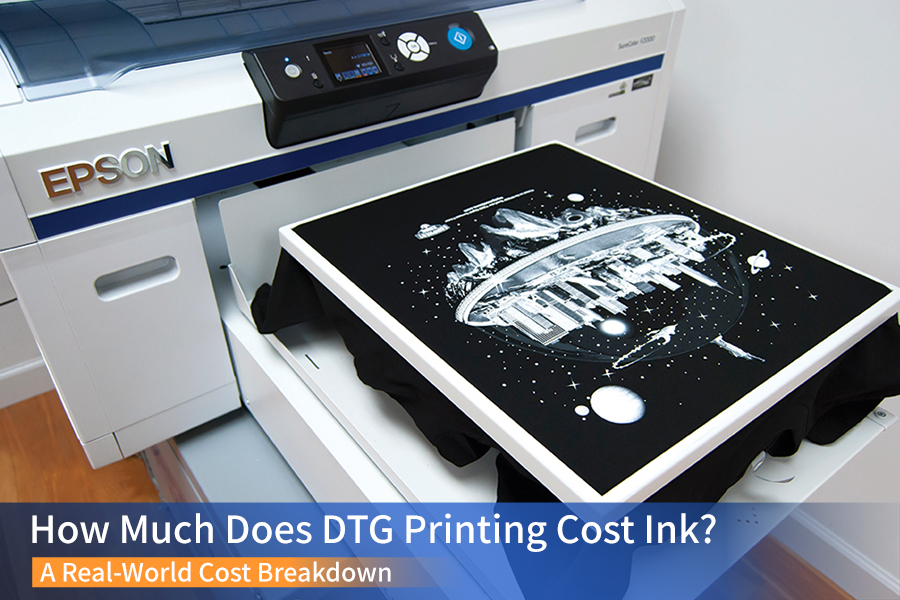
Single-Garment Cost Breakdown by Scenario:How much does DTG printing cost?
A Detailed DTG Ink Cost Breakdown: From Underbase to CMYK. To stop “guessing” your profit margins, we must categorize printing scenarios into two distinct logical types:
Light-Colored Garments: These require only CMYK ink and no pretreatment fluid. The ink cost for a standard A4-sized print is remarkably low, typically ranging from $0.15 to $0.40.
Dark-Colored Garments: This is where the budget shifts drastically. Because you must apply an expensive white ink underbase and pretreatment, the cost per garment spikes to $1.20 – $2.50.
White ink typically accounts for over 70% of the total ink expenditure on dark shirts. If you do not implement tiered pricing for dark garments, every single shirt you produce could be eroding your bottom line.
Furthermore, these figures only cover the active printing process. Once you factor in the “invisible ink” lost to daily automated maintenance and printhead flushing, your actual production costs can rise by another 10%.
DTG printing cost per shirt 2026
Tell you the DTG ink cost breakdown per shirt how much printing cost.
| Printing Type | Ink Composition | Avg. Cost (A4) | Profit Sensitivity |
|---|---|---|---|
| Light T-Shirt | CMYK Only | $0.25 | Low |
| Dark T-Shirt | White Base + CMYK + Pretreatment | $1.85 | Extremely High |
DTG printer ink cost: The Precision Formula for DTG Consumable Costs
To quote accurately, you must move beyond the “price per bottle” mindset and calculate the true cost per milliliter landed on the shirt. A logically sound DTG cost formula is:
Total Cost per Garment = (Ink Unit Price × Actual Consumption) + Pretreatment Cost + Maintenance Waste Allocation.
Pattern Size and Coverage: The Decisive Variables
In DTG accounting, “actual consumption” is never a fixed value. You must adopt a multidimensional mindset based on “square inches (sq in)” and “pixel coverage” rather than vague concepts like “small” or “large” prints.
1. The Hierarchy of Print Dimensions
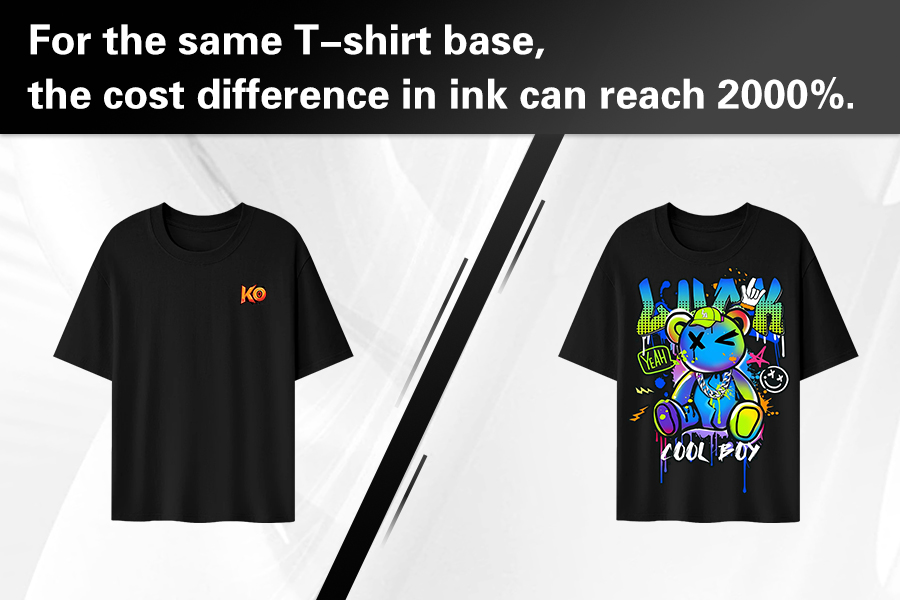
Logo & Chest Hits (Low Volume): A standard left-chest logo (approx. 4″ x 4″) on light fabric uses less than 0.3ml – 0.5ml of ink. With costs often below $0.10, these are your highest-margin “cash cows.”
Full-Chest Prints (The Cost Pivot): A standard A4 (8″ x 11″) or A3 (12″ x 16″) print sees ink consumption grow exponentially. On dark shirts, the white ink underbase area determines your success—an A3 full-print can cost 20 times more in ink than a chest logo.
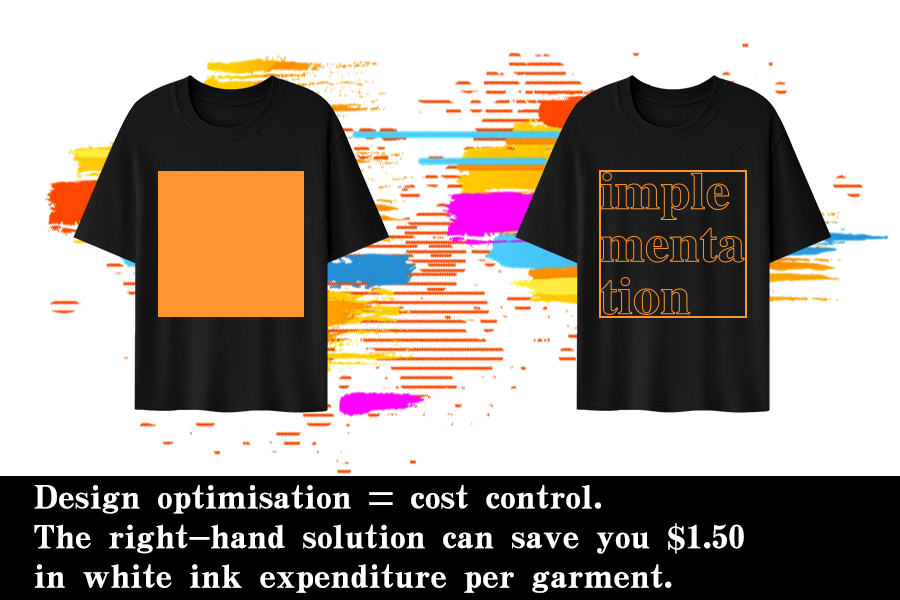
2. The Coverage Logic: Solid vs Knockout
Two designs of the same size (e.g., 10″ x 10″) can have vastly different financial profiles:
Solid Blocks: A 100% coverage design (like a solid square) soaks up ink like a sponge.
Knockout Designs: Utilizing the garment color (e.g., using the black of the shirt instead of black ink) or distressed vintage fonts can drop coverage below 30%.
The Result: For the same dimensions, a knockout design can cost 1/3 to 1/5 of a solid block.
3. Resolution (DPI) and Droplet Size
High-fidelity printing (e.g., 1440 x 1440 DPI) produces stunning detail but uses significantly more ink because the droplets are packed denser than in “Production Mode” (e.g., 720 x 720 DPI).
Print Speed vs Ink Consumption
In the DTG logical framework, print speed is not an isolated parameter; it directly dictates the value generated per milliliter of ink by influencing firing frequency and maintenance logic.
The DPI Trade-off: Many printers assume “high speed” means “more waste.” In fact, high-speed modes often reduce ink density per unit area. More importantly, One-pass technology (printing white and color simultaneously) reduces the time the printhead spends traveling, which minimizes ink evaporation at the nozzles and prevents frequent auto-cleaning cycles.
Utilization Rate: True ink cost includes waste. In high-speed production, the printhead stays in a continuous firing state, keeping the nozzles “wet” and reducing the need for idle-time purges.
“Speed Dilution” of Labor: From a business logic perspective, even if ink consumption remains flat at high speeds, the drop in labor cost per unit is staggering. Using Winnerjet high-flow inks ensures your machine runs at top speed without drop-outs, maximizing the profit margin of every drop through increased hourly output.
How Much Does DTG Printing Cost Ink?Ink price per liter?
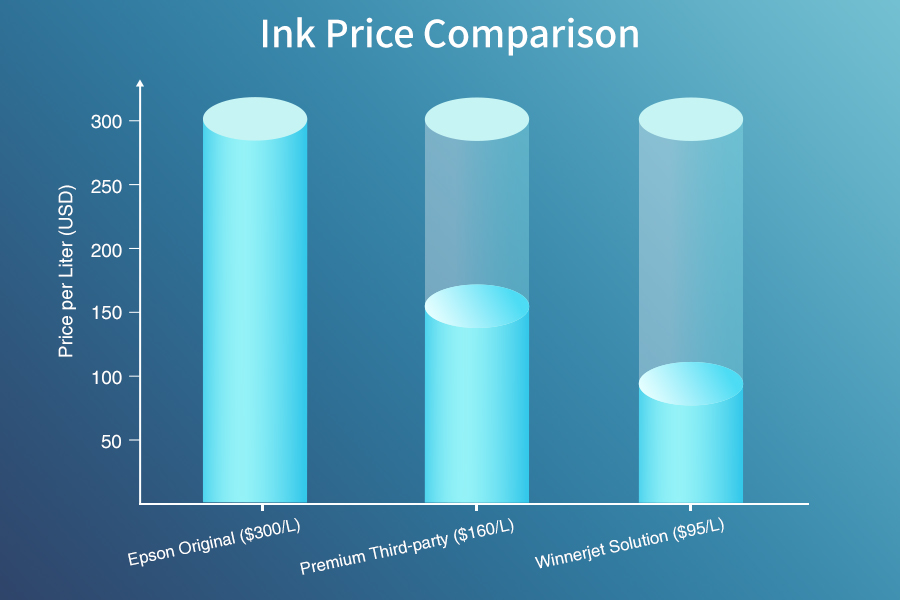
When analyzing DTG production costs, Epson OEM ink is often viewed as the industry “gold standard.” Many operators searching for how much is Epson DTG ink by the liter are shocked by the price barrier, which is often the primary divider between profitable shops and those struggling to survive.
1. OEM Ink: The Expensive “Safety Zone”
Price Reference: Regarding the core market question of how much is epson dtg ink by the liter, the retail price typically falls between $250 – $320/L.
Logical Analysis: OEM solutions provide stability through locked-in ICC profiles. However, this “security” comes at a price: high unit costs mean a single dark garment print can exceed $2.50. For factories seeking scalable growth, this creates a profit ceiling that cripples market competitiveness.
2. International Third-Party Brands: The Middle Ground
Price Reference: Brands like DuPont Artistri® or Image Armor typically price between $140 – $180/L.
Logical Analysis: These inks offer excellent washability but are often extremely picky regarding pretreatment compatibility, making it difficult to significantly lower the total production cost.
3. Winnerjet Professional Solution: Reimagining Profitability
Competitive Edge: Designed as a “profit multiplier” for high-volume production, Winnerjet shatters the monopoly of “high quality must mean high price.”
Core Advantage: Leveraging nano-scale pigment grinding technology, we keep the price per liter at approximately 1/3 of OEM costs.
Business Value: Winnerjet solves the industry-wide headache of white ink sedimentation. By maintaining OEM-level whiteness while slashing the cost per print, we give printers the leverage to win large contracts through aggressive pricing—or simply double their margins.
4. DTG Printing Cost Comparison: Original vs Premium Compatible Ink
When calculating your long-term ROI, the choice of ink is the biggest variable. While original equipment manufacturer (OEM) inks offer guaranteed consistency, the usual cost of DTG printer operations can be significantly reduced by switching to premium compatible inks.
Why the Cost Difference Matters
On average, OEM inks can cost between $200 and $400 per liter, depending on the brand. In contrast, premium compatible inks (like those from Winnerjet) typically range from $80 to $120 per liter. This creates a massive gap in your ink cost per print.
Real-World Cost Breakdown (Per Full-Size Print)
| Comparison Factor | Original Brands (OEM) | Winnerjet (Custom OEM) |
| Service Type | Standard Product Only | OEM & Custom Solutions |
| Price per Liter | $300.00 | $95.00 |
| Ink Cost per Shirt | ~$1.20 | ~$0.45 |
| 1,000 Shirts Cost | $1,200.00 | $450.00 (Save $750) |
*Based on 2026 market analysis. Winnerjet supports private label OEM for global partners.
💡 Related Reading: Looking for specific bulk pricing? Check out the latest Epson DTG Ink Price Per Liter Breakdown to compare different cartridge and bottle volumes.
Is Compatible Ink Safe for Your Printhead?
The most common concern is “Will it clog my printhead?” Premium compatible inks are now formulated with nano-scale filtration and high-quality pigments that match OEM viscosity. In 2026, many high-volume printing businesses have transitioned to compatible solutions to maintain competitive margins without sacrificing color vibrancy or wash fastness.
Winnerjet Lab: 3 Truths of Profitability
True cost control isn’t about finding the cheapest ink; it’s about understanding the “underlying logic” between ink, machine, and environment.
1. VSDT and the “Ink Mist” Variable
Insight: In high-speed modes, if ink surface tension is unstable, it creates “Overspray” (ink mist). These tiny droplets never land on the fabric; instead, they float inside the machine, contaminating the encoder strip and rails. This results in a 5%-8% invisible ink loss and increased repair costs.
Conclusion: Choosing ink with uniform particle distribution improves the “effective landing rate,” reducing waste by 10% on the same pattern.
2. Climate-Controlled Waste Costs
The Data: When your shop humidity drops below 35%, ink at the nozzle face dries 3x faster, forcing the machine to perform “Deep Cleaning” cycles more frequently.
Value Gain: We’ve monitored that in dry environments, a single machine can lose $5 – $12 per day in wasted maintenance ink. Investing in a $50 humidifier offers a higher ROI than almost any other equipment upgrade.
3. The Chemical Balance of “Wet-on-Wet” Printing
The Problem: In high-speed production, the interval between white and color ink is less than 0.1 seconds, which usually causes Bleeding.
The Winnerjet Logic: Our inks use specific penetration balancers that allow color ink to “set” instantly on the white base. This allows you to maintain maximum speed without fearing blurred edges, completing the logic of: Faster Speed = Shorter Lead Times = Increased Profit.
2026 DTG Profitability: The Golden Rules
If the logic above seems complex, use this table for a quick self-diagnosis. Switching from “Traditional Loss Mode” to “Winnerjet Profit Mode” is the transition from being a “payer” to a “controller.”
If your business fits more than three items on the left, you are losing the equivalent of a new machine’s profit every year.
| Dimension | Traditional Loss Mode | Winnerjet Profit Mode |
|---|---|---|
| Ink Strategy | ✘ Paying 300% OEM markup | ✔ High-stability solution, unit price 60% lower |
| Print Settings | ✘ Blindly chasing unnecessary DPI | ✔ Optimized resolution, activated One-pass speed |
| Climate Control | ✘ Ignoring humidity; waste tank is full | ✔ Stable 50% humidity, 70% less deep cleaning |
| Pattern Logic | ✘ Solid blocks, "guessing" the quote | ✔ Knockout designs + Precision sq/in pricing |
| Curing Process | ✘ Bottlenecks caused by long dry times | ✔ Fast-cure formula, 30% higher daily output |
Claim Your Free Sample & Start Testing 🧪 Take control of your margins today.