In the world of Direct-to-Garment (DTG) production, there is nothing more frustrating for an operator than running out of ink in the middle of a large-scale order. Not only does this result in a wasted garment, but it also risks sucking air into the lines, which can lead to permanent damage to expensive printheads.
As a global leader in ink manufacturing, Winnerjet is dedicated to helping our clients achieve high-efficiency, low-waste production. Today, we will provide a deep dive into how to estimate ink remaining for DTG and how to protect your equipment by managing ink shelf life.
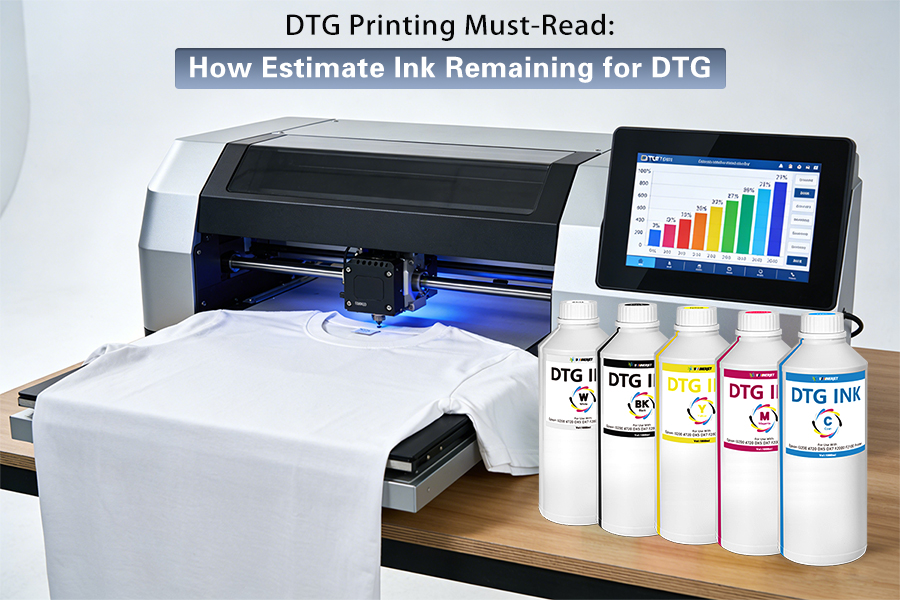
Three Guide:How to Estimate DTG Ink Remaining
In DTG production, precise ink monitoring is not just about cost accounting; it is a “firewall” for your printhead. Running dry allows air to enter the ink lines, which can lead to severe clogs or irrecoverable hardware failure. Drawing from years of industry experience, Winnerjet has summarized three proven methods—ranging from software algorithms to physical verification—to help you eliminate “downtime anxiety.”
1. Digital Estimation: Leveraging RIP Software
This is the most common and efficient method in the industry. Professional RIP software (such as Digital Factory, Cadlink, or Epson Garment Creator) calculates the specific volume of ink required for each job (often accurate to 0.01ml) based on resolution, drop size, and white ink underbase settings during the ripping process.
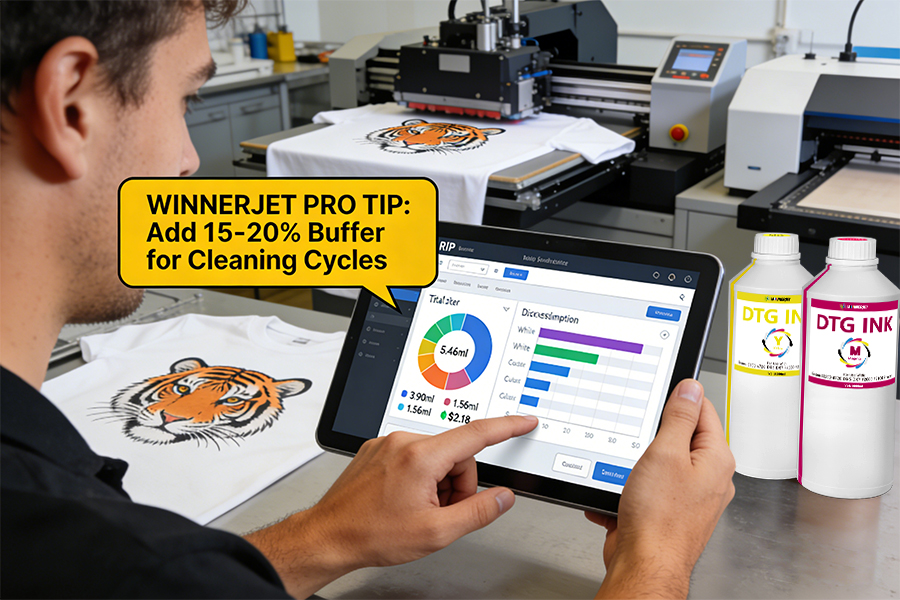
Quick Formula: How to Estimate DTG Ink Usage
Total Ink Volume (ml) ÷ Average Ink Consumption per Print (ml) = Estimated Total Prints
- 💡 Pro Tip: Always reserve 15-20% of ink as a "safety buffer" to avoid air entering the printhead during high-speed production.
- Winnerjet Note: Consumption varies based on image saturation and underbase settings.
2. Physical Verification: The Precision Weighing Method
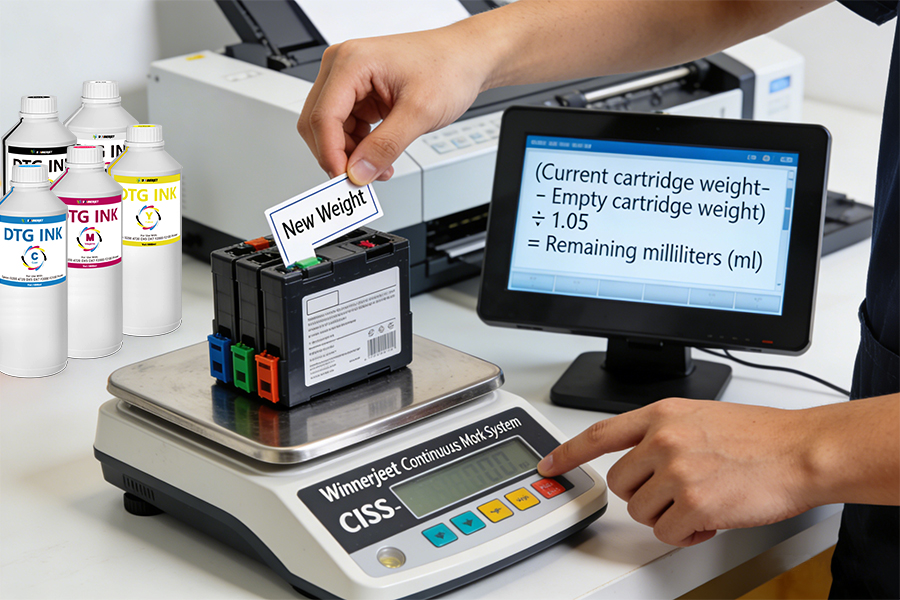
If you are using a Winnerjet Continuous Ink Supply System (CISS) or compatible cartridges on modified printers, digital sensors may provide inaccurate readings due to chip compatibility issues. In these cases, the “weighing method” is the gold standard for reliability.
Calculation Formula:(Current cartridge weight – Empty cartridge weight) ÷ 1.05 = Remaining milliliters (ml).
By using a precision digital scale, you can eliminate software errors. We recommend marking the “New Weight” on every cartridge before installation. This way, you can verify your inventory in seconds before a big run, avoiding printhead damage.
3. Yield-Based Back-Calculation: Building a Custom Production Model
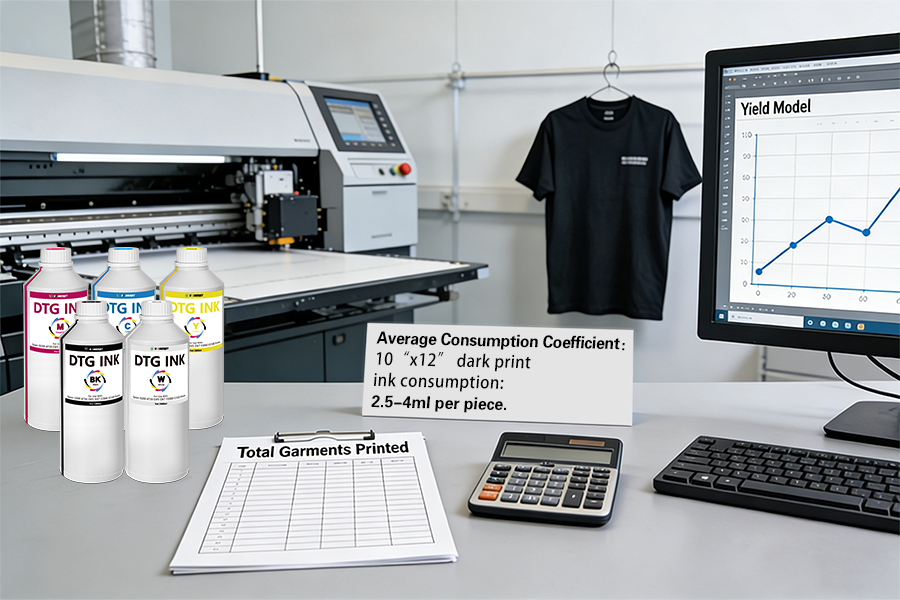
For established print shops, creating a “Yield Model” based on long-term data is the most intuitive way to manage costs. According to Winnerjet’s data from thousands of global customers, a standard 10″ x 12″ print on a dark garment (with white underbase) typically consumes between 2.5ml and 4ml of ink.
Recommendation: Track how many total garments you print from a single 1000ml bottle to find your “Average Consumption Coefficient.” This allows you to quickly translate remaining ink into “Printable Pieces,” helping you quote jobs more accurately and maintain fine-grained profit control.
Using high-quality ink helps minimize ink waste caused by equipment maintenance. [Explore Winnerjet’s Clog-Resistant DTG Ink Series]
Hidden Variables Affecting Ink Consumption
Beyond direct calculation, Winnerjet has identified several “invisible factors” that can disrupt your ink budget:
1. Ambient Temperature & Humidity:
DTG printers are extremely sensitive to their environment. If shop humidity drops below 40%, the printer may trigger more frequent “Power Cleanings” to prevent the nozzles from drying out. This maintenance ink can account for 10%-30% of total consumption.
2. Pretreatment and Ink Absorption:
If pretreatment is applied too heavily, ink floats on the surface, which looks vibrant but may result in “pooling.” If it’s too light, the fabric absorbs too much ink like a sponge. Maintaining a stable pretreatment process ensures your RIP software’s algorithms align with actual usage.
3. Resolution and Dot Settings (DPI vs. Ink Drop):
A 1440×1440 DPI setting is not a simple linear increase in ink over 1440×720 DPI. Higher resolutions utilize more “small drops,” which have a slightly higher loss rate in the delivery lines due to surface tension. Add an extra 5% budget for high-precision orders.
Digital Management Advice
To eliminate downtime, large-scale factories should implement a simple digital log:
Consumption Ledger: Record the entry date, opening date, and empty date for every ink batch.
Reorder Point Formula:Formula—Safety Stock = (Average Daily Ink Consumption × Lead Time) + Emergency Reserve
Winnerjet Reminder: Always maintain a 20% turnover buffer in your warehouse to account for international shipping delays or holidays.
Driving Profitability: Ink Estimation vs Production Efficiency
In the DTG industry, estimation is only the first step; the real winners know how to turn data into profit. According to Winnerjet’s global research, ink typically accounts for over 60% of total material costs.
With precise estimation, you can confidently enable advanced RIP features like “Black Removal.” When printing on black garments, this feature uses the fabric color instead of black ink, instantly saving 20%-30% of white ink consumption and significantly improving the “hand feel” of the print, making it lighter and more breathable.
Furthermore, Winnerjet highlights the “hidden costs” of unstable ink. Poor-quality ink leads to frequent nozzle dropouts and deep cleanings, wasting both ink and labor hours. Choosing high-stability ink combined with a scientific estimation model ensures your “cost-per-print” remains steady. Remember: Every milliliter saved is a direct increase in your net profit.
However, in the pursuit of extreme cost control, there exists a frequently overlooked drain—the time-sensitive nature of ink. If precise estimation aims to “save money,” then focusing on the following critical factor is essential to prevent “losing money.”
Critical Factors: How Long Does DTG Ink Last?
While precise estimation is about “saving money,” managing ink shelf life is about “preventing loss.” Using expired ink will lead to poor wash fastness, color shifts, and irreversible clogs in expensive printheads.
1. White Ink: The Sensitive 6-Month Lifespan
White ink is the core of DTG. Because it contains high concentrations of Titanium Dioxide, it is prone to sedimentation even in unopened bottles.
Shelf Life: Generally 6 months in ideal conditions.
Winnerjet Advice: Expired white ink develops “clumping” that cannot be reversed by shaking, which leads to nozzle deflection.
2. CMYK Ink: The Stable 12-Month Lifespan
CMYK inks are more chemically stable.
Shelf Life: Generally 12 months unopened.
Note: Radical temperature fluctuations can still change the ink’s Viscosity, causing actual consumption to deviate from software estimates.
3. The “Golden Window” After Opening
Once ink is poured into a CISS or ink bag, it is exposed to air.
Recommended Use: Within 90 days.
Risk Warning: Long-term exposure leads to solvent evaporation, causing an imbalance that affects curing and increases the risk of ink drying on the nozzle plate.
4. Winnerjet’s Exclusive Maintenance Tips
Small & Frequent Orders: Avoid stockpiling white ink in bulk; keep your inventory fresh.
The Daily Wake-up Call: Before starting work each day, manually remove white ink containers and shake gently for 1-2 minutes. This ensures even Titanium Dioxide distribution and consistent color density.
Climate-Controlled Storage: Store ink between 15°C – 25°C (59°F – 77°F). Stability drops significantly for every 10°C increase in temperature.
Precision Management: The Foundation of DTG Success
In the competitive custom apparel market, profit is found in the details. Mastering the estimation of remaining DTG ink allows you to schedule production with confidence; strictly adhering to ink shelf life ensures the quality that builds your brand’s reputation.
As your technical partner, Winnerjet does more than provide high-elasticity DTG ink; we provide end-to-end production optimization. From reducing every milliliter of waste to protecting every printhead, we stand with you to grow your profits.