DTG Ink Removal from Shirts: What You Need to Know.DTG (Direct-to-Garment) printing is a process designed for permanent adhesion. Because of this, when a print shows color misalignment, placement errors, or print failure, the first question many ask is: Can DTG ink be removed from the shirt?
Before discussing specific removal methods, it’s important to establish a practical fact: in most cases, fully cured DTG ink cannot be completely removed.
However, under certain conditions, limited remediation is possible. This article draws from real-world printing experience to clarify what actually works, what is futile, and when it’s better to stop and prevent further damage.
Why DTG Ink is Difficult to Remove
DTG ink is not ordinary water-based pigment. It is designed to create long-lasting, wash-resistant, and durable prints on fabric. This is why garment factories and custom print shops widely adopt DTG printing—but it also means that once cured, the ink is extremely difficult to remove.
In a standard production process, DTG ink undergoes three key stages:
- Printing and fiber penetration: The ink is sprayed directly onto the fabric, simultaneously penetrating the fiber gaps, ensuring the print bonds tightly to the garment rather than just sitting on the surface.
- Pigment-resin combination: Pigment particles in the ink combine with resin to form a micro-particle network, increasing adhesion and maintaining vibrant colors.
- Heat press or drying curing: During heat pressing or tunnel drying, the resin in the ink is heat-cured, forming a stable chemical bond with the fibers. After this step, the ink essentially becomes part of the fabric.
Because of these three properties, cured ink penetrates the fibers and binds chemically, creating a “semi-permanent” print. This explains why DTG prints are highly wash-resistant, abrasion-resistant, and colorfast—and why subsequent removal attempts are almost always ineffective. Ordinary detergents, bleach, or household stain removers do not affect cured DTG ink.
Even professional ink removers can only partially fade prints before curing; after heat pressing, attempts usually result in fabric damage with residual ink remaining. Understanding the curing mechanism is therefore key to deciding if removal is possible and how to mitigate losses.
The Only Effective Window: Before Curing
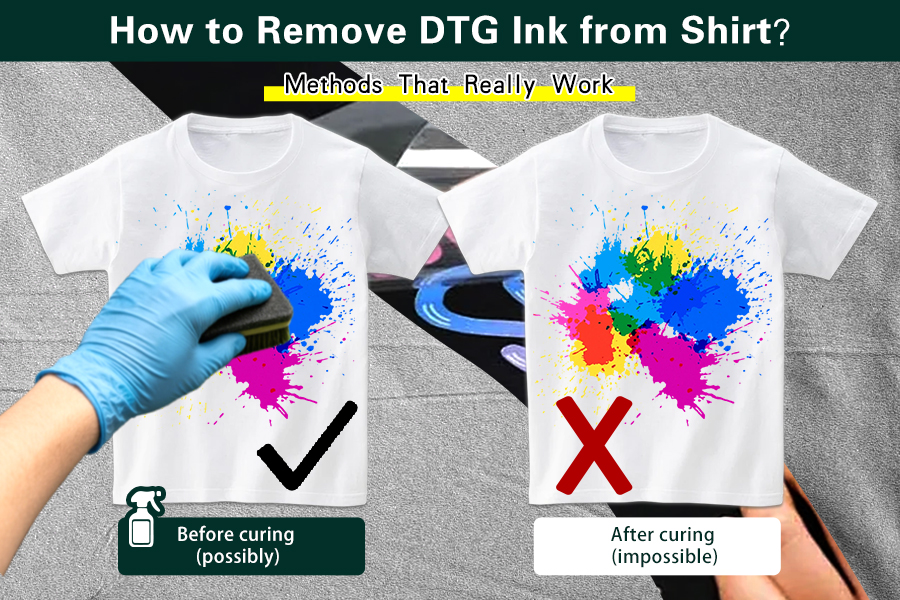
The only stage where DTG ink can be partially or fully removed is before heat pressing or drying. At this stage, the ink is wet or semi-dry and has not yet formed a permanent chemical bond with the fibers, so careful handling may correct misprints or ink bleed.
✅ Conditions for success
- Immediately after printing: The ink is not fully cured—usually only a few minutes to tens of minutes, depending on ink type and ambient temperature.
- Wet or semi-dry ink: Easier to dissolve or blot.
- No heat applied: Once cured with heat press or drying, the ink-fiber bond becomes permanent.
Experienced operators act within minutes of printing to reduce loss, rather than waiting for the ink to dry completely.
✅ Methods to try
- Rinse from the back with cold water: Helps release ink from fiber gaps without spreading it on the surface.
- Lightly rub with high-concentration isopropyl alcohol (90%+): Can dissolve some pigment particles. Press gently with a clean cloth to avoid fabric damage.
- Blot with absorbent paper or tissues: Removes surface ink quickly and limits further penetration.
✅ Expected results
- Colored ink: May significantly fade, with partial pattern outline remaining.
- Light-colored prints: In ideal conditions, may be almost completely removed.
- Fabric damage: Minimal if ink is still uncured.
⚠️ Note: Once heat or drying is applied, this window closes, and removal attempts will likely damage the fabric while ink remains.
Why Cured DTG Ink Cannot Be Removed
Once DTG ink is cured via heat press or drying, it chemically bonds with fabric fibers. Any removal attempts can only fade or partially improve the print; the original fabric cannot be fully restored.
Characteristics of cured ink:
- Strong chemical bond: Pigment and resin are fixed within the fibers.
- Wash and abrasion resistance: Core advantage of DTG printing, making removal difficult.
- White ink: Heavier particles with stronger adhesion, almost impossible to remove chemically or mechanically.
Common methods and results:
- Chemical solvents: Acetone, industrial alcohol, or commercial ink removers may slightly lighten prints but are ineffective on large or dense cured areas. Solvents may also damage fabric, causing discoloration or stiffness.
- Mechanical scrubbing: May slightly fade cured ink but reduces fabric strength, especially cotton or blends.
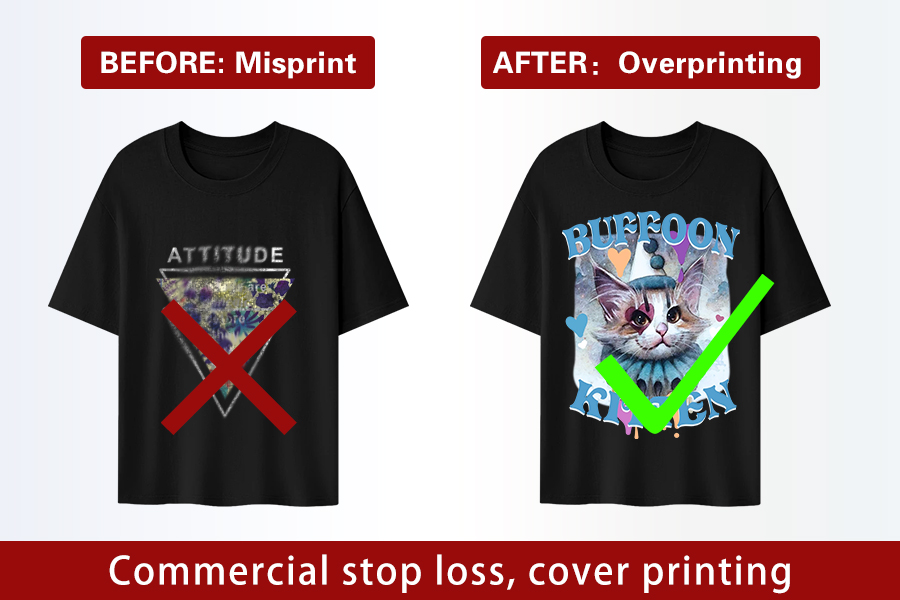
- Spot coverage or reprinting: For acceptable light-residual areas, overlaying new prints is a practical “stop-loss” approach, protecting fabric and reducing production loss.
Practical experience:
- Cured colored ink: Can fade slightly, cannot be fully removed.
- White DTG ink: Nearly impossible to remove.
- Large errors or dark garments: Blind removal attempts usually damage fabric, leaving ink residues.
In commercial practice, deciding when to stop is more important than removing ink. Misprints can be covered, partially reprinted, or used as internal test garments to minimize loss.
White DTG Ink: Irreversible Nature and Prevention
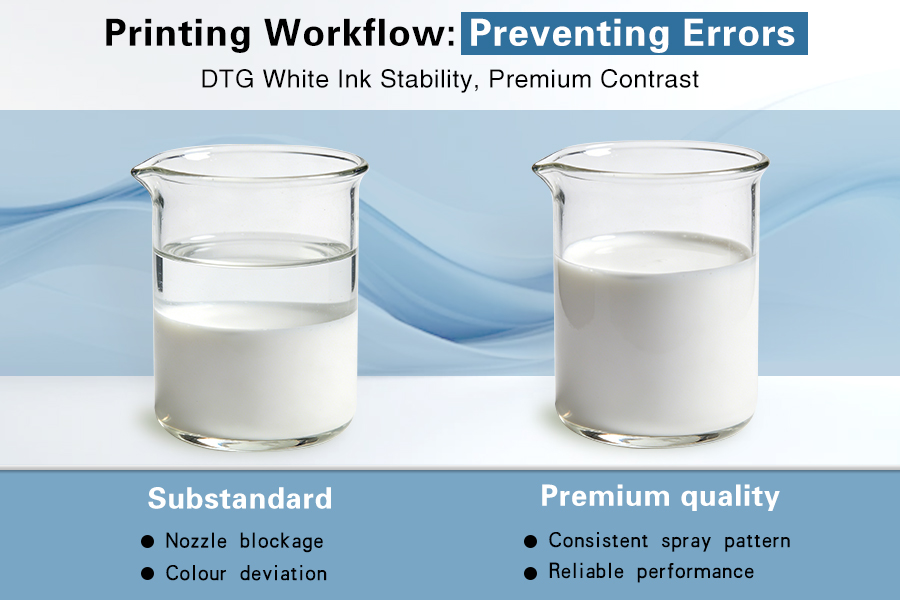
White DTG ink differs fundamentally from colored ink: it contains a high proportion of titanium dioxide, with heavier particles and strong coverage and adhesion. On dark or blended fabrics, white ink not only covers the surface but penetrates fibers for high opacity and long-term durability. Once cured, the ink forms a permanent bond, impossible to remove with chemicals or mechanical means. Attempting removal usually damages the fabric first.
Effective prevention strategies include:
- Strict curing control: Ensure proper temperature and time to avoid uneven curing or color shifts.
- Use high-quality, stable ink batches: Premium inks such as Winnerjet white ink have uniform particles, excellent flow, minimal settling, and do not clog nozzles, reducing print failures.
- Precise pretreatment: Select appropriate pretreatment agents for cotton, polyester, and blends; ensure even drying for consistent adhesion.
- Spot coverage or reprinting for minor errors: Avoid damaging fabric with chemical removers.
- Use unremovable misprints as internal test garments: For printer calibration or ink testing, reducing resource waste.
By combining preventive measures, strategic coverage, and high-quality ink, DTG shops can reduce ink removal needs, improve print success rates, increase efficiency, and minimize losses when dealing with white or cured inks.
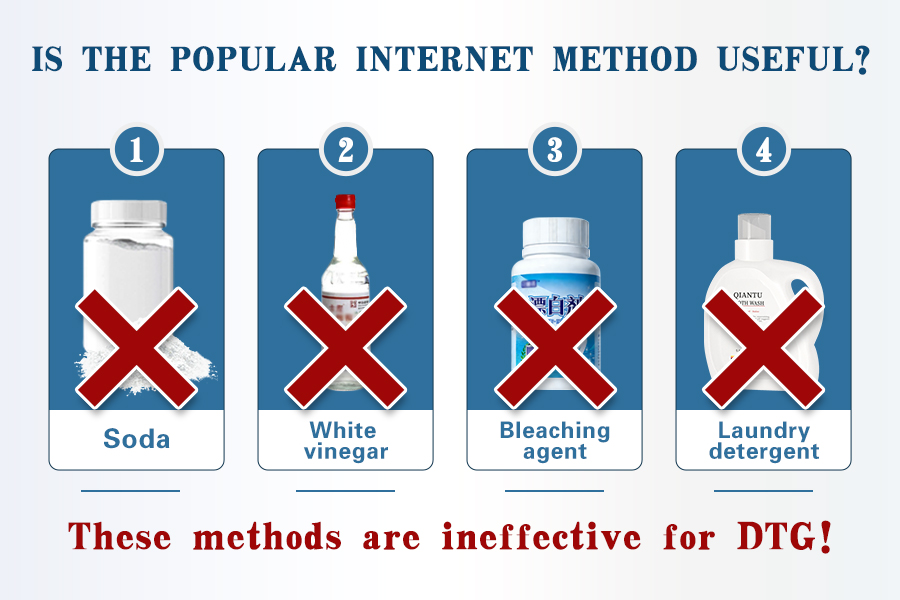
Why Common Online Methods Don’t Work
Many online suggestions—baking soda, vinegar, detergent, or bleach—may work for ordinary stains (coffee, juice, light pigment), but DTG ink behaves differently.
DTG ink is pigment-based, not soluble dye. Resin-fiber chemical bonds are permanent once cured, so household methods cannot break this bond. Even repeated attempts only slightly lighten color, leaving ink largely intact.
Commercial operators note: using these methods on cured DTG prints is ineffective, potentially damaging fabrics, and wastes time. The rational solution is coverage, partial reprinting, or redesign.
Professional and Practical Approaches
For cured misprints, professional DTG shops generally stop removal attempts and instead:
- Accept the ink is fixed.
- Adjust design or layout to cover errors.
- Overlay new prints on misprints to preserve garment value and save production costs.
- Use defective garments for testing printer parameters or inks.
Advantages:
- Cost control: Avoid high-cost solvents or labor-intensive removal.
- Fabric protection: Avoid chemical or mechanical damage.
- Higher efficiency: Reduce handling time, increase production throughput.
High-quality, wash-resistant, and compatible DTG inks, like Winnerjet products, further minimize misprint risks and improve reliability.
Preventing Ink Removal Issues from the Source
Most DTG ink removal issues originate from lack of process control:
- Inconsistent curing temperatures
- Ink batch variability
- White ink settling or print anomalies
- Improper pretreatment
Prevention measures:
- Strict temperature and curing control
- Use stable, compatible inks with good flow and minimal settling
- Regular mixing and monitoring of white ink
- Accurate pretreatment and uniform drying
By controlling ink stability, curing conditions, and pretreatment, the question “how to remove DTG ink” rarely arises. Prevention, operational standards, and material quality are the keys to minimizing losses and increasing efficiency.
Summary: Only Three Practical Outcomes
Based on production experience:
- Uncured ink: Can be partially or fully removed.
- Cured ink: Can only be faded; full removal is impossible.
- White DTG ink: Almost irreversible; stop-loss or coverage strategies are recommended.
Key takeaway: DTG printing is permanent by design. Understanding this allows rational decision-making for production, rework, and cost control. By choosing high-quality inks and optimizing processes, you can reduce ink removal issues, improve efficiency, control costs, and enhance print quality.
Winnerjet provides high-compatibility, wash-resistant DTG inks and professional consumables to help your prints stay reliable and reduce rework.
FAQ
Can DTG ink be completely washed out?
Usually not, especially after curing.
Can alcohol remove DTG ink?
Only effective for uncured colored inks.
Can white DTG ink be removed?
Practically impossible in production.
Why is DTG printing so wash-resistant?
Because the ink forms a stable chemical bond with fibers under heat.
Better than removing ink, what should I do?
Reduce print failures by controlling ink stability and curing conditions.